

Blog
What Is Industrial Real Estate? A 2026 Investor Guide

TL;DR:
- Industrial real estate involves properties used for manufacturing, warehousing, and logistics, designed for operational efficiency. The 2026 market shows record leasing activity, driven by e-commerce growth and supply chain shifts, with location and building specifications key. Successful investment requires careful audit of building features and focus on location, rather than market momentum or superficial trends.
Industrial real estate is defined as physical property used primarily for manufacturing, warehousing, distribution, and logistics operations. It is a distinct asset class within commercial real estate, designed around operational efficiency rather than consumer visibility. U.S. e-commerce sales reached $1.82 trillion as of 2025, and that growth has made industrial properties one of the most actively leased sectors in the market. For investors, operators, and asset managers, understanding this property type is the foundation of sound decision-making.
What is industrial real estate and how is it defined?
Industrial real estate refers to properties built or adapted for production, storage, and the movement of goods. The industrial property definition covers a wide range of facility types, from a 500,000-square-foot fulfillment center to a 20,000-square-foot flex space used by a regional manufacturer.
These properties share a set of structural characteristics that separate them from office or retail buildings. Office space comprises only 5–15% of total area in a typical industrial facility. Ceiling heights range from 24 to 36 feet, and floor plates commonly exceed 50,000 square feet to support heavy equipment and bulk inventory.
The term “industrial property” carries a separate legal meaning worth clarifying. In intellectual property law, industrial property refers to patents, trademarks, and trade secrets, as defined under the Paris Convention, which governs rights in over 175 countries. That legal definition has no connection to physical industrial real estate. Keeping these two uses of the term distinct avoids confusion in business and legal contexts.
What are the main types of industrial real estate properties?
Industrial properties divide into five primary categories, each with distinct design requirements and tenant profiles.
- Manufacturing facilities house production lines, heavy machinery, and raw material storage. They require reinforced floor slabs, high power capacity, and ventilation systems. Size ranges vary widely, from 10,000 square feet for light assembly to several million square feet for automotive plants.
- Warehouses store finished goods or raw materials. Standard warehouses prioritize clear height, column spacing, and dock door count over specialized infrastructure.
- Distribution centers are built for speed. They sit near major highways, ports, or rail lines and are designed to receive, sort, and ship goods rapidly. E-commerce retailers need roughly three times the warehouse space per dollar of sales compared to traditional retailers, which explains why distribution centers have grown in both size and number.
- Flex space combines warehouse and office functions in a single building. Tenants include light manufacturers, contractors, and technology firms needing both lab and storage space.
- Cold storage facilities maintain temperature-controlled environments for food, pharmaceuticals, and biotech products. They carry the highest construction and operating costs of any industrial property type.
| Property type | Typical size | Primary function | Key design feature |
|---|---|---|---|
| Manufacturing | 10,000–1,000,000+ sq ft | Production and assembly | Heavy power, reinforced floors |
| Warehouse | 50,000–500,000 sq ft | Inventory storage | Clear height, dock doors |
| Distribution center | 200,000–1,000,000+ sq ft | Goods movement and fulfillment | Highway/port proximity |
| Flex space | 5,000–50,000 sq ft | Mixed use | Office-to-warehouse ratio |
| Cold storage | 20,000–300,000 sq ft | Temperature-controlled storage | Refrigeration infrastructure |
Pro Tip: Before signing a lease or acquiring a facility, confirm the office-to-warehouse ratio matches your operational needs. A building with 30% office buildout is not easily converted to pure warehouse use without significant cost. The Maascompanies industrial real estate checklist covers these specifications in detail.
How is the industrial real estate market performing in 2026?
The industrial real estate market is performing at record levels. Leasing activity for logistics space surged to 62 million square feet in mid-2026, 24% higher than 2024 and above all previous records. Base rents on U.S. industrial platforms rose approximately 50% over the last five years. That rent growth reflects a structural shortage of quality space relative to demand.

Three forces drive this demand. First, e-commerce growth requires more physical fulfillment infrastructure than traditional retail ever did. Second, reshoring of manufacturing and supply chain diversification have pushed companies to secure domestic production and storage capacity. Third, REIT portfolios focused on industrial assets have attracted institutional capital, raising acquisition prices and compressing cap rates across the sector.
Location remains the single most important variable in industrial real estate value. Investors prioritize proximity to ports, rail, and highways and access to labor pools to reduce operational costs. Shaving a few transit miles translates into measurable savings over a multi-year lease term. Properties within 30 miles of a major port or intermodal hub command a consistent premium.
Modern facilities incorporating automation and LEED energy ratings command higher rents and retain tenants longer than older Class B and Class C assets. Older properties face growing obsolescence pressure as tenants migrate toward buildings that support automated picking systems and electric vehicle charging infrastructure.
Pro Tip: When evaluating market data, separate asking rents from effective rents. Landlord concessions such as free rent periods and tenant improvement allowances can reduce the true cost of occupancy by 10–20% in slower submarkets.
What should investors and businesses know about leasing and investment?
Triple Net (NNN) leases are the standard structure in industrial real estate. Under a NNN lease, tenants pay property taxes, insurance, and maintenance in addition to base rent. These pass-through expenses typically add $2 to $5 per square foot annually. First-time tenants frequently underestimate total occupancy costs by focusing only on the headline rent figure.
Building specifications determine whether a facility actually supports your operations. Ceiling height, floor load capacity, dock door count, and power supply are the four metrics that most directly affect operational success and retrofit costs. Failing to audit these specifications before signing a lease or closing an acquisition leads to expensive corrections after the fact.
Key evaluation factors for investors and operators include:
- Ceiling clear height: 28 feet is the current functional minimum for modern racking systems. Buildings under 24 feet clear are increasingly difficult to lease to logistics tenants.
- Floor load capacity: Heavy manufacturing requires floor slabs rated at 6,000–8,000 pounds per square foot or higher. Standard warehouse slabs often fall short.
- Dock doors and grade-level access: Distribution operations need one dock door per 5,000–10,000 square feet of floor area. Grade-level doors serve manufacturing and smaller delivery vehicles.
- Power supply: Automated facilities and cold storage require three-phase power at 2,000–4,000 amps. Upgrading power infrastructure after occupancy is costly and time-consuming.
- Vacancy concentration risk: A single-tenant industrial building carries significant re-leasing risk if the tenant vacates. Multi-tenant flex properties spread that risk across several occupants.
The “flight to quality” trend is reshaping asset values across the sector. Tenants favor modern, automated, energy-efficient buildings, and that preference directly influences which assets hold value and which face prolonged vacancy. For investors managing legacy industrial assets, the choice is clear: invest in upgrades or accept lower rents and higher turnover. Maascompanies covers the full spectrum of industrial property sales considerations for investors working through these decisions.
How does industrial real estate differ from other commercial property types?
Industrial real estate focuses on operational efficiency rather than consumer-facing aesthetics. That single distinction drives most of the differences between industrial and other commercial property categories.
Office buildings prioritize location within business districts, floor plate flexibility, and amenities that attract and retain white-collar workers. Retail properties depend on foot traffic, visibility, and proximity to consumers. Multifamily assets are governed by residential demand, population density, and rental affordability. Industrial properties, by contrast, are selected based on infrastructure access, building specifications, and proximity to supply chain nodes.
| Attribute | Industrial | Office | Retail |
|---|---|---|---|
| Location driver | Ports, highways, labor pools | CBD, transit access | Consumer foot traffic |
| Design priority | Load capacity, ceiling height, docks | Floor plate, amenities | Visibility, storefront |
| Typical lease structure | NNN, 5–10 year terms | Gross or modified gross | NNN or percentage rent |
| Primary tenant | Manufacturer, 3PL, distributor | Corporate tenant | Retailer, restaurant |
| Consumer-facing | No | Partially | Yes |
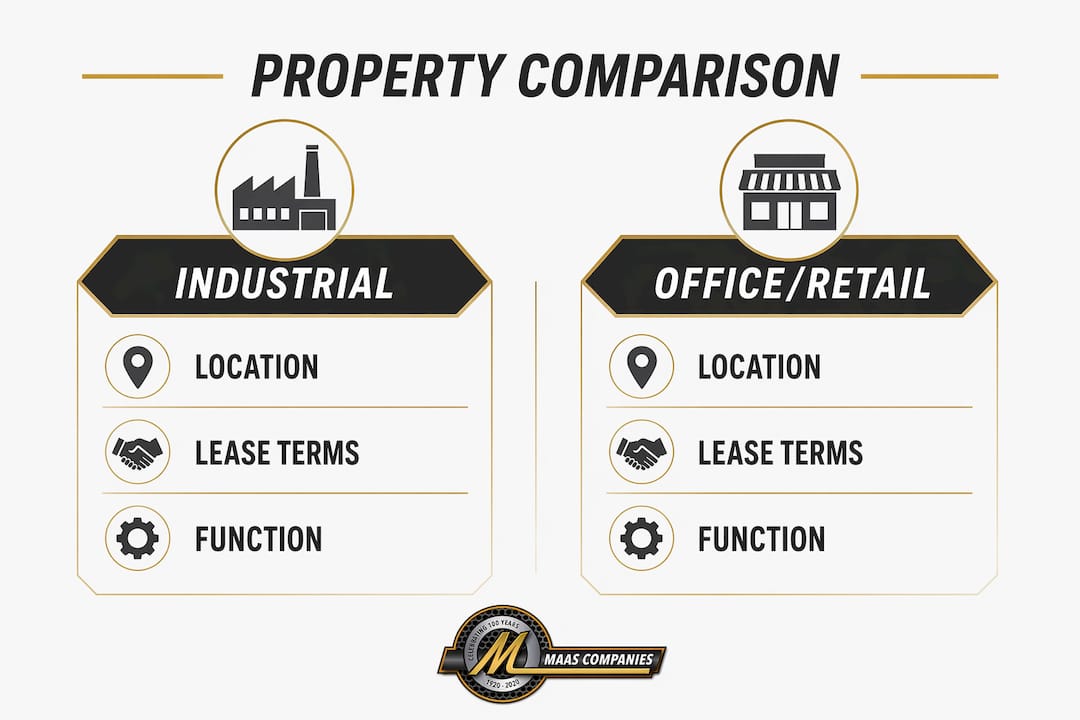
Lease terms in industrial real estate tend to run longer than retail or office leases, often 5 to 10 years, because tenants invest heavily in racking, equipment, and infrastructure buildouts. That investment creates switching costs that favor lease renewal. For investors, long lease terms with NNN structures provide predictable cash flow with limited management burden.
Pro Tip: Do not confuse “industrial property” in a legal document with physical industrial real estate. If a contract references industrial property rights, it almost certainly refers to intellectual property under the Paris Convention framework, not a warehouse or manufacturing plant.
Key Takeaways
Industrial real estate is the most operationally specific asset class in commercial real estate, and its value depends on building specifications, location, and lease structure more than any other factor.
| Point | Details |
|---|---|
| Industrial real estate definition | Properties used for manufacturing, warehousing, distribution, and logistics, designed around operational efficiency. |
| Five core property types | Manufacturing, warehouse, distribution center, flex space, and cold storage each serve distinct operational needs. |
| Market performance in 2026 | Leasing activity hit 62 million square feet in mid-2026, with base rents up approximately 50% over five years. |
| NNN lease structure | Tenants pay taxes, insurance, and maintenance on top of base rent, adding $2–$5 per square foot annually. |
| Specification audit is non-negotiable | Ceiling height, floor load, dock doors, and power supply determine operational fit and retrofit costs before signing. |
Why industrial real estate rewards disciplined analysis over market enthusiasm
I have reviewed enough industrial facility transactions to know that the biggest mistakes happen when buyers or tenants focus on market momentum instead of building fundamentals. The 2026 leasing surge is real, and the rent growth numbers are accurate. But a building in a strong submarket with inadequate power supply or a 22-foot clear height is still the wrong building for most modern tenants.
Location matters enormously, but it is not a substitute for specification review. I have seen operators commit to facilities near major ports only to discover the floor slab could not support their racking system. The retrofit cost erased two years of rent savings from the favorable location. A thorough facility audit, covering every metric from dock door count to transformer capacity, is the only way to avoid that outcome.
The flight-to-quality trend is not a temporary cycle. Tenants are building automation into their operations permanently, and they will not move backward to older buildings when leases expire. For investors holding Class B or Class C industrial assets, the window to reposition those properties is narrowing. The operators and investors who treat industrial real estate as a precision asset class, not a commodity, are the ones who will outperform over the next decade.
— Vector
Maascompanies and industrial asset recovery
Maascompanies brings decades of experience marketing industrial plants, equipment, and real estate to qualified buyers worldwide. When a facility closes, a company restructures, or an operator needs to maximize recovery from surplus assets, Maascompanies provides the auction and brokerage expertise to move those assets efficiently.

Current projects include a 3-MGY biodiesel plant, oilseed processing facilities, and manufacturing and warehouse facilities available through structured auction. If you are managing an industrial asset transition, contact Maascompanies to discuss how an aggressive marketing and recovery plan can maximize your outcome. Review the full Maascompanies services portfolio to understand the scope of support available for industrial property and equipment dispositions.
FAQ
What is the industrial property definition in real estate?
Industrial real estate refers to properties used for manufacturing, warehousing, distribution, and logistics. These facilities are designed around operational efficiency, with features like high ceilings, reinforced floors, and multiple loading docks.
What are the main types of industrial real estate?
The five primary types are manufacturing facilities, warehouses, distribution centers, flex space, and cold storage. Each serves a distinct operational function and carries different design and infrastructure requirements.
Why choose industrial real estate as an investment?
Industrial real estate offers long NNN lease terms, predictable pass-through income, and strong demand driven by e-commerce growth and supply chain reshoring. Base rents rose approximately 50% over the last five years, reflecting sustained structural demand.
What does a triple net lease mean in industrial real estate?
A triple net lease requires the tenant to pay property taxes, insurance, and maintenance costs in addition to base rent. These pass-through expenses typically add $2 to $5 per square foot annually beyond the headline rent figure.
How does industrial real estate differ from commercial real estate?
Industrial real estate prioritizes operational infrastructure such as load-bearing floors, ceiling height, and dock access, while other commercial property types prioritize consumer visibility or workplace amenities. Industrial leases also tend to run longer and carry fewer landlord management obligations.
Recommended
- Industrial Real Estate Checklist: 2026 Investor Guide | Blog | Insights on Asset Liquidation and Auction Trends
- Industrial Property Sales Explained for Investors in 2026 | Blog | Insights on Asset Liquidation and Auction Trends
- Real estate auctions: Fast liquidation for industrial assets | Blog | Insights on Asset Liquidation and Auction Trends
- What Is Industrial Surplus? A 2026 Asset Guide | Blog | Insights on Asset Liquidation and Auction Trends