

Blog
What Is Industrial Surplus? A 2026 Asset Guide
TL;DR:
- Industrial surplus consists of functional equipment and materials that organizations no longer need due to operational changes. Managing surplus proactively reduces holding costs, which can reach 18-32% of inventory value annually, and preserves asset value. Early identification and strategic liquidation optimize recovery, emphasizing disciplined planning over reactive responses to surplus accumulation.
Industrial surplus is defined as functional equipment, materials, and inventory that exceed an organization’s current operational requirements, typically resulting from production changes, facility shutdowns, or strategic realignment. Unlike scrap or defective assets, surplus equipment remains viable and retains recoverable value. The challenge for operations leaders, lenders, and asset managers is not whether surplus exists, but how quickly they recognize it and act. Delayed decisions cost money. This guide explains the industrial surplus definition, its financial consequences, and the most effective strategies for managing and liquidating surplus assets in 2026.
What is industrial surplus and why does it occur?
Industrial surplus is the stock of functional equipment, parts, and materials that a business no longer needs in its current operations. The term covers a wide range of asset types: CNC machinery, electrical components, process equipment, raw materials, spare parts, and finished goods inventory. Surplus status is determined by operational fit, not asset condition. A piece of equipment becomes surplus the moment it no longer serves a production or operational purpose, regardless of its working condition.
The most common trigger events include:
- Production line changes: Upgrading to new machinery renders existing equipment redundant, even when that equipment is fully operational.
- Facility shutdowns or consolidations: Plant closures generate large volumes of surplus across all asset categories simultaneously.
- Project cancellations: Capital equipment purchased for a specific project becomes surplus when that project is discontinued.
- Process upgrades: Switching to automated systems or new manufacturing methods leaves legacy equipment without a role.
- End-of-life product lines: Discontinuing a product eliminates demand for the tooling, molds, and dedicated machinery used to produce it.
A critical distinction separates surplus from scrap. Surplus equipment remains functional and retains market value. Scrap has reached the end of its useful life and is recovered only for material content. Treating surplus as scrap is one of the most expensive mistakes an asset manager can make.
Pro Tip: Conduct a surplus identification review immediately after any facility consolidation, product line discontinuation, or capital equipment upgrade. Early identification preserves valuation options and prevents idle assets from accumulating unnoticed.

How much does holding industrial surplus actually cost?
Holding industrial surplus is not a neutral decision. Every month an asset sits idle, it generates costs and loses value. Carrying costs total 18–32% of inventory value annually. That figure represents a substantial drain on net asset value for any organization holding significant surplus.
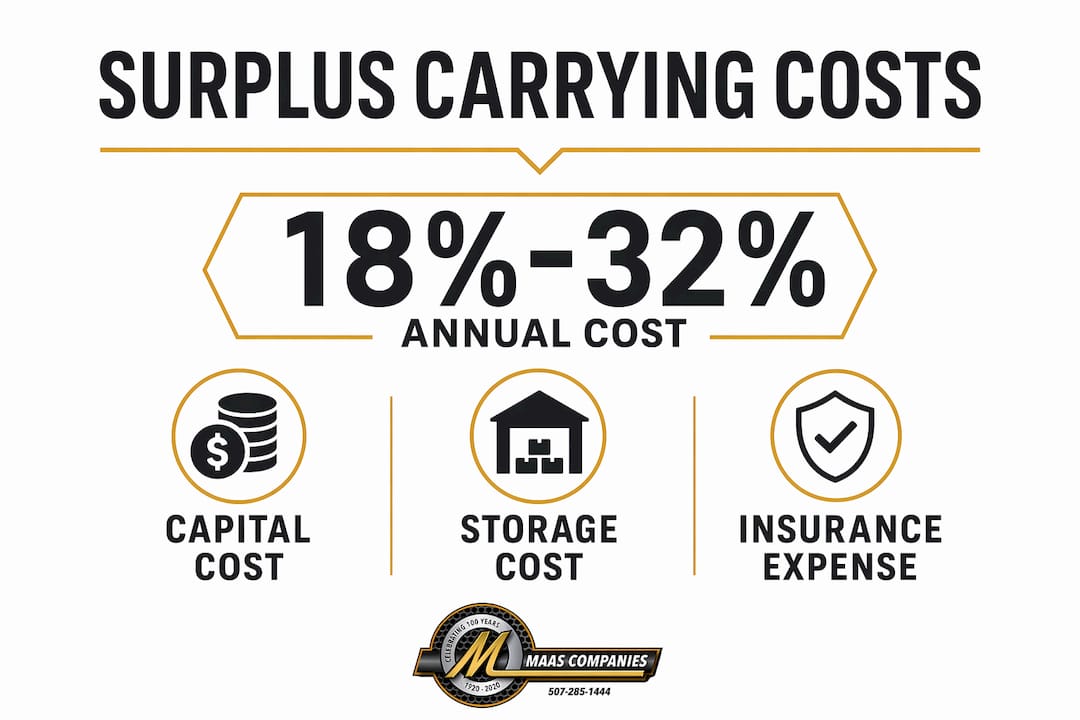
The components of carrying cost break down as follows:
| Cost Component | Description |
|---|---|
| Capital cost | Largest single component; reflects the weighted-average cost of capital tied up in idle assets |
| Storage cost | Facility space, utilities, and security allocated to surplus inventory |
| Insurance | Ongoing coverage required for assets regardless of operational status |
| Obsolescence | Value erosion as technology advances and market demand for older equipment declines |
| Material handling | Labor and equipment costs for moving and maintaining surplus inventory |
| Administrative expenses | Record-keeping, compliance, and audit costs associated with surplus assets |
The opportunity cost of idle assets compounds the direct carrying costs. Capital locked in surplus cannot fund new equipment purchases, working capital needs, or debt reduction. For lenders and special asset managers, this dynamic directly affects recovery timelines and net proceeds.
Space utilization is a secondary but significant impact. Surplus inventory occupies warehouse and floor space that could otherwise support active production or generate lease revenue. Facilities holding large volumes of surplus often face operational bottlenecks because productive space is consumed by idle assets.
Pro Tip: Calculate your carrying cost exposure before deciding to hold surplus for a better market. At 20% annually, a $500,000 equipment lot costs $100,000 per year to hold. That number changes the math on waiting.
How to reduce industrial surplus through smarter operations
The most effective way to manage surplus is to prevent it from accumulating in the first place. Surplus reflects planning and forecasting mismatches between projected and actual consumption, making it a direct indicator of operational inefficiency. Addressing the root causes requires both process discipline and the right technology.
The following steps represent proven practice for reducing surplus accumulation:
- Implement demand-driven purchasing. Align procurement decisions with real-time consumption data rather than historical averages or optimistic project forecasts. Enterprise resource planning systems such as SAP and Oracle provide the demand visibility needed to prevent overstock.
- Adopt just-in-time inventory principles. JIT inventory management, a core lean manufacturing practice, reduces the buffer stock that becomes surplus when demand shifts. Lean inventory systems align purchasing closely with production schedules.
- Conduct regular asset audits. Schedule formal surplus identification reviews at least twice annually. Surplus often accumulates unnoticed until an audit or a space crisis forces the issue. By then, valuation options narrow and obsolescence has already reduced asset value.
- Establish a surplus disposition policy. Define clear thresholds for when an asset is reclassified as surplus and what disposition process follows. Without a policy, surplus decisions default to inaction.
- Integrate cross-departmental visibility. Procurement, operations, and finance teams frequently hold different views of asset status. A shared inventory platform eliminates the information gaps that allow surplus to accumulate across departments.
Idle assets accumulate unnoticed in most organizations until a physical audit or a space constraint forces the issue. By that point, the window for maximum value recovery has often already closed. Proactive surplus management is not an administrative function. It is a capital preservation strategy.
What are the best options for industrial surplus liquidation?
When surplus cannot be redeployed internally, liquidation is the most direct path to capital recovery. The right liquidation method depends on asset type, volume, condition, and the timeline available. Auctions, negotiated sales, and specialized brokerages each serve different scenarios and produce different outcomes.
| Liquidation Method | Best Suited For | Key Advantage |
|---|---|---|
| Public auction | Large asset volumes, plant closures, time-sensitive dispositions | Maximum market exposure, competitive bidding drives price |
| Negotiated sale | Specialized equipment with a defined buyer pool | Controlled process, potential for higher per-unit recovery |
| Brokerage | Unique or high-value individual assets | Expert positioning and targeted marketing to qualified buyers |
| Internal redeployment | Multi-site organizations with compatible operations | Zero transaction cost, immediate capital preservation |
Timing is the most underestimated variable in surplus liquidation. Assets that are current-generation technology today become legacy equipment within two to four years as manufacturing processes advance. Delaying valuation leads to dormant assets with increasing obsolescence, which restricts recovery options and reduces net proceeds.
The following considerations guide effective liquidation decisions:
- Engage a qualified asset recovery firm early. Professional valuation and marketing expertise directly affects final recovery. Firms with established buyer networks reach qualified purchasers faster than internal efforts.
- Prioritize documentation. Complete maintenance records, operating manuals, and asset histories increase buyer confidence and support higher bids.
- Evaluate the full cost of delay. Carrying costs, obsolescence risk, and narrowing buyer pools all argue for earlier action rather than waiting for ideal market conditions.
- Consider surplus equipment buyers as a market segment. Buyers seeking surplus assets are often motivated by cost savings and speed, creating a ready market when assets are properly marketed.
For lenders and special asset managers, the plant liquidation process requires additional attention to chain of custody, legal compliance, and creditor reporting. Partnering with an experienced firm reduces execution risk and supports defensible recovery outcomes.
Key takeaways
Industrial surplus is a capital management issue, not simply a storage problem, and the cost of inaction compounds at 18–32% of inventory value annually.
| Point | Details |
|---|---|
| Surplus definition | Functional assets no longer needed in current operations, distinct from scrap or defective equipment. |
| Carrying cost exposure | Holding costs total 18–32% of inventory value annually, eroding net asset value with every passing month. |
| Root cause prevention | Demand-driven purchasing, JIT inventory, and regular audits reduce surplus accumulation at the source. |
| Liquidation timing | Early action preserves valuation options; delayed disposition narrows recovery choices and increases obsolescence risk. |
| Method selection | Auctions, negotiated sales, and brokerage each serve different asset types and timelines. |
The case for treating surplus as a strategic decision
After working through hundreds of surplus disposition projects, the pattern I see most consistently is not a lack of assets to sell. It is a lack of urgency in recognizing that surplus exists and acting on it.
Operations teams often view surplus as a future problem. Finance teams frequently underestimate carrying costs because storage and insurance appear as fixed overhead rather than variable costs tied to specific assets. The result is that surplus sits for 12, 18, or 24 months before anyone calculates what holding it has actually cost. By then, the equipment that could have sold at 60 cents on the dollar in year one sells at 30 cents, if it sells at all.
The organizations that recover the most value from surplus share one characteristic: they treat surplus identification as a standing operational discipline, not a reactive response to a crisis. They audit regularly, classify assets promptly, and engage recovery partners before the market window closes. That discipline is not complicated. It simply requires treating surplus as the capital management issue it actually is, rather than a warehouse problem to be addressed later.
The surplus equipment sale process rewards preparation and penalizes delay. That is the most consistent truth in this business.
— Vector
How Maascompanies supports industrial surplus liquidation
Maascompanies brings decades of experience managing complex surplus disposition across industrial plants, manufacturing facilities, and commercial properties worldwide. Whether the situation calls for a competitive public auction or an orderly negotiated sale, Maascompanies structures each engagement around maximum recovery and clear execution timelines.

Recent projects include a biodiesel plant auction encompassing oilseed processing facilities, grain handling equipment, and surplus manufacturing assets. Maascompanies combines targeted marketing, established buyer networks, and expert negotiation to deliver results that internal disposition efforts rarely match. If you are managing surplus assets and need a structured recovery plan, contact Maascompanies through the seller services page to discuss your situation.
FAQ
What is the industrial surplus definition?
Industrial surplus is functional equipment, materials, or inventory that exceeds an organization’s current operational needs, typically resulting from production changes, facility shutdowns, or process upgrades. Surplus status reflects operational misalignment, not asset failure or defect.
How is industrial surplus different from scrap?
Surplus assets remain functional and retain recoverable market value, while scrap has reached end of life and is recovered only for raw material content. Treating surplus as scrap results in significant underrecovery of asset value.
What are typical carrying costs for surplus inventory?
Carrying costs total 18–32% of inventory value annually, including capital cost, storage, insurance, obsolescence, handling, and administrative expenses. Capital cost is the largest single component.
What is the best way to liquidate industrial surplus?
The best method depends on asset type, volume, and timeline. Public auctions maximize market exposure for large volumes, negotiated sales suit specialized equipment, and brokerage works best for high-value individual assets. Engaging an experienced asset recovery firm early improves outcomes across all methods.
How can businesses prevent industrial surplus from accumulating?
Demand-driven purchasing, just-in-time inventory systems, and regular asset audits are the primary prevention tools. Lean manufacturing practices align procurement with actual consumption and reduce the overstock that becomes surplus when operational plans change.
Recommended
- How Auctions Help Speed Up Industrial Asset Disposition | Blog | Insights on Asset Liquidation and Auction Trends
- Why buy surplus equipment? Cut costs, preserve cash, boost ESG | Blog | Insights on Asset Liquidation and Auction Trends
- Surplus equipment sale guide: maximize asset recovery fast | Blog | Insights on Asset Liquidation and Auction Trends
- How Auctions Help Speed Up Industrial Asset Disposition | Blog | Insights on Asset Liquidation and Auction Trends