

Blog
What Is a Private Treaty Sale? A Practical Guide

TL;DR:
- A private treaty sale involves direct negotiation between buyer and seller without public bidding. It allows for confidential, flexible transactions suitable for sensitive or complex assets.
What is a private treaty sale?
A private treaty sale is a transaction in which assets, commercial property, or industrial equipment change hands through direct, private negotiation between seller and buyer rather than through a public auction. The Collins English Dictionary defines it plainly: “a sale of property for a price agreed directly between seller and buyer.” That simplicity is precisely what makes this method attractive in complex or sensitive disposals.
Key characteristics of a private treaty sale include:
- The seller lists the asset at a fixed asking price or a stated price range.
- Buyers submit offers privately, typically through an agent or intermediary.
- Negotiations on price, contingencies, and settlement dates occur directly between the parties.
- No public bidding process takes place; competing offers remain confidential.
- The method is common in commercial real estate, industrial plant disposals, and specialized equipment sales.
- Agents or legal representatives typically facilitate the process, managing offers and counteroffers on behalf of their clients.
The distinction from a public auction is fundamental. Where an auction compresses decision-making into a single competitive event, a private treaty sale creates space for deliberate, structured negotiation.
How does the private treaty sale process work?
The private treaty sale process moves through a defined sequence, though its timeline remains flexible by design. Understanding each stage helps both sellers and buyers manage expectations and protect their interests.
Step-by-step process:
- Listing: The seller, usually with an agent, sets an asking price based on comparable sales, asset condition, and market conditions.
- Marketing: The agent advertises the asset to qualified buyers, conducts inspections or site visits, and fields initial inquiries.
- Offer submission: Interested buyers submit written offers, which the agent presents to the seller.
- Negotiation: The seller accepts, rejects, or counters each offer. Price, settlement date, and contract conditions are all negotiable.
- Contract preparation: Once terms are agreed, solicitors or conveyancers draft and review the contract of sale.
- Signing and deposit: Both parties sign the contract, and the buyer pays an initial deposit.
- Cooling-off period: In many jurisdictions, a statutory cooling-off period begins at signing, during which the buyer may withdraw under defined conditions.
- Exchange and settlement: Contracts are formally exchanged, making the agreement legally binding. Settlement follows, with the remaining purchase price paid and title transferred.
Key parties in every transaction include the seller, the buyer, the listing agent, and legal counsel for both sides. Buyer’s agents are increasingly common in commercial transactions, particularly when the buyer is evaluating multiple assets simultaneously.
Pro Tip: Set an internal “best and final offer” deadline early in the campaign. Experienced practitioners use this tactic to create negotiation urgency without the public exposure of an auction.

Timeline expectations vary. A straightforward transaction can close in 30–60 days from listing to settlement. Complex industrial or commercial assets with environmental reviews, financing contingencies, or multiple stakeholders often take longer.
Private treaty vs auction: how do the two methods compare?
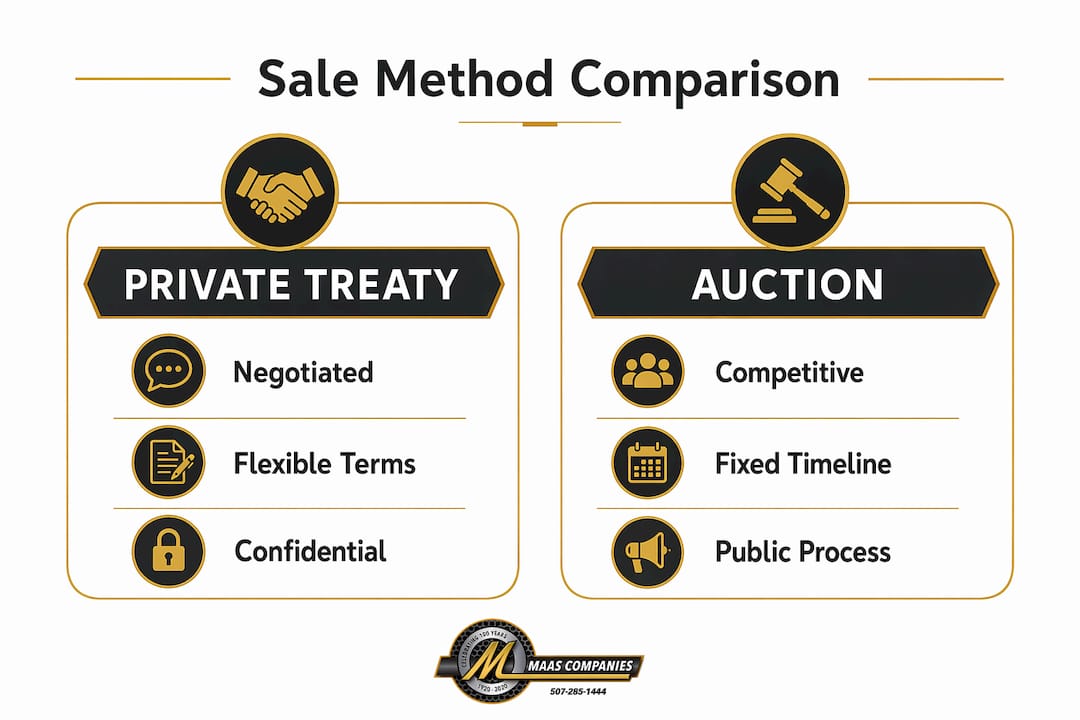
The choice between a private treaty and an auction is rarely about preference alone. It reflects the nature of the asset, the seller’s timeline, and the depth of the buyer pool. The table below compares both methods across the dimensions that matter most in asset recovery and commercial transactions.

| Dimension | Private treaty | Auction |
|---|---|---|
| Process | Negotiated offers, flexible terms | Competitive public bidding on a fixed date |
| Control over sale | Seller sets price, accepts or rejects offers | Seller sets reserve; market determines final price |
| Timeliness | Flexible; no fixed sale date | Defined auction date creates a hard deadline |
| Cost | Lower marketing costs, especially for niche assets | Higher upfront campaign costs |
| Confidentiality | Offers and negotiations remain private | Bids are public; final price is disclosed |
For a deeper analysis of when each method serves asset sellers best, Maascompanies has published a detailed breakdown on auction versus private treaty for asset disposals.
The confidentiality column deserves particular attention in restructuring or liquidation scenarios. Public price signaling during a plant closure or corporate reorganization can damage supplier relationships, unsettle employees, and reduce the perceived going-concern value of remaining operations. A private treaty avoids that exposure entirely.
Advantages and disadvantages of private treaty sales
No single sales method fits every situation. Private treaty sales carry genuine strengths and real limitations, and understanding both is necessary before committing to this approach.
Advantages:
- Negotiation control: Sellers retain the right to accept, reject, or counter any offer without auction-day pressure.
- Confidentiality: Sensitive asset disposals during restructuring or plant closures proceed without public disclosure of pricing or buyer identity.
- Flexibility on terms: Settlement dates, contingencies, and contract conditions are all negotiable, which suits complex transactions.
- Lower marketing costs: Private treaty campaigns typically cost less than full auction campaigns, particularly when targeting a narrow pool of qualified buyers.
- Cooling-off protection: Buyers benefit from a statutory period to conduct due diligence after signing, reducing the risk of uninformed commitments.
Disadvantages:
- No guaranteed sale date: Unlike an auction, there is no fixed closing event. Campaigns can extend well beyond initial projections.
- Reduced competitive pressure: Without competing bidders visible to one another, the seller may not achieve the price discovery that a well-run auction generates.
- Negotiation stalls: Prolonged back-and-forth between parties can delay closing, particularly when multiple contingencies are in play.
- Timeline uncertainty: Extended campaigns increase carrying costs, including insurance, maintenance, and financing on unsold assets.
Private treaty is particularly well suited to specialized industrial assets, sensitive corporate disposals, and situations where the seller needs to control the narrative around the transaction.
Legal considerations in private treaty sales
The legal framework governing private treaty sales is straightforward in principle but demands careful execution in practice. Several points carry significant risk if overlooked.
- When the sale becomes binding: A private treaty sale becomes legally binding only when both parties have signed and exchanged contracts. Prior verbal agreements or accepted offers do not create enforceable obligations in most U.S. jurisdictions.
- Cooling-off periods: Many jurisdictions provide buyers a statutory period after signing during which they may withdraw, subject to conditions. The length and terms of this period vary by state and asset type.
- Contract contingencies: Buyers routinely include conditions such as financing approval, environmental inspection, or equipment appraisal. These contingencies protect the buyer but can be used to delay or exit a deal. Vetting buyer capability before accepting a contingent offer is a standard risk-mitigation step.
- Required disclosures: Sellers must disclose known material defects, environmental liabilities, and title encumbrances. Failure to disclose can void the contract or expose the seller to liability after closing.
- Documentation: A complete private treaty transaction requires a signed purchase agreement, proof of deposit, title search results, any required inspection reports, and transfer documents at settlement.
- Due diligence period: Buyers should use the period between offer acceptance and contract exchange to complete financing, inspections, and legal review. Rushing this stage is a common source of post-closing disputes.
Engaging qualified legal counsel on both sides is not optional in commercial or industrial transactions. The contract of sale is the governing document, and its terms define every party’s rights and obligations from signing through settlement.
How Maascompanies approaches private treaty sales
Maascompanies has structured private treaty campaigns for industrial plants, manufacturing equipment, and commercial real estate across multiple sectors. The firm’s approach centers on three priorities: price discovery without public exposure, qualified buyer targeting, and transaction certainty.
In restructuring and plant closure scenarios, Maascompanies applies a targeted marketing approach that reaches industry-specific buyers without broadcasting the transaction to the broader market. This preserves going-concern value and prevents premature price signaling to competitors, creditors, or the press. The firm’s experience with specialized industrial assets, where the buyer pool may be limited to a handful of qualified operators, makes private treaty the preferred method in many capital recovery engagements.
For operations leaders and lenders evaluating disposition options, the private treaty process offers a structured path to recovery that an open auction cannot always match, particularly when asset complexity, regulatory requirements, or reputational considerations are factors.

Maascompanies works with executives, lenders, and legal teams to structure private treaty campaigns that maximize recovery on industrial and commercial assets. Whether you are managing a plant closure, excess inventory, or a restructuring disposition, the firm’s specialized marketing services are built for exactly these scenarios. Contact Maascompanies to discuss your asset recovery objectives.
Key Takeaways
A private treaty sale gives sellers direct control over price, terms, and confidentiality, making it the preferred method for complex, sensitive, or specialized asset disposals where public auction exposure carries real business risk.
| Point | Details |
|---|---|
| Definition | A private treaty sale is a negotiated transaction between seller and buyer, conducted without public bidding. |
| Binding moment | The sale becomes legally binding only when both parties have signed and exchanged contracts. |
| Confidentiality advantage | Private negotiations prevent public price signaling, protecting reputation during restructuring or liquidation. |
| Cost profile | Private treaty marketing campaigns typically cost less than auction campaigns, especially for niche assets. |
| Key risk | The absence of a fixed sale date creates timeline uncertainty and can increase carrying costs on unsold assets. |
Recommended
- Auction Versus Private Treaty Explained for Asset Sellers | Blog | Insights on Asset Liquidation and Auction Trends
- ORDERLY NEGOTIATED SALE: Taylor Bagger | View Our Current Projects | Maas Companies
- What Is a Negotiated Sale? A Guide for Asset Managers | Blog | Insights on Asset Liquidation and Auction Trends
- Commercial Property Sale Guide for Investors and Owners | Blog | Insights on Asset Liquidation and Auction Trends