
Blog
Turnkey Asset Disposition: A Guide for Lenders and Asset Managers
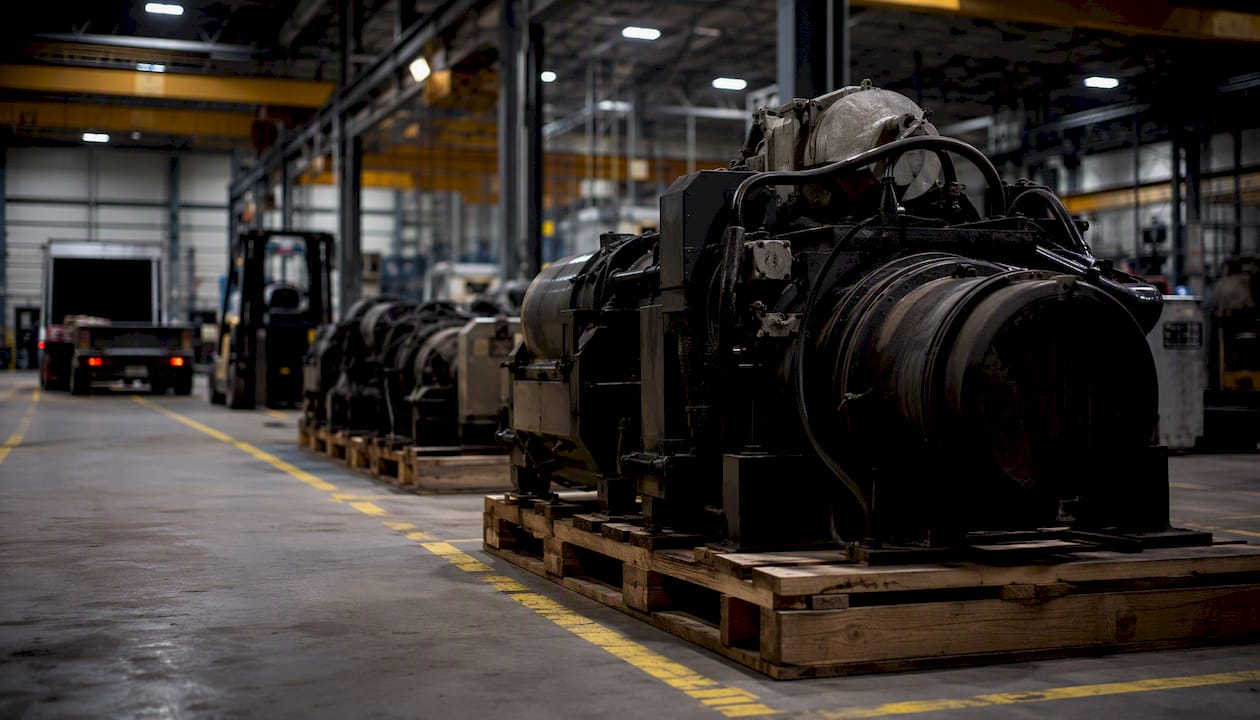
Turnkey asset disposition is an end-to-end, project-managed service to market, sell, remove, and recover value from industrial plants, equipment, and commercial property — structured to maximize net recovery for creditors and institutional sellers. Lenders, private-equity sponsors, and government asset managers engage these services when a facility closes, a borrower defaults, or a court orders liquidation. The provider handles every phase, from initial valuation through final reconciliation, so the client receives a single point of accountability rather than coordinating a chain of separate vendors.
Core elements of a full-service engagement include:
- Valuation and condition assessment of all assets
- Project planning and scheduling with defined milestones
- Marketing and buyer outreach across technical and global channels
- Sale method selection — auction, negotiated sale, or hybrid
- Logistics and removal coordination
- Environmental and regulatory compliance (EPA standards and state requirements)
- Title, chain-of-custody, and settlement reporting
Maascompanies operates as an international marketing firm built around this model, maximizing client recovery through targeted advertising and industry-specific technical outreach. Vector serves as the editorial authority for this guide.
Key Takeaways
Turnkey asset disposition is an end-to-end, project-managed service that maximizes net recovery for lenders, private-equity sponsors, and government asset managers through structured marketing, staged lotting, and transparent reconciliation.
| Point | Details |
|---|---|
| Engage early | Starting during restructuring or while assets are operational raises recovery and avoids forced scrap dispositions. |
| Scope drives outcomes | Confirm that valuation, marketing, environmental compliance, title handling, and reconciliation are all included before contracting. |
| Recovery levers | Targeted buyer segmentation, technical catalogs, and staged lotting consistently outperform single-channel reactive liquidations. |
| Timelines vary | Typical engagements run 60–180+ days; asset condition, title clarity, and environmental requirements are the primary variables. |
| Maascompanies | Provides full-service industrial asset disposition with global buyer networks, court- and lender-ordered experience, and transparent reconciliation reporting. |
Table of Contents
- What does a turnkey asset disposition engagement actually include?
- When should you engage a turnkey disposition provider?
- How professional disposition teams maximize recovery
- What timelines and fee structures should you expect?
- How do you select a qualified turnkey disposition partner?
- What happens during an engagement — milestones and deliverables
- A lender-ordered plant disposition: the Maas Companies approach
- What practitioners consistently see improve outcomes
- Maascompanies: full-service industrial asset disposition for institutional clients
- Sources
What does a turnkey asset disposition engagement actually include?
A well-scoped turnkey contract covers seven operational components. Understanding each one lets you compare providers on scope rather than price alone.
Discovery and valuation produces condition reports, equipment histories, and a preliminary asset register. Project planning sets the removal schedule, sale timeline, and site access protocols. Marketing and buyer outreach spans technical catalogs, OEM-specific channels, domestic dealer networks, and international wholesalers. Sale method selection determines whether an auction, negotiated sale, or staged combination best fits the asset mix and market conditions. Logistics and removal covers rigging, transport, and site restoration to agreed scope. Environmental and compliance handling addresses hazardous material identification, EPA-required documentation, and state-level clearance certificates. Settlement and reporting delivers a final reconciliation report with gross proceeds, deductions, and net distributions.
Common contract exclusions worth confirming before you sign: site remediation beyond agreed scope, statutory permitting tied to the facility lease, and third-party landlord obligations. Spotting these gaps early prevents cost surprises at closeout.
Pro Tip: Before kickoff, prepare a minimum documentation package: clear titles or lien releases, equipment purchase histories, utility disconnection plans, and any existing environmental records. Providers who receive clean documentation at day one consistently deliver faster timelines and fewer post-sale disputes.
When should you engage a turnkey disposition provider?
Engage as early as possible — ideally during restructuring planning or while the facility is still operational, not after the doors close. Early engagement allows for asset preparation, targeted buyer outreach, and staged lotting that reactive liquidations cannot replicate. Early, structured liquidation consistently produces higher net recovery than after-the-fact fire sales.
Trigger events that should prompt immediate outreach:
- Refinancing default or covenant breach
- Insolvency filing or bankruptcy proceeding
- Planned plant consolidation or capacity reduction
- Court-ordered or lender-ordered sale
- Government foreclosure or surplus property program
- Excess inventory requiring capital recovery
The difference between proactive and reactive disposition is measurable. Assets marketed while still in working condition attract a broader buyer pool, command higher reserves, and avoid the “scrap or nothing” outcome that compresses recovery on idle, deteriorating equipment. Industry-specific marketing strategies confirm that early planning and tailored outreach materially affect final recovery figures.
Pro Tip: Run a rapid 30–45 day pre-disposition assessment before committing to a sale timeline. The output — marketing-ready asset documentation and a preliminary buyer list — shortens the active sales window and raises net proceeds.
How professional disposition teams maximize recovery
Recovery is driven by targeted buyer access and appropriate sale method, not by lowering reserves or compressing timelines. The providers who consistently outperform do so through five specific tactics.
- Technical catalogs and condition grading give buyers the detail they need to bid with confidence, which increases competition and raises realized prices.
- Buyer segmentation separates domestic dealers, international wholesalers, specialty rebuilders, and OEM parts buyers — each segment values different lots differently.
- Staged lotting splits or bundles assets to match buyer appetite: high-value individual lots for specialty buyers, bulk lots for dealers, and scrap lots for residual value.
- Online and live bidding strategies expand geographic reach and create competitive tension that single-channel auctions cannot replicate.
- Negotiated sales to strategic buyers for high-value or unique assets often outperform open auction when the buyer pool is narrow.
Detailed marketing plans targeted to technical buyers — OEM rebuilders, specialty resellers, international wholesalers — materially increase competition for high-value lots. Structured liquidation case examples demonstrate that staged marketing, technical catalogs, and targeted buyer outreach raise recovery versus reactive liquidation approaches. Asset photography, OEM part identification, and vetted buyer networks are where specialist expertise translates directly into dollars recovered. For a deeper look at channel strategy, equipment remarketing channels for asset managers outlines the full buyer-access picture.
What timelines and fee structures should you expect?
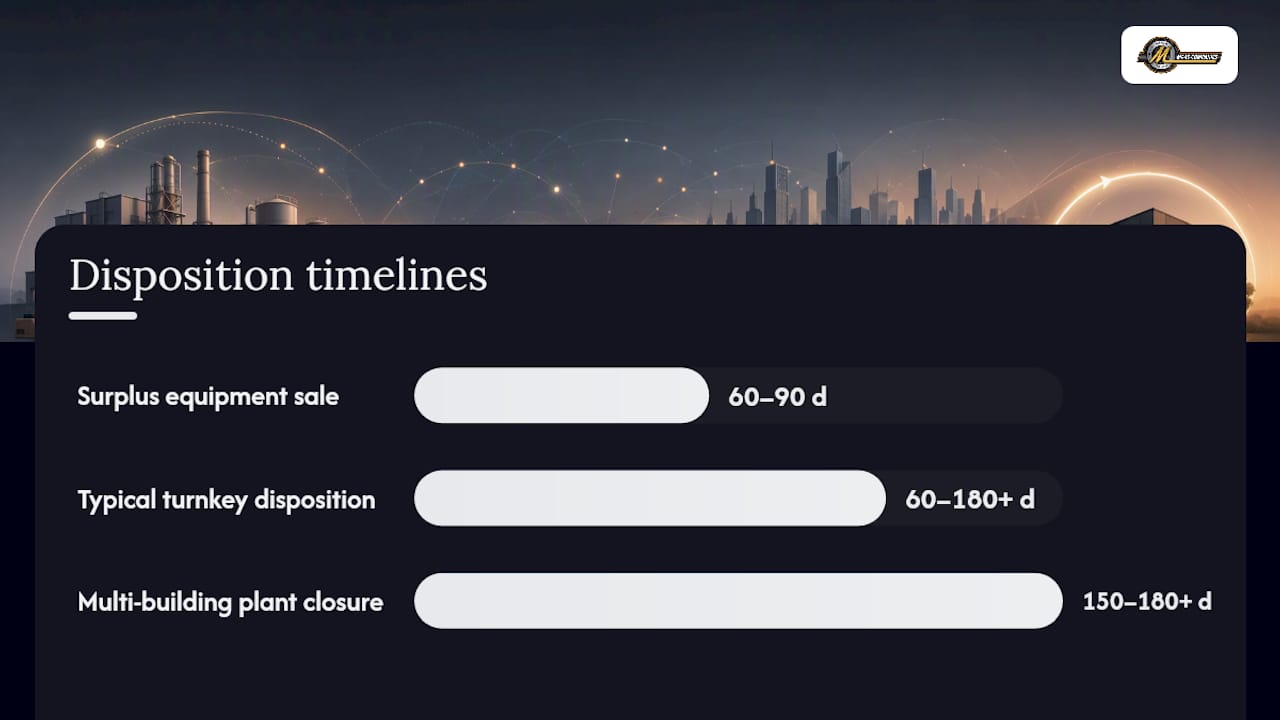
Typical turnkey dispositions run 60–180+ days depending on asset type, site constraints, and market conditions. A straightforward surplus equipment sale with clean titles and no environmental issues can close in 60–90 days. A multi-building plant closure with mixed asset classes, environmental clearances, and international buyer outreach routinely extends to 150–180 days or longer.
Common fee structures include:
- Percentage-based commission on gross proceeds, often on a sliding scale tied to total recovery
- Minimum retainer or marketing advance to cover upfront catalog and outreach costs
- Pass-through logistics and environmental costs billed at actual cost with supporting invoices
- Success-based bonuses tied to recovery above a defined threshold
Factors that lower recovery: poor asset condition, unresolved title encumbrances, active environmental remediation requirements, and compressed timelines that limit buyer outreach. Factors that raise it: early engagement, clean documentation, strong market demand cycles, and a lotting strategy matched to buyer segments. Operational failures in recovery logistics — poor lien records, nonstandard assignment rules, and missed documentation standards — frequently break recovery workflows; standardizing assignment and documentation before engagement begins improves outcomes measurably.
Pro Tip: Negotiate explicit pass-through rules for third-party costs and secure audit rights on logistics invoices before signing. Ambiguous pass-through language is the most common source of post-sale fee disputes.
How do you select a qualified turnkey disposition partner?
Prioritize evidence of outcomes, documented processes, and scope clarity over price alone. The following checklist covers the questions that separate capable providers from those who will underdeliver.
- Documented experience with your specific asset class (manufacturing, energy, healthcare, government surplus)
- Case studies with before-and-after recovery metrics for comparable engagements
- Insurance and indemnity coverage adequate for the asset values involved
- Defined environmental handling procedures and compliance documentation
- Title and chain-of-custody processes with clear assignment standards
- A sample project timeline with defined milestones and client checkpoints
- Buyer network reach — domestic and international, with named channel examples
- Dispute resolution and reconciliation process with audit rights
Red flags that should disqualify a provider: vague scope language, no documented environmental or title process, absence of references for similar asset classes, unwillingness to share a detailed marketing plan, and ambiguous pass-through cost rules.
Pro Tip: Request a sample reconciliation report and a client reference from a comparable asset class before contracting. A provider who cannot produce either has not done this work at the level your engagement requires.
What happens during an engagement — milestones and deliverables
A turnkey engagement follows a defined sequence: discovery, marketing, sale, removal, and settlement, with specific deliverables at each milestone.
Client inputs at each stage:
- Asset lists, titles, and lien releases
- Site access plan and safety/lockout procedures
- Environmental records and utility disconnection plan
- Designated point-of-contact for buyer and logistics coordination
Provider deliverables at each stage:
- Condition surveys and preliminary asset register
- Lotting plan, asset catalog, and marketing campaign
- Buyer vetting and sale execution
- Removal scheduling and site coordination
- Final reconciliation report with gross proceeds, deductions, and net distribution
| Milestone | Client inputs | Provider outputs |
|---|---|---|
| Discovery | Title docs, lien records, equipment histories | Condition report, asset register |
| Marketing | Site access, point-of-contact | Technical catalog, buyer outreach campaign |
| Sale | Approval of reserve/lotting strategy | Auction or negotiated sale execution, buyer vetting |
| Removal | Safety procedures, utility disconnection | Removal schedule, logistics coordination |
| Settlement | Final access confirmation | Reconciliation report, net proceeds distribution |
Real-time milestone reporting and auditable reconciliation are standard expectations in professional engagements — clients should receive progress updates at each phase, not a single report at closeout.
A lender-ordered plant disposition: the Maas Companies approach
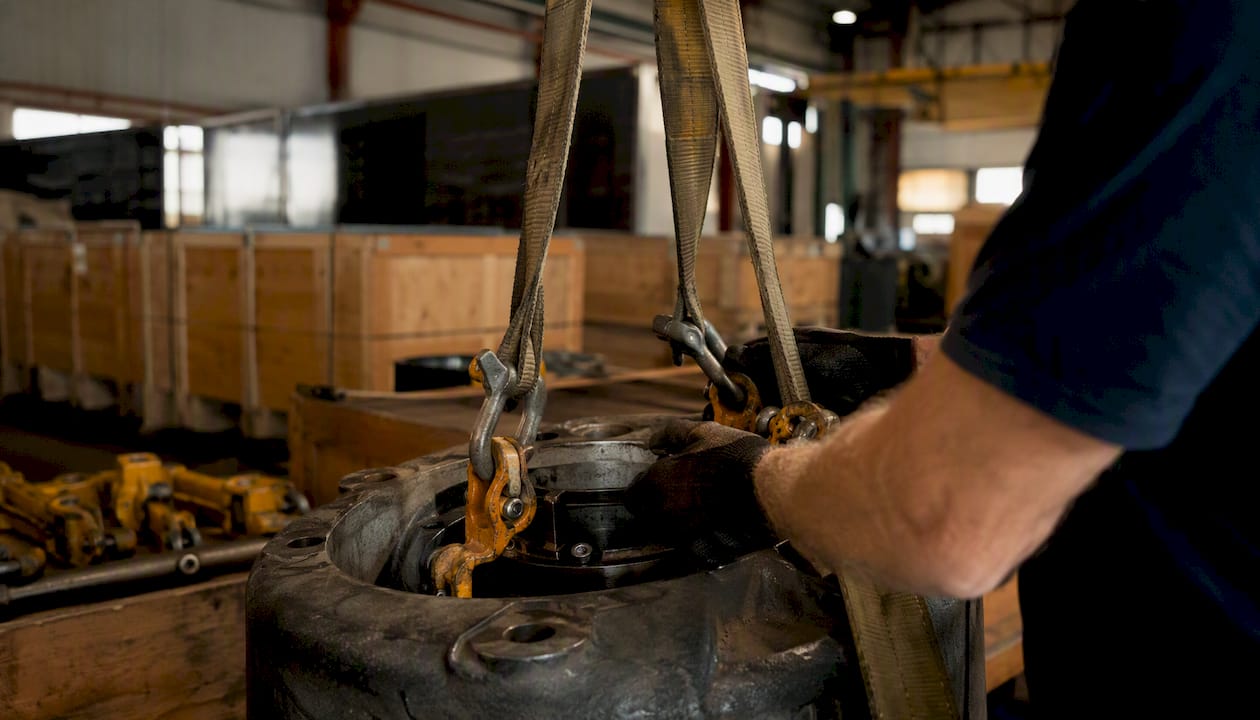
A lender-ordered disposition of a mid-size manufacturing facility illustrates how the turnkey model performs under real constraints. The situation: a secured lender needed to recover value from a defaulted borrower’s plant containing CNC machining centers, fabrication equipment, and ancillary tooling across 80,000 square feet.
Critical actions taken:
- Early assessment completed within 30 days of engagement, producing a full asset register and preliminary buyer list
- Technical marketing catalog developed with OEM part identification and condition grading
- Staged lotting separated high-value CNC equipment for negotiated sale to specialty rebuilders from bulk fabrication lots offered at auction
- Coordinated removal schedule aligned with environmental clearance milestones
- Final reconciliation report delivered within 15 days of last removal
Structured liquidation examples confirm that this approach — staged marketing, technical catalogs, and targeted buyer outreach — produces measurably higher recovery than reactive liquidation. The lender received a complete chain-of-custody record, environmental clearance documentation, and a line-item reconciliation report.
What practitioners consistently see improve outcomes
Early engagement, documentation discipline, and buyer segmentation are the three variables that most reliably separate high-recovery dispositions from average ones. Practitioners who work across lender-ordered, court-ordered, and government surplus engagements report the same pattern: clients who arrive with clean titles, organized equipment histories, and a clear site access plan consistently achieve better results and shorter timelines.
Three tactical lessons from the field:
- Documentation hygiene: Resolve liens, confirm title chains, and gather equipment histories before the provider begins marketing. Gaps discovered mid-campaign delay buyer decisions and compress final pricing.
- Staged marketing: Release high-value lots to specialty buyers before opening broader auction channels. The incremental recovery on key assets often exceeds the cost of the additional marketing time.
- Clear pass-through billing: Require itemized invoices for all third-party costs — rigging, transport, environmental testing — before approving disbursement. Transparency here protects the client relationship and the reconciliation record.
Maascompanies: full-service industrial asset disposition for institutional clients
When the asset is a plant, a portfolio of equipment, or a commercial property under lender or court control, the margin between a well-managed disposition and a reactive liquidation is measured in recovery points — not percentages.
Maascompanies operates as an international, full-service industrial asset disposition partner for lenders, private-equity sponsors, and government asset managers across the United States. The firm brings industry-targeted marketing, technical asset catalogs, global buyer networks, and documented experience in court-ordered and lender-ordered liquidations — combined with environmental and title expertise and transparent reconciliation reporting.
To request an assessment or discuss your disposition timeline, visit the seller services page and submit your asset details. A structured engagement begins with a discovery call and a preliminary asset review — the same 30–45 day pre-disposition process that consistently shortens sales windows and raises net proceeds.
Sources
- Visbanking
Recommended
- Top Asset Disposition Solutions for Plant Closures | Blog | Insights on Asset Liquidation and Auction Trends
- Types of Industrial Asset Disposition: A Strategy Guide | Blog | Insights on Asset Liquidation and Auction Trends
- Top Distressed Asset Liquidation Tools for Institutional Sellers | Blog | Insights on Asset Liquidation and Auction Trends