
Blog
Top Asset Disposition Solutions for Plant Closures

TL;DR:
- An auction-led sale with a negotiated fallback is the preferred method for asset liquidation and plant exits. Emergency cases require compressed timelines that shift focus to rapid disposition methods like online or onsite auctions. Maas Companies structures each engagement around buyer reach, transparent pricing, and flexibility to meet environmental and legal constraints.
Orderly auction-led sale with a negotiated-sale fallback is the leading asset disposition solution for planned plant exits and lender-led liquidations where both timing and recovery matter. For court-ordered or emergency foreclosure scenarios, a compressed timeline takes priority and the methodology shifts accordingly. Three factors drive executives toward this approach: broad buyer reach through targeted marketing, transparent pricing through competitive bidding, and optionality to shift between auction and negotiated sale when specialized production lines or commercial real estate require a different buyer fit. Maas Companies Inc. structures every engagement around these priorities, with documented experience in lender-ordered, court-ordered, and voluntary corporate shutdowns. The EPA’s remediation requirements and state environmental programs add a fourth constraint that shapes both timing and contract structure, particularly for sites with legacy industrial use.
- Recommended primary solution: Staged auction-led sale with negotiated-sale fallback for specialized or high-value machinery
- Exception: Emergency or court-ordered liquidation where a compressed short timeline overrides recovery optimization
- Three selection drivers: buyer reach and marketing depth, price transparency through competitive bidding, and structural flexibility for real estate or specialty-line disposition
BCG’s analysis of industrial closures confirms that executives who plan backward from a defined end state capture more value and reduce remediation liability compared to those who treat closure as a cost center.
Table of Contents
- What does ‘asset disposition’ mean for industrial plants?
- Which disposition solution fits your situation?
- How do you select the right disposition partner?
- What timelines and fees should you expect?
- How do you manage legal and environmental risks?
- What does a proven disposition methodology look like?
- What happens after you engage a disposition partner?
- Key Takeaways
- The case for treating closure as a portfolio decision
- Maascompanies: auction and negotiated-sale services for industrial assets
- Useful resources for further planning
What does ‘asset disposition’ mean for industrial plants?
In the industrial and commercial context, asset disposition refers to the structured sale, transfer, or liquidation of physical plant assets: production equipment, machinery, spare parts, inventory, and the facility real estate itself. The goal is maximum net recovery for the seller, whether that seller is a corporation winding down a division, a lender recovering collateral, or a court-appointed trustee executing a judgment.
Scope inclusions are specific. Onsite machinery, production lines, plant-support equipment such as cranes and HVAC systems, raw material inventory, and the underlying real property all fall within industrial asset disposition. What falls outside this scope: IT asset disposition (ITAD), which covers electronic recycling and data destruction for retired hardware; hazardous-waste disposal governed solely by environmental remediation law; and consumer resale channels. This article covers none of those.
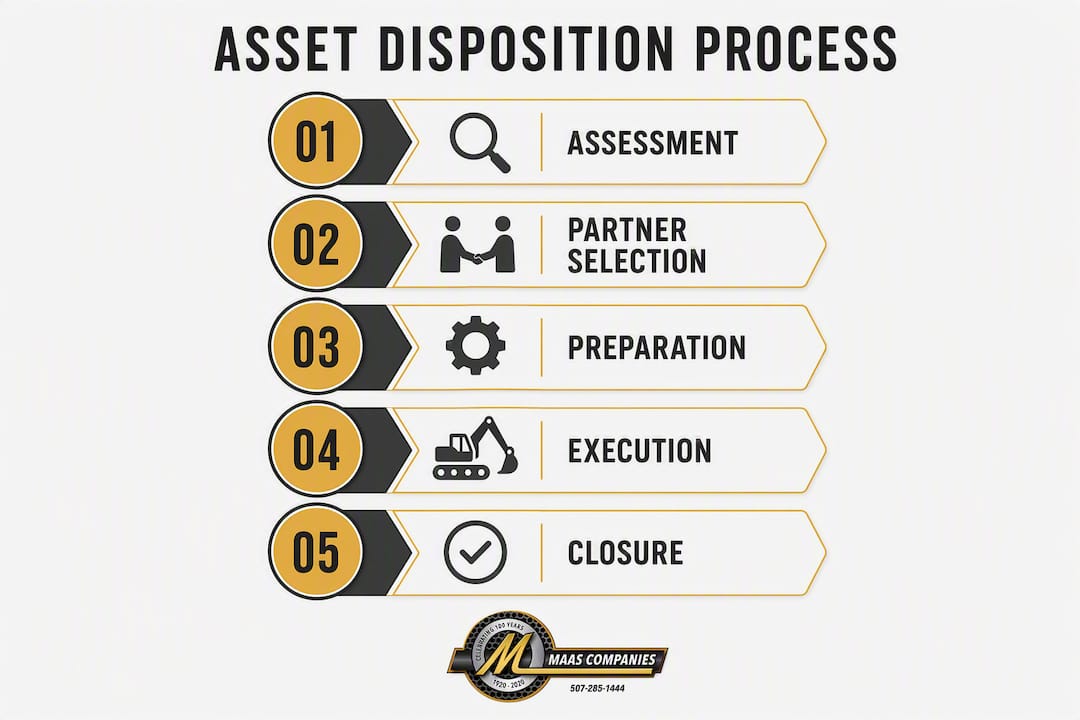
Transaction types within scope include onsite auctions, online auctions, brokered negotiated sales, bulk salvage, and real-estate marketing for site transfers. Each carries a different risk profile, timeline, and recovery expectation.
Which disposition solution fits your situation?
Understanding the types of industrial asset disposition is the first step toward selecting the right method. The taxonomy below maps each solution to its primary use case.
- Onsite auction: Best for high-volume commodity assets, general manufacturing equipment, and situations where buyers need to inspect before bidding. Generates competitive pricing through live or simulcast bidding and typically clears a facility within 30–90 days of marketing launch.
- Online auction: Suited to geographically dispersed buyer pools and assets with established secondary markets. Extends reach beyond regional buyers and can run concurrently with onsite events.
- Negotiated/private sale: The preferred method for specialized production lines, custom-engineered equipment, or assets where buyer fit matters more than speed. Recovery can exceed auction results when the right buyer is identified, though timelines extend to 90–180 days or longer.
- Turnkey liquidation (industrial liquidator-managed): Appropriate for complete plant shutdowns requiring a single contractor to handle cataloging, marketing, sale execution, removal, and site clearance. Reduces internal resource burden but requires careful fee and performance-incentive structuring.
- Staged/structured liquidation: Used when a large asset portfolio risks market oversaturation if sold at once. Structured liquidation phases the sale to protect pricing on specialty equipment while clearing commodity assets quickly.
- Bulk salvage/scrap: Last resort for assets with no secondary market value. Recovery is lowest but execution is fastest, typically days to weeks.
For lender-ordered dispositions, auction-led methods with documented buyer vetting satisfy court and lender reporting requirements most cleanly. Court-ordered liquidations often compress timelines to 7–60 days, which pushes toward onsite or online auction regardless of asset type. Voluntary corporate shutdowns allow the most planning time and typically benefit from staged approaches.
How do you select the right disposition partner?
The decision checklist below separates capable providers from those who will cost you recovery points.
Evaluation criteria:
- Projected net recovery range, stated by asset category, not as a single blended estimate
- Buyer reach: size and quality of the active buyer database, geographic coverage, and industry-specific marketing channels
- Environmental and regulatory experience, including EPA compliance, state remediation program familiarity, and hazardous-material inventory capability
- Logistics: removal scheduling, transport coordination, and site-clearance management
- References for lender-ordered or court-ordered cases specifically
Red flags in proposals:
- Commission structures that obscure buyer premiums or marketing cost pass-throughs
- No documented buyer-vetting process
- Vague or absent environmental-risk allocation language
- Settlement timelines stated as “approximately” with no contractual milestone
Contract clauses to negotiate:
- Fee and commission structure with explicit treatment of buyer premiums
- Reserve pricing or guaranteed minimums by asset category
- Performance incentives tied to net recovery and schedule adherence
- Environmental indemnities and remediation-cost allocation
- Title transfer and warranty language, particularly for real estate
- Escrow and settlement timing with specific milestone dates
Lender-focused liquidation guidance reinforces that documentation practices and settlement transparency are as important to lenders as gross recovery figures.
What timelines and fees should you expect?

| Scenario | Typical Timeline | Fee Model | Recovery Notes |
|---|---|---|---|
| Planned orderly exit | 90–180 days | Commission on gross proceeds | Highest net recovery; allows staged marketing |
| Staged liquidation | 60–180 days per stage | Commission plus marketing fee | Protects specialty-equipment pricing |
| Emergency/foreclosure | 7–60 days | Commission or lump-sum | Recovery compressed by timeline constraints |
| Real estate marketing | 90–180 days | Commission or hybrid | Varies significantly by site condition and location |
Commission-based models are standard, with the seller paying a percentage of gross proceeds. Hybrid models add a flat marketing fee to a lower commission rate, which aligns provider incentives with marketing investment. Lump-sum engagements appear in real-estate marketing and turnkey plant clearances where scope is well-defined upfront.
Recovery ranges vary by method and asset condition. Negotiated sales for specialized equipment generally outperform auction results when the right buyer is found. Auction results for commodity manufacturing equipment depend heavily on market demand, asset characterization quality, and seasonality. Bulk salvage returns the least but closes fastest.
Cash flow timing matters for lender covenants and board reporting. Auction settlements typically occur within 30–45 days of the sale event. Negotiated sales settle on closing, which may be 60–120 days after engagement. Delays in title clearance or environmental disclosure can push settlement past lender-covenant deadlines, making early legal and environmental scoping a financial priority, not just a compliance one.
How do you manage legal and environmental risks?
Title issues, liens, and environmental remediation obligations are the three constraints most likely to reduce recovery or delay a sale. Early identification of each is the only reliable mitigation.
Order a lien search and title review before marketing begins. Undisclosed liens discovered during buyer due diligence kill transactions or force price reductions at the worst possible moment. For real estate, a Phase I Environmental Site Assessment is the minimum; sites with legacy industrial use typically require Phase II sampling before a buyer will commit.
Environmental remediation obligations under state programs or EPA oversight must be scoped and allocated in the disposition contract. The contract should specify which party bears remediation cost, what triggers a remediation obligation, and how remediation timelines interact with removal and site-clearance schedules. Seasonal windows for certain remediation activities can extend timelines by months if not planned for early.
Auction readiness also requires a hazardous-material inventory, removal permits for regulated equipment, and insurance and bonding confirmation from the disposition provider. These are not optional steps; they are prerequisites for a legally clean sale.
What does a proven disposition methodology look like?
The following sequence reflects how a disciplined provider structures a full plant disposition engagement.
- End-state planning: Define the desired outcome before any asset is touched. Repurpose, redevelop, or clear? The answer shapes every subsequent decision.
- Early characterization: Environmental scoping and asset inventory run concurrently. This step surfaces title issues, lien positions, and remediation obligations before they become transaction blockers.
- Commercial strategy: Determine the auction-vs.-negotiated-sale mix by asset category. Commodity equipment goes to auction; specialty lines get a negotiated-sale process with targeted buyer outreach.
- Staged cataloging and valuation: Detailed catalogs with high-quality photography and condition grading materially increase realized prices. This is not an administrative step; it is a recovery driver.
- Targeted marketing and buyer vetting: Reach the right buyers through industry-specific channels, direct outreach to qualified operators, and digital marketing. Buyer vetting protects against non-performing bidders and satisfies lender reporting requirements.
- Execution: Auction or negotiated closing, with real-time reporting to the client and lender as required.
- Removal and settlement: Logistics coordination, site clearance, and final settlement statement with full proceeds reconciliation.
Maas Companies layers targeted marketing reach, staged cataloging, and flexible sale structures to preserve optionality at every phase. For lender- and court-ordered liquidations, this methodology produces documented recovery results and the settlement transparency that institutional clients require.
Measurable deliverables a client should require: estimated net recovery by asset category, timeline milestones with contractual dates, buyer-engagement metrics during the marketing period, and environmental and safety compliance sign-offs at each phase gate.
What happens after you engage a disposition partner?
From kickoff to final settlement, a well-run engagement follows a defined milestone sequence.
Milestone checklist:
- Site assessment and asset inventory (weeks 1–3)
- Environmental and title review (concurrent with inventory)
- Marketing plan approval and buyer-list confirmation (week 4)
- Catalog publication and marketing launch (weeks 4–6)
- Bidding or negotiation period (weeks 6–12, varies by method)
- Removal scheduling and logistics coordination (post-sale)
- Final settlement and proceeds reconciliation (30–45 days post-sale for auctions)
Deliverables the seller receives:
- Asset inventory with condition grades and valuations
- Marketing plan with buyer-outreach channels and timeline
- Auction catalog or negotiation memorandum
- Environmental and title reports
- Settlement statement with full proceeds reconciliation
Internal resource requirements are modest but real. A site liaison for access coordination, security coverage during the marketing and removal period, and a point of contact for surplus-transfer coordination are the minimum. For multi-site liquidations, centralized coordination and standardized staging protocols across locations protect recovery consistency.
Key Takeaways
The most effective asset disposition approach for industrial plant closures combines staged auction-led sales with negotiated-sale fallbacks, early environmental scoping, and targeted buyer marketing to maximize net recovery while managing timeline and legal risk.
| Point | Details |
|---|---|
| Plan from the end state | Define repurpose, redevelop, or clear before engaging any provider; this shapes every commercial and environmental decision. |
| Match method to asset type | Auction suits commodity equipment; negotiated sale protects recovery on specialized production lines and custom machinery. |
| Scope environmental risk early | Title reviews and Phase I assessments before marketing launch prevent transaction-killing surprises during buyer due diligence. |
| Require contractual milestones | Settlement timing, fee structures, and performance incentives must be written into the contract, not left to verbal agreement. |
| Maascompanies as disposition partner | Maascompanies provides auction and negotiated-sale services with lender- and court-ordered experience, staged cataloging, and targeted buyer marketing. |
The case for treating closure as a portfolio decision
The conventional framing of plant closure as a cost-containment exercise misses the recovery opportunity entirely. A facility with aging equipment and environmental obligations looks like a liability on a balance sheet until a disciplined disposition process reveals the buyer pool for its production lines, the land value after remediation, and the carrying-cost savings from a clean, documented exit.
The executives who recover the most are not the ones who move fastest. They are the ones who define the end state first, scope the environmental and title constraints before marketing begins, and then use competitive buyer reach to set price. Speed matters in court-ordered and foreclosure-driven cases, but even there, a provider with a deep buyer network and a documented auction process outperforms a rushed bulk-salvage approach on net recovery.
The gap between what a disposition firm promises and what it delivers almost always comes down to marketing depth and cataloging quality. A provider who cannot show you a buyer list, a catalog methodology, and prior settlement statements for comparable transactions is not a strategic partner. They are a clearance service.
Maascompanies: auction and negotiated-sale services for industrial assets
When a plant closure, restructuring, or lender-ordered liquidation requires a partner with documented recovery results and the marketing reach to find the right buyers, Maascompanies delivers more than an auction platform.
Maascompanies provides end-to-end auction and negotiated-sale services for industrial plants, equipment, and commercial real estate across the United States and internationally, with specific experience in court-ordered and lender-ordered liquidations that demand both recovery performance and institutional-grade reporting.
What Maascompanies offers:
- Appraisal and asset valuation by category
- Staged cataloging with condition grading and photography
- Targeted buyer marketing through industry-specific channels and a qualified buyer database
- Auction and negotiated-sale execution with real-time client reporting
- Logistics, removal coordination, and site clearance
- Settlement statements and full proceeds reconciliation
Past projects include industrial real-estate auctions such as the former INEOS-New Planet Biorefinery in Vero Beach, FL, demonstrating capability across both equipment and property disposition. To discuss your disposition requirements and receive a recovery-focused engagement proposal, visit Maascompanies’s seller services page or contact the team directly.
Useful resources for further planning
- BCG: Industrial Asset Closures Are Inevitable. Value Isn’t. — Strategic framing for end-state planning and value capture
- Maascompanies: Types of Industrial Asset Disposition — Disposition taxonomy and staged-sale methodology
- Maascompanies: Structured Liquidation Guide — Staging strategies to protect specialty-equipment pricing
- Maascompanies: How to Market Idle Equipment — Cataloging and buyer-outreach tactics that increase realized prices
- Maascompanies: Lender and Special Asset Manager Guide — Documentation and recovery practices for institutional clients
- Maascompanies: Surplus Equipment Auctions — Operational checklist for auction readiness and buyer vetting
- FieldVest: Oil and Gas Exit Strategy Tips — Sector-specific exit planning for energy asset holders
- Maascompanies: Seller Services — Primary contact path for sellers ready to engage
Recommended
- How Industrial Plant Liquidation Maximizes Recovery Value for Lenders | Blog | Insights on Asset Liquidation and Auction Trends
- Types of Industrial Asset Disposition: A Strategy Guide | Blog | Insights on Asset Liquidation and Auction Trends
- Facility Liquidation Strategies That Keep Transitions on Track | Blog | Insights on Asset Liquidation and Auction Trends
- Plan Better Industrial Closures With Expert Auction Help | Blog | Insights on Asset Liquidation and Auction Trends