

Blog
Surplus equipment auctions: maximize asset recovery smartly
TL;DR:
- Surplus equipment auctions are strategic tools used during restructuring to quickly convert assets into capital.
- Effective pre-auction marketing and accurate asset presentation are key to maximizing recovery value.
- Choosing the right auction type and partner impacts speed, reach, and final sale price.
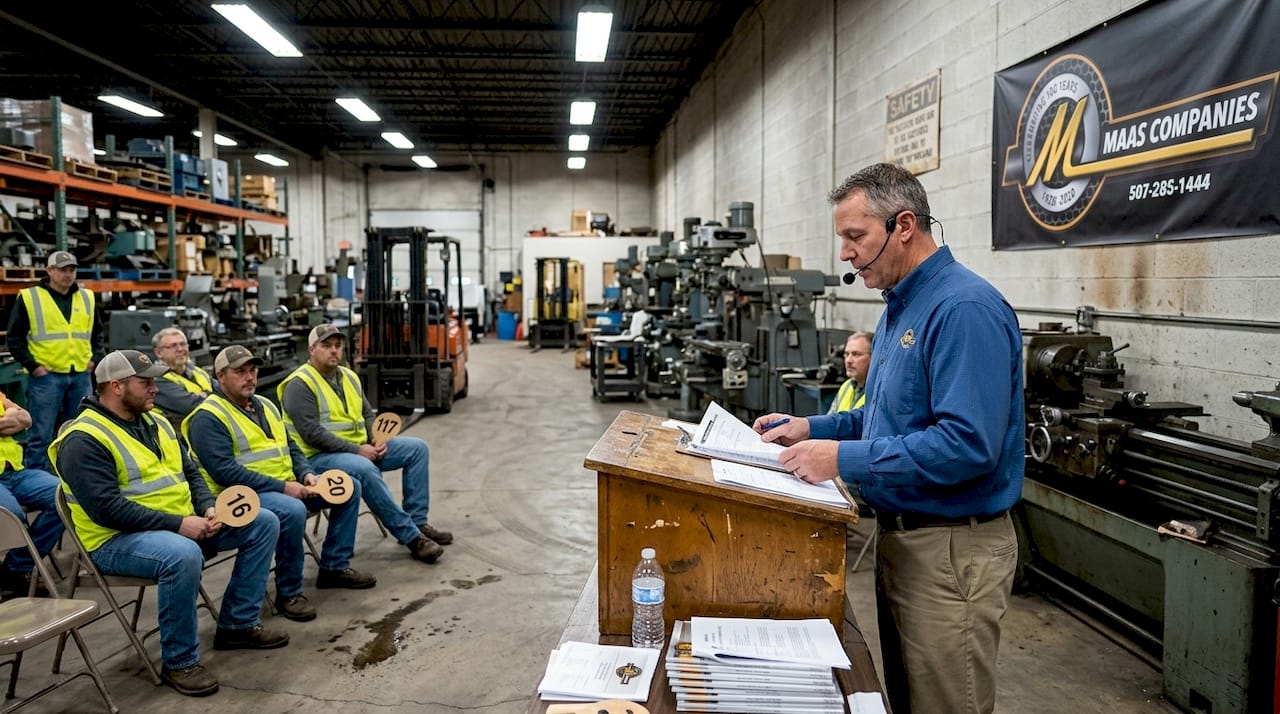
Surplus equipment auctions are widely misunderstood as a last resort for worn-out or obsolete machinery. In reality, leading manufacturers and industrial companies use them as a deliberate, strategic tool during restructuring, right-sizing, or plant transitions. The structured competitive bidding process drives transparent price discovery, attracts a global buyer base, and converts idle assets into working capital far faster than private treaty sales. This article covers what a surplus equipment auction is, how the process works end-to-end, how government and corporate auction formats compare, and the practical benefits and risks every decision-maker should evaluate before committing to a liquidation strategy.
Table of Contents
- What is a surplus equipment auction?
- How the surplus equipment auction process works
- Government vs. corporate surplus auctions: Key differences
- Practical benefits and risks: What decision-makers must know
- The real story: What most guides miss about surplus equipment auctions
- Ready to get expert help? Explore proven surplus auction solutions
- Frequently asked questions
Key Takeaways
| Point | Details |
|---|---|
| Rapid asset liquidation | Surplus equipment auctions enable fast, transparent conversion of idle assets into cash using competitive bidding. |
| Strategic process steps | Screening, preparation, marketing, and post-auction logistics are critical for maximizing returns and minimizing risk. |
| Know your auction type | Government auctions offer lower risk but longer timelines, while corporate auctions provide higher recovery potential with more buyer responsibility. |
| Factoring in fees | Expect auctions to carry buyer premiums, typically 10-18%, requiring careful pricing strategy to meet your targets. |
What is a surplus equipment auction?
A surplus equipment auction is the structured sale of unneeded industrial assets to qualified buyers through transparent, competitive bidding. Surplus inventory typically arises from operational restructuring, capacity downsizing, technology upgrades, or full plant closures. These events leave companies holding equipment that carries ongoing storage, insurance, and maintenance costs, all without generating revenue. Auctioning those assets converts the idle inventory into capital quickly and efficiently.
It is important to distinguish auctions from straightforward liquidations. A liquidation often implies a bulk, discounted sale with minimal buyer competition. Auctions, by contrast, create a competitive environment where multiple buyers bid against each other, which supports stronger price realization. Key participants in any industrial auction include the selling company, a specialist auctioneer, and a qualified buyer pool that may span domestic dealers, end users, and international operators.
Several formats exist for selling surplus industrial equipment, and choosing the right one matters. Common auction formats used in industrial asset sales include:
- Timed online auction: Buyers bid asynchronously over a set period; the most common format for industrial assets due to its global reach.
- Live webcast auction: A real-time auctioneer calls bids while online participants submit offers simultaneously.
- Sealed bid: Each buyer submits one confidential offer; the highest qualifying bid wins.
- Spot bid: Buyers submit bids on-site during an inspection period, often for smaller lots.
- Fixed-price sale: Assets are listed at a set price, removing competitive dynamics but accelerating closing.
- Negotiated sale: Direct negotiation between seller and a shortlisted buyer group, often used for specialized or high-value equipment.
Key terms to know: Industrial surplus auctions are conducted on an as-is, where-is basis, meaning no warranties are provided on condition or fitness. Buyer premiums, the fee a winning bidder pays on top of the hammer price, typically range from 10 to 18 percent. Sales cycles generally run 45 to 90 days from asset screening through buyer removal.
For a closer look at the full selling workflow, review this surplus sale step-by-step guide to understand how each phase connects.
How the surplus equipment auction process works
Understanding the mechanics helps sellers make better decisions at the critical checkpoints that directly affect recovery value. The full auction process moves through seven distinct stages:
- Asset screening: Identify which equipment qualifies for sale, separate items by condition and category, and establish a preliminary value range.
- Preparation and documentation: Clean equipment, photograph it thoroughly, compile serial numbers, specifications, and any available service records.
- Marketing and buyer outreach: Publish listings to targeted industry databases, email qualified buyer lists, and distribute globally to maximize competition.
- Inspection and Q&A: Allow registered bidders to inspect assets on-site or review detailed virtual walk-throughs and submit technical questions.
- Bidding and closing: Open the bidding window; timed auctions often feature auto-extend functions that add time when bids arrive near the deadline, preventing sniping.
- Payment processing: Winning bidders typically remit full payment within two to five business days of closing.
- Buyer removal and logistics: Buyers coordinate and fund their own removal within the contracted window; sellers oversee site clearance.
Pro Tip: Invest in professional cleaning and thorough documentation before listing. Well-presented assets with complete spec sheets and clear photos consistently outperform bare-bones “as-is” listings in final recovery value.
The table below outlines a typical auction timeline and the associated cost elements sellers should plan for:
| Phase | Typical duration | Key cost element |
|---|---|---|
| Asset screening and setup | 5 to 10 days | Auctioneer setup fee |
| Marketing period | 21 to 35 days | Advertising and promotion costs |
| Inspection window | 3 to 5 days | Staff coordination time |
| Bidding open | 7 to 14 days | Platform hosting fee |
| Payment window | 2 to 5 business days | Payment processing fees |
| Buyer removal window | 10 to 30 days | Site supervision costs |
| Buyer premium | Charged at close | 10 to 18% of hammer price |
Three milestones have the greatest impact on final returns: the breadth of marketing outreach, the realism of reserve prices, and the scheduling of inspection windows. Narrow marketing limits bidder competition; reserves set too high suppress bids; and poorly scheduled inspections reduce serious buyer participation. For guidance on structuring sale groupings, see how to maximize value with auction lots, and when evaluating format options, this resource on choosing the right auction format provides a useful comparison.

Government vs. corporate surplus auctions: Key differences
Now that you know the standard process, understanding the structural differences between government and corporate auction approaches helps you determine which path aligns with your company’s objectives.
| Factor | Government surplus auction | Corporate surplus auction |
|---|---|---|
| Auction type | Structured, regulated (GSA, GovDeals) | Flexible, market-driven |
| Risk profile | Low for buyers | Moderate to high (as-is terms) |
| Typical buyers | Public, small businesses, dealers | Industrial end users, global dealers |
| Marketing reach | National registries | Targeted global outreach |
| Asset condition disclosure | Standardized grading | Seller-defined documentation |
| Buyer premium | Varies by platform | 10 to 18% typical |
| Removal responsibility | Buyer | Buyer |
| Regulatory oversight | High | Moderate |
| Payment terms | Fixed per platform rules | Defined in auction contract |
Government surplus platforms such as GSA Auctions and GovDeals prioritize compliance, standardized grading, and broader public access. Corporate surplus auctions, by contrast, prioritize speed, global buyer reach, and maximum competitive tension around specialized industrial assets.
When deciding between the two approaches, consider the following:
- Choose a government auction channel if: your assets include government property, compliance documentation is required, or longer timescales are acceptable in exchange for lower administrative risk.
- Choose a corporate industrial auction if: you need faster turnaround, higher recovery potential, and access to a global buyer base that understands your specific equipment category.
- Hybrid strategies: Some companies run a government channel for compliant assets while using a corporate auctioneer for high-value specialized machinery simultaneously.
Corporate industrial auctions consistently favor timed online formats for their efficiency and global reach. However, sellers must account for buyer logistics and the absence of warranties. Working with a specialist auctioneer who already maintains relationships with qualified end users in your equipment category is the clearest way to speed up asset disposition while protecting recovery value.
Practical benefits and risks: What decision-makers must know
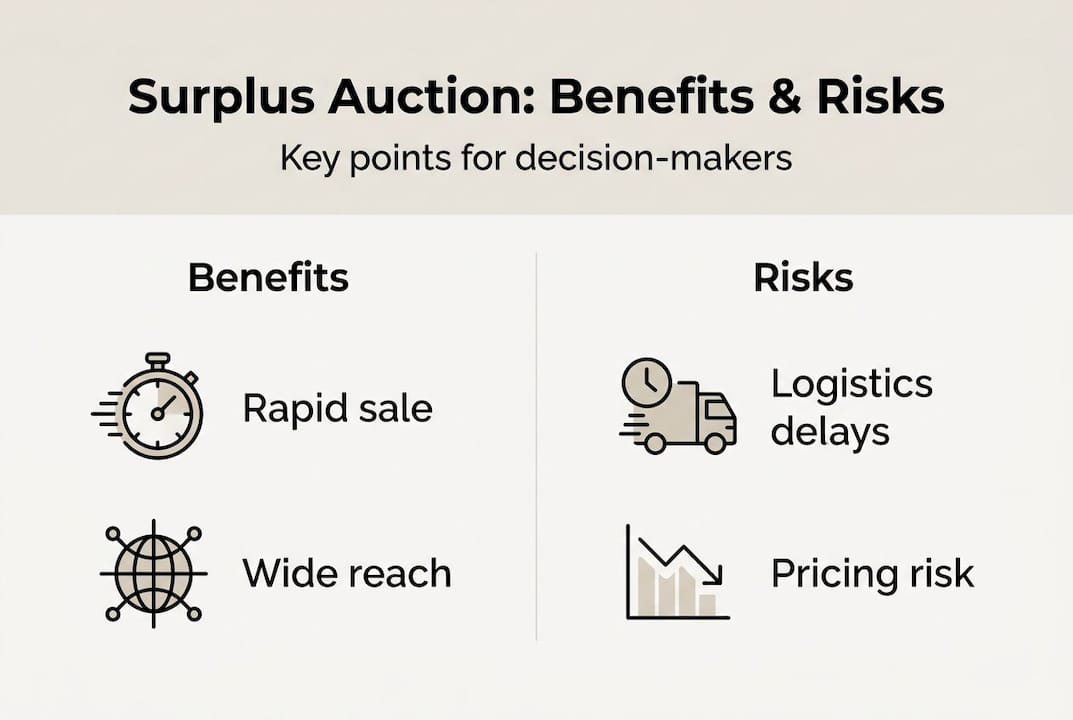
The core value proposition of surplus auctions is well established: fast liquidation, transparent competitive bidding, global buyer access, minimal negotiation overhead, and real-time price discovery. These advantages are particularly relevant for manufacturing companies managing plant closures or restructuring timelines, where carrying costs accumulate daily.
That said, auctions are not without risk. Sales are conducted on an as-is, where-is basis, meaning no warranties are offered and buyer premiums of 10 to 18 percent affect the total realized value equation. Decision-makers should weigh the following risks carefully:
- Under-recovery risk: Thin bidder pools or overly optimistic reserves can result in assets selling below replacement cost or not selling at all.
- Buyer default: Winning bidders occasionally fail to complete payment, requiring re-listing and delaying site clearance.
- Removal delays: Buyers who win assets but struggle with logistics can hold up facility clearance, extending your carrying costs.
- Reputation considerations: For branded or identifiable equipment, public auction exposure may signal financial distress if not managed carefully.
Pro Tip: Define clear removal deadlines in your auction contract, set reserves based on current market comparables rather than book value, and document asset condition honestly in your listings. Transparent disclosures reduce buyer disputes and drive stronger, more committed bids.
The most effective mitigation strategy is selecting an auctioneer with deep experience in your specific equipment category. General-purpose brokers lack the buyer relationships and technical marketing knowledge that specialist auctioneers bring to complex industrial sales. For sellers considering absentee buyers, reviewing absentee bidding strategies can help you structure bidding terms that attract serious remote participants.
The real story: What most guides miss about surplus equipment auctions
Most operational guides focus on mechanics: asset screening, format selection, payment terms. What they underplay is the degree to which pre-auction marketing and post-sale logistics determine whether a company achieves a strong recovery or a disappointing one.
Here is a hard-won reality: the auction catalog is not the marketing plan. The catalog is the output. The real work happens before the bidding opens, through targeted outreach to known industry buyers, cross-border promotion to international operators, and proactive technical briefings that build buyer confidence in high-value assets. Companies that treat the listing as the strategy consistently leave money on the table.
The most common reason surplus auctions underperform is not poor asset quality. It is a thin buyer pool caused by inadequate pre-sale marketing. The companies that consistently outperform expectations invest in specialist partners who already know the buyers before the auction begins.
Post-sale asset transfer logistics are equally underappreciated. Removal disputes, export documentation delays, and site clearance overruns are preventable with clear contractual terms and an auctioneer who manages buyer compliance actively. Prioritize transparency in condition reporting and invest in partners who understand your niche equipment market at a technical level. For companies newer to this process, auction strategies for businesses of various sizes offer practical frameworks that scale to larger industrial operations as well.
Ready to get expert help? Explore proven surplus auction solutions
For manufacturing and industrial companies ready to act, Maas Companies Inc. brings decades of hands-on experience marketing surplus equipment, industrial plants, and commercial properties to a global buyer audience.

Whether you are managing a single-facility wind-down or a multi-site restructuring, our team builds personalized liquidation plans backed by aggressive advertising, targeted buyer outreach, and full compliance support. Explore your options through our sell industrial equipment portal, review our full range of capabilities through asset auction consulting, or browse recent auction projects to see the breadth of industrial assets we have successfully brought to market.
Frequently asked questions
What kinds of assets qualify for a surplus equipment auction?
Surplus auctions typically include manufacturing equipment, vehicles, processing machinery, tools, and facility systems that are no longer needed due to restructuring, upgrades, or plant closures. Asset screening at the start of the process identifies which items are appropriate for competitive sale.
How long does a typical surplus auction take from start to finish?
Most industrial surplus auctions run for 45 to 90 days from initial planning through buyer removal, though asset complexity and marketing scope can extend or compress that window.
Who handles shipping and removal after a surplus auction closes?
Buyers are responsible for coordinating and funding their own asset removal under standard as-is, where-is terms; sellers define the removal window in the auction contract and oversee site clearance compliance.
Are there any fees for sellers in a surplus auction?
Sellers typically pay setup and marketing costs upfront, while the buyer premium of 10 to 18 percent is charged to the winning bidder, though sellers should factor premium levels into their reserve pricing strategy.
Recommended
- Surplus equipment sale guide: maximize asset recovery fast | Blog | Insights on Asset Liquidation and Auction Trends
- Auction strategies for small businesses: Maximize asset recovery | Blog | Insights on Asset Liquidation and Auction Trends
- How Auctions Help Speed Up Industrial Asset Disposition | Blog | Insights on Asset Liquidation and Auction Trends
- How Auctions Help Speed Up Industrial Asset Disposition | Blog | Insights on Asset Liquidation and Auction Trends
- Inventory Is Not an Asset If You Can’t Turn It Into Cash | John Galt