
Blog
Why Conduct Pre-Auction Marketing to Maximize Sale Value

TL;DR:
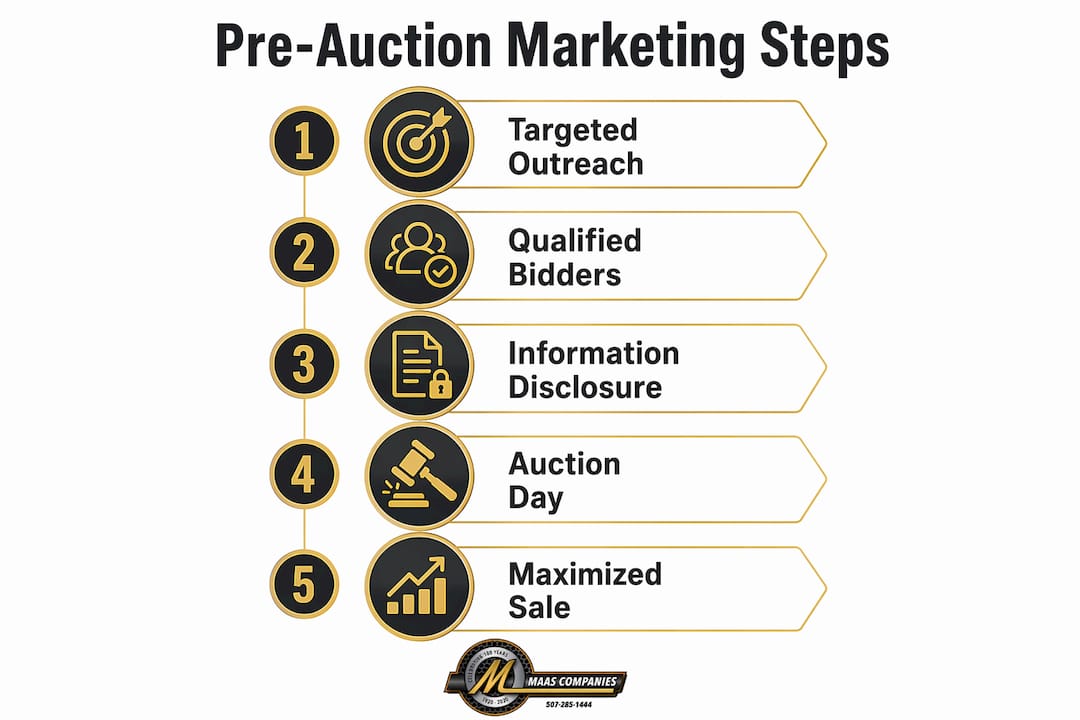
- Pre-auction marketing engages qualified bidders early to create competition and drive prices above estimates. It expands market thickness, reduces bidder uncertainty, and attracts high-valuation buyers through targeted disclosures and multi-channel outreach. Effective campaigns start 8 to 12 weeks before auction, measured by registered bidders and inspection requests that predict final prices.
Pre-auction marketing is the targeted process of engaging qualified bidders before auction day to build competition and maximize realized prices. For asset management professionals overseeing industrial plant closures, equipment liquidations, or capital recovery programs, the decision to conduct pre-auction marketing is not optional. It is the primary lever that determines whether a sale clears at estimate or exceeds it. Research confirms that attracting multiple serious bidders through pre-sale promotion creates the competitive pressure that drives hammer prices above stated estimates. Without that preparation, auction day becomes a passive event rather than a managed outcome.
How does pre-auction marketing increase competition and final sale prices?
The economic logic of auction pricing is straightforward: hammer prices rise when more qualified bidders compete for the same asset. Pre-auction marketing expands what auction economists call “market thickness,” the density of serious, prepared buyers who show up ready to bid. A thin market, where only one or two bidders participate, produces prices that reflect the floor of buyer interest. A thick market, where five or more qualified bidders compete, produces prices that reflect the ceiling.
Estimates are starting points; pre-sale marketing builds the competitive participation that determines final prices above those estimates. This is not a theoretical claim. It reflects how auction psychology operates in practice: bidders who have been engaged, informed, and prepared before the event arrive with higher confidence and stronger intent to win. That intent translates directly into bid increments.
Research in fine art auction markets demonstrates that marketing expands participation in ways that disproportionately elevate top-end sale prices. The highest bids come from the highest-valuation buyers, and those buyers only participate if they know about the auction, trust the asset information, and have had time to conduct due diligence. Pre-auction marketing is the mechanism that brings them into the process.
“The goal of pre-auction marketing is not awareness for its own sake. It is the deliberate construction of a competitive buying environment where high-valuation bidders arrive prepared and motivated.”
Pro Tip: Track registered bidder counts and inspection requests as leading indicators of auction competitiveness. These metrics predict final prices more reliably than raw impression counts or website traffic.
For asset managers running industrial asset sales, the implication is direct: every dollar spent on qualified bidder outreach before the auction date has a measurable return in final sale price.
What types of information and disclosures are most impactful in pre-auction marketing?
The quality of information provided before an auction determines how confidently buyers bid. Bidder uncertainty is the primary suppressor of final prices. When buyers cannot assess condition, provenance, or operational history, they discount their bids to account for perceived risk. Comprehensive pre-auction disclosures eliminate that discount.
A 2026 study of eBay auctions found that photo disclosure most strongly influences auction outcomes through bidder participation rather than price increases alone. More photos and richer descriptions bring more bidders into the process, and more bidders produce higher closing prices. The mechanism is bidder entry, not individual valuation shifts. This distinction matters for budget allocation: spending on high-quality asset documentation yields better returns than spending on broad advertising.
The most impactful pre-auction marketing content types include:
- Condition reports and defect disclosures: Structured documentation of asset condition reduces buyer uncertainty and prevents post-sale disputes. Buyers bid higher when they know exactly what they are acquiring.
- High-resolution photography and video walkthroughs: Visual media allows remote buyers to conduct preliminary due diligence without a site visit, expanding the geographic reach of the qualified bidder pool.
- Provenance and operational history documentation: For industrial equipment, service records, maintenance logs, and prior ownership history provide the context buyers need to assess residual value.
- Expert valuations and reserve guidance: Analysis of 57,000 listings showed that higher expert estimates raised prices and influenced seller behavior toward fewer reserve prices, enhancing overall market efficiency.
- Auction packs and due diligence packages: Consolidated information packages reduce friction for serious buyers and signal that the seller is organized and transparent.
| Information Type | Primary Effect on Auction Outcome |
|---|---|
| High-resolution photos | Increases bidder entry and participation rates |
| Condition and defect reports | Reduces buyer risk discount on bids |
| Expert valuations | Builds trust and reduces seller reserve reliance |
| Provenance documentation | Expands qualified buyer pool for specialized assets |
| Auction packs | Reduces friction and accelerates buyer due diligence |
Pro Tip: For unique or specialized industrial assets, prioritize provenance documentation and operational records over generic advertising. Buyers of specialized equipment make decisions based on technical data, not marketing copy.

The difference between standardized and unique assets matters here. Standardized equipment, such as common CNC machines or forklifts, benefits from competitive pricing data and condition grading. Unique assets, such as a 3-MGY biodiesel plant or a specialized processing facility, require deeper technical disclosure to attract the narrow pool of buyers capable of evaluating and operating them.
Traditional outreach vs. digital and multi-channel pre-auction strategies
Pre-auction marketing strategies fall into two broad categories: traditional outreach and digital or multi-channel approaches. Neither category alone produces optimal results. The most effective campaigns combine both, using each channel’s strengths to reach different segments of the qualified buyer pool.
Traditional methods retain significant value in industrial asset sales. Printed catalogs distributed to industry contacts provide a tangible reference that buyers return to during due diligence. Preview events and on-site inspections allow buyers to assess equipment condition directly, which is particularly important for high-value or complex assets. Email newsletters sent to curated industry lists reach buyers who are not active on social media but are actively managing capital budgets.
Digital strategies extend reach and build anticipation at lower cost per contact. Social media teasers on platforms like LinkedIn reach financial professionals and operations executives who may not be on traditional auction mailing lists. Online preview platforms allow buyers in other regions or countries to conduct preliminary assessments without travel costs. Video highlights of key assets, particularly for plant closures involving multiple equipment categories, give buyers a structured overview that accelerates their decision to register.
The principle underlying multi-channel effectiveness is the Rule of Six. Repeated buyer exposure through email, social media, websites, and physical catalogs creates buyer anticipation and readiness to bid. Buyers need to encounter an auction opportunity multiple times before they commit to registering and preparing a bid. A single email announcement rarely produces the engagement that a staged, multi-touchpoint campaign achieves.
A structured multi-channel campaign for an industrial auction might follow this sequence:
- Six to eight weeks out: Distribute initial announcement to curated industry contact lists and post asset highlights on LinkedIn and relevant industry forums.
- Four to six weeks out: Release detailed auction packs, condition reports, and high-resolution photo galleries through the auction platform and email follow-up.
- Two to four weeks out: Host preview events or virtual walkthroughs for registered bidders. Send reminder communications to all contacts who opened prior emails.
- One to two weeks out: Final push communications emphasizing registration deadlines, bidding procedures, and key asset highlights.
- Auction week: Day-of reminders, bidding instructions, and last-minute engagement for registered participants.
This staged approach mirrors how auction marketing companies structure campaigns for plant closures and equipment liquidations, where the buyer pool is specialized and requires sustained engagement to convert interest into active bidding.
How to measure and optimize pre-auction marketing effectiveness
Asset managers who treat pre-auction marketing as a cost center rather than a revenue driver miss the opportunity to optimize it. Measuring the right metrics separates campaigns that generate qualified competition from those that generate only impressions.
The metrics that matter most are:
- Registered bidder count: The number of buyers who complete registration is the clearest leading indicator of auction competitiveness. More registered bidders mean more potential competition on auction day.
- Auction pack downloads and due diligence requests: Buyers who download condition reports and request additional documentation are conducting serious pre-purchase analysis. These are the buyers most likely to bid at or above estimate.
- Inquiry volume and quality: The number of inbound questions about specific assets, and the technical sophistication of those questions, indicates whether the marketing is reaching qualified buyers or generating casual interest.
- Preview event attendance: Physical or virtual attendance at preview events signals buyer intent. Buyers who invest time in due diligence are buyers who plan to bid.
Disclosure drives auction outcomes by boosting bidder entry and market thickness, not just by shifting individual bidder valuations. This means budget optimization should prioritize content that converts interested parties into registered, prepared bidders. Condition reports, technical specifications, and high-quality visual media yield higher returns than broad digital advertising with no targeting.
Common pitfalls in pre-auction marketing include starting outreach too late, targeting too broadly without filtering for qualified buyers, and underinvesting in asset documentation while overspending on generic promotion. Asset managers following a structured pre-auction selling checklist avoid these errors by building documentation and outreach timelines into the overall auction preparation process.
Pro Tip: Compare registered bidder counts across successive auctions to identify which outreach channels and content types drive the highest-quality engagement. This longitudinal data is more valuable than any single campaign metric.
Key takeaways
Effective pre-auction marketing requires targeted information disclosure, multi-channel outreach, and qualified bidder engagement to consistently produce sale prices above estimate.
| Point | Details |
|---|---|
| Market thickness drives prices | More qualified registered bidders produce higher hammer prices through direct competition. |
| Information quality reduces risk discounts | Condition reports, photos, and provenance documentation eliminate the uncertainty that suppresses bids. |
| Expert valuations build trust | Higher expert estimates increase buyer confidence and reduce seller reliance on reserve prices. |
| Multi-channel campaigns outperform single-channel | Staged outreach across email, digital, and physical channels converts interest into active bidder registration. |
| Measure qualified engagement, not raw exposure | Registered bidder counts and due diligence requests predict auction outcomes better than impression metrics. |
What I have learned from managing pre-auction campaigns for industrial assets
After working through numerous industrial plant closures and equipment liquidations, the pattern that stands out most clearly is this: sellers who invest in pre-auction marketing as a preparation discipline, not a promotional afterthought, consistently outperform those who treat it as optional.
The buyers who drive the highest hammer prices in industrial auctions are not casual participants. They are operations executives, equipment dealers, and capital allocators who need time to evaluate assets, secure financing, and obtain internal approvals before they can bid. A campaign that starts four weeks before auction day does not give those buyers enough runway. The campaigns that produce the best outcomes start eight to twelve weeks out and build systematically through each phase of buyer engagement.
What has also become clear is that buyer expectations for transparency have shifted. Buyers now expect digital access to condition reports, high-resolution imagery, and operational documentation before they commit to traveling for a preview or registering to bid. Sellers who provide that level of disclosure attract more serious buyers. Sellers who withhold it face thinner markets and lower realized prices.
The practical advice is direct: treat your pre-auction marketing budget as an investment in the quality of your buyer pool, not a line item to minimize. Allocate the majority of that budget to asset documentation and targeted outreach to qualified industry contacts. The return on that investment shows up in the final hammer price.
— Vector
How Maascompanies supports sellers with expert pre-auction marketing
Maascompanies brings decades of experience in marketing industrial plants, equipment, real estate, and commercial properties to buyers worldwide. For CFOs and operations leaders managing asset disposition under time and budget constraints, Maascompanies provides the structured pre-auction marketing campaigns that build qualified bidder pools and maximize recovery.
From condition documentation and auction pack preparation to multi-channel outreach targeting industry-specific buyer networks, Maascompanies manages the full pre-sale marketing process. The firm’s auction and brokerage services are designed for sellers who need results, not just activity. Asset managers seeking a strategic partner for their next industrial auction or plant closure can review Maascompanies’ full services portfolio to understand how pre-auction marketing integrates with the broader disposition strategy.
FAQ
What is pre-auction marketing?
Pre-auction marketing is the targeted process of engaging qualified buyers before an auction through information disclosure, outreach campaigns, and preview events to build competition and maximize final sale prices.
Why does pre-auction marketing increase sale prices?
Pre-auction marketing increases sale prices by expanding the pool of qualified bidders who compete on auction day. More competition among prepared buyers drives hammer prices above stated estimates.
What information should be included in pre-auction marketing materials?
The highest-impact materials include condition reports, defect disclosures, high-resolution photography, provenance documentation, and expert valuations. These reduce buyer uncertainty and encourage confident bidding at higher price levels.
How early should pre-auction marketing begin?
For industrial assets and plant closures, pre-auction marketing should begin eight to twelve weeks before the auction date. This timeline gives qualified buyers sufficient time to conduct due diligence, secure financing, and obtain internal approvals before bidding.
How do you measure pre-auction marketing success?
Success is measured through registered bidder counts, auction pack downloads, inspection requests, and preview event attendance. These metrics reflect qualified bidder engagement and predict auction competitiveness more accurately than raw impression or reach data.
Recommended
- Top reasons to buy at auction: maximize value & cut risk | Blog | Insights on Asset Liquidation and Auction Trends
- Auction strategies for small businesses: Maximize asset recovery | Blog | Insights on Asset Liquidation and Auction Trends
- Plan Better Industrial Closures With Expert Auction Help | Blog | Insights on Asset Liquidation and Auction Trends
- Commercial Real Estate Auctions Speed Up Sales | Blog | Insights on Asset Liquidation and Auction Trends