
Blog
Why Monetize Idle Equipment: A Recovery Guide for Decision-Makers

TL;DR:
- Monetizing idle equipment transforms unused machinery into revenue-generating assets, reducing costs and increasing profitability. Effective programs involve dedicated management, real-time tracking, and strategic selection of rental, leasing, or sale methods based on asset condition and market demand. Engaging early with experienced asset recovery partners maximizes total recovery value during operational transitions.
Monetizing idle equipment is the process of converting underutilized or unused machinery into productive assets that generate ongoing revenue while reducing carrying costs. For industrial and corporate decision-makers, this is not a secondary consideration. It is a direct response to a measurable financial problem: manufacturers routinely operate at 60–70% capacity utilization, meaning a significant portion of the asset base sits dormant while still accumulating costs. The financial case for acting on idle assets is clear, and the methods to do so are well established.
Why monetize idle equipment: the financial case
Idle equipment does not simply sit still. It generates costs every day it remains unused. Carrying costs include insurance, storage, maintenance, and depreciation, and these expenses compound over time without producing any offsetting revenue. The result is a direct drag on profitability that shows up in financial reporting whether or not leadership acknowledges the root cause.
The impact extends beyond the income statement. Idle assets reduce fixed asset turnover, a ratio lenders and investors use to assess how efficiently a company deploys its capital base. A low fixed asset turnover signals poor capital discipline. Return on invested capital (ROIC) also suffers when capital is tied up in machinery that produces no output. Both metrics matter during financing events, restructuring reviews, and M&A due diligence.
The opportunity cost compounds the problem further. Capital locked in idle machinery cannot be redeployed into growth, debt reduction, or working capital. For companies managing operational transitions, this is a critical constraint. Every month an asset sits idle, the window to recover full value narrows as depreciation continues and market demand for that equipment type shifts.
The good news is that the marginal cost of serving external users on already paid-for assets is near zero. Revenue generated from renting or leasing idle equipment flows almost entirely to gross profit. That economic reality makes equipment monetization one of the highest-return initiatives available to operations and finance leaders.
What are the most effective strategies to monetize unused machinery?

The right monetization method depends on how long the equipment will remain idle, its condition, and the company’s operational capacity to manage external relationships. The four primary approaches each carry distinct financial and operational profiles.
Rental and leasing programs
Renting idle equipment to external parties generates continuous income without transferring ownership. Rental programs can offset 30–60% of total annual equipment costs, and in high-demand periods, that figure can exceed 100%. This approach works best for equipment with broad market demand, such as heavy construction machinery, processing equipment, and specialized manufacturing tools. For agricultural operations, renting out idle agricultural equipment follows the same economic logic and is a growing practice across the sector.
Leasing differs from rental in duration and structure. A lease agreement typically runs for a fixed term with defined payment schedules, providing more predictable cash flow. Leasing also transfers some maintenance responsibility to the lessee, reducing the lessor’s carrying costs during the agreement period.
Subcontracting and contract manufacturing
Companies with idle production capacity can offer that capacity to third parties through subcontracting or contract manufacturing arrangements. This approach monetizes both the equipment and the facility simultaneously. It requires more operational coordination than a simple rental, but it can generate substantially higher revenue per asset hour.
Asset liquidation
Selling assets that remain idle beyond 12–18 months allows companies to reinvest the proceeds and may produce tax-deductible losses that improve the overall financial position. Liquidation is the appropriate choice when there is no credible plan to return the equipment to productive use. Waiting too long reduces recoverable value as the asset depreciates and market conditions change. Coordinating a sale through a structured auction or brokerage process, as outlined in equipment remarketing channels, typically produces better recovery than a direct private sale.
Repurposing for new product lines
Some equipment can be reconfigured or redeployed for a different production application within the same organization. This approach avoids the transaction costs of an external sale and keeps the asset on the balance sheet at productive value. It requires engineering assessment and capital investment, so it suits situations where the new application has a confirmed demand and the modification cost is justified by projected output.
Pro Tip: Before committing to any single monetization method, conduct a formal asset utilization audit. Document current utilization rates, maintenance costs, and market rental rates for comparable equipment. That data set will determine which approach produces the highest net recovery.
How should companies structure an equipment monetization program?
Treating equipment monetization as an ad hoc activity produces inconsistent results. Successful monetization requires dedicated management similar to core business units, with tracking, dispatch, and proactive availability management built into the operating model. Companies that assign this function to an existing team as a secondary responsibility consistently underperform against those that treat it as a distinct business line.
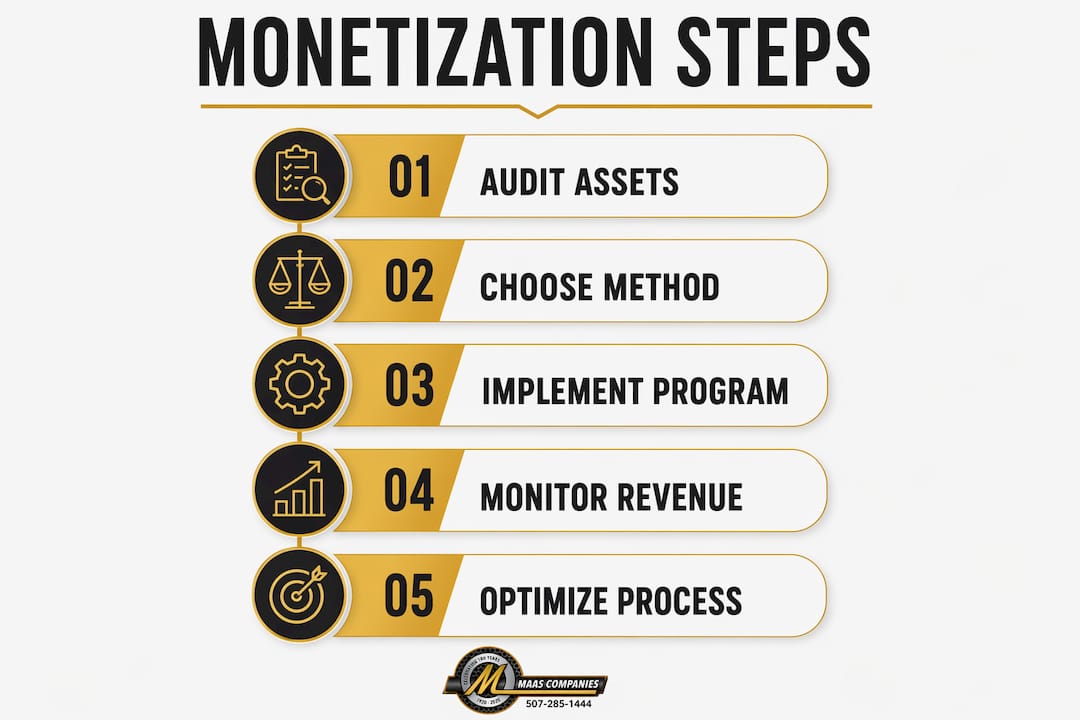
A well-structured program includes the following operational elements:
- Dedicated profit and loss tracking. Assign revenue and costs to each asset or asset group. This creates accountability and enables accurate ROI measurement at the individual equipment level.
- Real-time utilization tracking. Implement systems that record when each asset is in use, by whom, and at what rate. Tracking rental income per asset and utilization rates enables informed capital planning and accurate ROI projections.
- Billing automation and contract management. Manual billing creates revenue leakage and disputes. Automated systems tied to utilization data reduce errors and accelerate cash collection.
- Centralized dispatching. A single point of coordination for all external equipment requests prevents scheduling conflicts and ensures that internal production needs take priority over external commitments.
- Governance and compliance controls. External use of company assets creates liability exposure. Insurance coverage, maintenance standards, and chain-of-custody documentation must be formalized before any external deployment.
Implementing equipment monetization requires systems integration, including real-time tracking, billing automation, and centralized dispatching to prevent revenue loss and operational risk. Companies that skip this infrastructure investment typically recover less revenue and face higher operational risk than those that build the program correctly from the start.
Pro Tip: Assign a dedicated program manager to the monetization function from day one. This person owns the P&L, manages external relationships, and reports results to senior leadership on a monthly basis. Without clear ownership, the program will drift.
How does equipment monetization fit into broader asset recovery strategies?
Equipment monetization becomes most critical during operational transitions: plant closures, restructuring events, portfolio rationalization, and financial distress situations. In these contexts, the goal shifts from generating ongoing income to maximizing total recovery value within a defined timeline. The two objectives require different tactics but share the same analytical foundation.
During a plant closure or restructuring, the asset recovery process typically involves several parallel workstreams:
- Inventory and valuation. Conduct a complete physical inventory of all equipment, with condition assessments and fair market value estimates. This establishes the recovery baseline and informs the monetization sequence.
- Triage by recovery method. Classify each asset by the method most likely to produce the highest net recovery: rental, direct sale, auction, or scrap. Assets with active market demand go to auction or brokerage. Specialized equipment with a narrow buyer pool may require targeted marketing to industry-specific buyers.
- Sequencing and timeline management. Auction timelines, lease wind-downs, and direct sale negotiations must be coordinated to avoid conflicts and ensure that the highest-value assets receive the most marketing attention.
- Lender and investor communication. Improved asset utilization and documented recovery plans directly affect lender confidence during restructuring negotiations. A credible monetization plan, supported by utilization data and market valuations, strengthens the company’s position in those discussions.
Monetizing idle equipment through structured marketing produces materially better outcomes than reactive, uncoordinated disposal. Companies that engage experienced asset recovery partners early in the transition process consistently recover more value than those that wait until operational pressure forces a distressed sale.
External equipment rentals create new revenue streams and reduce reliance on third-party rentals, improving operational efficiency even during wind-down periods. That efficiency gain can offset transition costs and reduce the net financial impact of the closure or restructuring event.
Key Takeaways
Monetizing idle equipment is the single most direct way to convert a cost-generating asset into a revenue-producing one, and the financial impact compounds quickly when the program is managed with operational discipline.
| Point | Details |
|---|---|
| Idle equipment carries real costs | Insurance, storage, maintenance, and depreciation accumulate daily, reducing profitability and key financial ratios. |
| Rental programs produce high returns | Rental income can offset 30–60% of annual equipment costs, with near-zero marginal cost on already-owned assets. |
| Method selection drives recovery | Choose between rental, leasing, subcontracting, liquidation, or repurposing based on idle duration and market demand. |
| Program structure determines results | Dedicated P&L tracking, real-time utilization data, and centralized dispatch are required for consistent revenue generation. |
| Transitions require coordinated recovery | During restructuring or closures, triage assets by recovery method and engage experienced partners early to maximize total value. |
The underestimated cost of doing nothing
The most common mistake I see in industrial asset management is treating idle equipment as a neutral condition. Decision-makers often classify it as “available capacity” and move on. That framing is incorrect and expensive. Idle equipment is a liability with a daily cost, and every month without a monetization plan is a month of recoverable value lost to depreciation and market drift.
The second mistake is treating monetization as a one-time transaction rather than a managed program. Companies that rent out a piece of equipment once, collect the revenue, and return to informal management capture a fraction of the available return. The organizations that build structured programs, with dedicated oversight, real-time tracking, and formal governance, consistently outperform on recovery metrics. The discipline required is not extraordinary. It mirrors what any well-run business unit requires: clear ownership, defined metrics, and regular reporting.
The third mistake is waiting too long to engage external expertise during transitions. Asset values are time-sensitive. A plant closure that triggers a 90-day liquidation timeline produces worse outcomes than one that begins the recovery process 12 months in advance. The gap in recovery value between early and late engagement is significant, and it is entirely avoidable.
— Vector
Maascompanies: a partner for equipment monetization and asset recovery
Maascompanies brings decades of experience in industrial asset recovery, auction management, and equipment brokerage to clients facing operational transitions and excess asset situations.
Whether you are managing a plant closure, rationalizing a production portfolio, or looking to sell industrial equipment through a structured auction or brokerage process, Maascompanies provides the marketing reach, industry expertise, and process discipline to maximize your recovery. The firm’s full services portfolio covers everything from initial asset valuation through final disposition, with a track record that includes large-scale industrial facilities, processing plants, and surplus equipment across multiple sectors. Contact Maascompanies to discuss your asset recovery objectives and receive a recovery plan tailored to your timeline and asset profile.
FAQ
Why monetize idle equipment instead of storing it?
Idle equipment accumulates carrying costs including insurance, maintenance, and depreciation every day it sits unused. Monetizing through rental, leasing, or sale converts those costs into revenue and improves key financial ratios.
What is the fastest way to generate income from unused machinery?
Short-term rental agreements produce income the fastest, often within days of listing, and can offset 30–60% of annual equipment costs without requiring an ownership transfer.
When should a company sell rather than rent idle equipment?
Assets idle for more than 12–18 months are strong candidates for sale. Prolonged idleness increases depreciation and reduces market value, making liquidation more financially sound than continued storage.
How does equipment monetization affect financial reporting?
Rental and lease income improves fixed asset turnover and ROIC, two metrics that lenders and investors use to evaluate capital efficiency. A formal monetization program also reduces the carrying cost burden on the income statement.
What role does Maascompanies play in equipment monetization?
Maascompanies provides auction, brokerage, and marketing services that connect sellers of idle industrial equipment with qualified buyers, maximizing recovery value during operational transitions and plant closures.
Recommended
- How to Market Idle Equipment for Maximum Recovery | Blog | Insights on Asset Liquidation and Auction Trends
- Industrial equipment buying checklist: maximize asset recovery | Blog | Insights on Asset Liquidation and Auction Trends
- Equipment Liquidation Workflow: Maximize Asset Recovery | Blog | Insights on Asset Liquidation and Auction Trends
- Industrial Equipment Value Explained for Decision-Makers | Blog | Insights on Asset Liquidation and Auction Trends