

Blog
Estate Auctions Los Angeles: A Guide for Institutional Sellers

TL;DR:
- A targeted auction approach involving institutional channels and full documentation yields better recovery for industrial and commercial assets in Los Angeles.
- County tax-auction sales are irrevocable once completed, requiring careful legal and financial planning beforehand.
For most corporate, lender, and government clients disposing of industrial or commercial assets in Los Angeles, the right approach is a B2B-focused auction partner that combines targeted bidder acquisition, institutional disposal channels such as LACoMAX, and full documentation — not a consumer estate listing platform.
The distinction matters. Auction success for institutional assets is primarily marketing-driven: the sale event is the final conversion of an aggressive campaign aimed at qualified commercial and trade buyers. Placing industrial equipment or commercial property on a consumer-facing estate sales site leaves recovery on the table and creates compliance exposure.
Table of Contents
- What does the end-to-end timeline look like for institutional asset sales?
- What are the total costs in a Los Angeles institutional auction?
- Maascompanies: a strategic partner for institutional estate auctions in Los Angeles
When auctions make sense vs. alternative sale formats
Use this checklist before committing to a format:
Auction is appropriate when:
- Trigger event is a plant closure, lender enforcement, bankruptcy, or surplus inventory reduction
- Asset types include industrial equipment, commercial real estate, or tax-defaulted property
- A competitive bidding environment exists among qualified buyers
- Time-to-cash is a priority alongside recovery maximization
Consider sealed-bid or reserve formats when:
- Assets are highly specialized with a narrow buyer pool
- Environmental or title issues require buyer qualification before exposure
- Lender or court approval is required before price acceptance
Prefer an orderly negotiated sale or immediate buyout when:
- Carrying costs exceed the incremental recovery a timed auction would generate
- The asset pool is too small to justify full auction marketing spend
Mandatory operational items before any sale
- Certified appraisals and third-party valuations (documentation quality directly reduces buyer risk premiums and increases qualified bids)
- Detailed condition reports with photographic inventory
- Title search, lien clearance, and environmental screening where applicable
- Insured on-site security and logistics planning for heavy equipment removal
- Bonded-sale permits and any required court or lender authorizations
- Bidder prequalification including deposit thresholds and registration deadlines
Los Angeles County tax-auction mechanics: what institutional sellers must know
The Los Angeles County Treasurer and Tax Collector conducts scheduled online auctions for tax-defaulted property with defined registration windows. Bidding runs through GovEase, the county’s designated platform. The 2026A Terms and Conditions govern minimum-price rules under California Revenue and Taxation Code, bidding increments, deposit requirements, and payment deadlines. Critically, there is no extended right of redemption on tax-defaulted sales, making these transactions irrevocable once completed. Institutional sellers and counsel should budget legal and title-curing costs into net-recovery forecasts before the auction window opens.
| Fee Item | Detail |
|---|---|
| City transfer taxes | Vary by municipality; confirm before listing |
| GovEase registration | Required before bidding opens |
Pro Tip: Request a multi-modal proposal that models projected gross recovery under (A) traditional auction, (B) sealed-bid paired with negotiated sale, and © immediate buyout — with explicit time-to-cash and net-recovery assumptions for each.
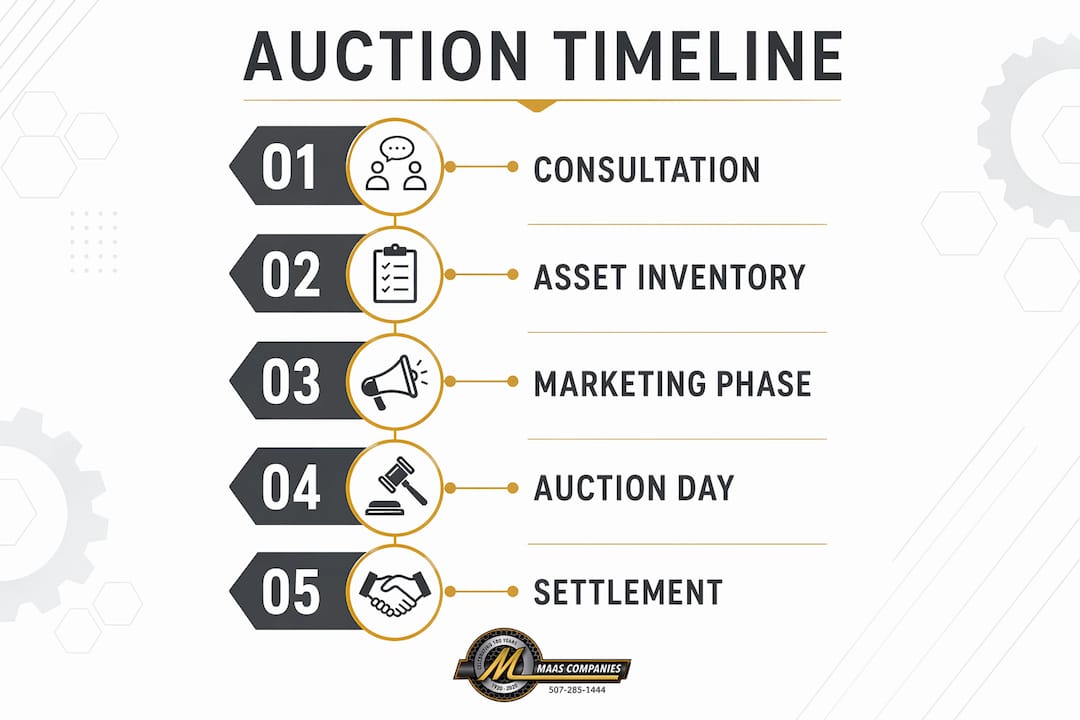
What does the end-to-end timeline look like for institutional asset sales?
A well-managed institutional auction in Los Angeles typically runs across five phases:
- Asset evaluation and inventory (weeks 1–2): On-site inspection, certified appraisals, condition reporting, and environmental screening.
- Title and compliance clearance (weeks 2–4): Lien searches, permit verification, bonded-sale authorizations, and court or lender approvals where required.
- Marketing and bidder acquisition (weeks 3–8): Targeted outreach to qualified commercial buyers, trade publications, and institutional channels. Proven marketing tactics at this stage determine final recovery more than any other variable.
- Auction or sale event (day of): Bidder registration confirmed, deposits collected, bidding conducted, and winning bids accepted per agreed terms.
- Settlement and transfer (days 1–30 post-sale): Invoice issuance, payment collection within defined deadlines, title transfer, and final accounting to the seller.
For industrial plant or heavy-equipment dispositions, bundling logistics and secure removal planning into the auction scope prevents post-sale disputes and accelerates final settlement. County tax-auction payment deadlines are strict; institutional sellers should confirm settlement windows with counsel before the sale date.
What are the total costs in a Los Angeles institutional auction?
Cost transparency is a prerequisite for accurate net-recovery modeling. The table below covers the primary cost categories institutional sellers encounter.

| Cost Category | Typical Range / Structure |
|---|---|
| Auction commission (seller-side) | Negotiated; commission-based on gross proceeds |
| Buyer premium | Varies by auction format and asset type |
| Appraisal and condition reporting | Third-party fee; varies by asset complexity |
| Title search and lien clearance | Legal/title company fee per property |
| Environmental screening | Phase I or Phase II cost; varies by site |
| On-site security and logistics | Scope-dependent; included or itemized |
| Survey monument fee | — (county auctions) |
| Legal and compliance counsel | Budgeted separately; required for court-ordered sales |
Hidden costs that frequently compress net recovery include city-level transfer taxes (which vary by municipality across Los Angeles County), environmental remediation holdbacks, and post-sale removal disputes when logistics were not scoped upfront. Payment terms and settlement deadlines should be confirmed in writing before the auction is marketed; county tax-auction terms require strict adherence to deposit and payment windows with no grace period.
For industrial real estate liquidations, the full cost picture — including carrying costs during the marketing period — should be modeled against projected gross recovery to determine whether a timed auction, sealed bid, or negotiated sale produces the best net outcome.
Maascompanies: a strategic partner for institutional estate auctions in Los Angeles
Maascompanies is the institutional asset recovery partner for corporate, lender, and government clients who need more than a listing service. Maas Companies Inc. manages the full scope of industrial plant, equipment, and commercial property liquidations — from certified appraisals and targeted bidder acquisition to compliance management, title coordination, and institutional channel engagement including LACoMAX where applicable. The firm’s commission-based model aligns its recovery objectives directly with yours.
What to expect in an engagement: an initial consultation to assess asset inventory and trigger conditions, followed by a transparent fee proposal that models recovery across sale formats. Clients should have ready an inventory list, available titles, and any existing environmental reports. Maascompanies’s full services portfolio covers auction, orderly negotiated sale, and immediate buyout options across manufacturing, energy, hospitality, healthcare, and commercial real estate sectors.
To start a conversation about your disposition, visit the looking to sell page. Typical response time is one business day.
This article provides general information about institutional auction processes in Los Angeles and does not constitute legal, financial, or regulatory advice. Confirm current rules, fee schedules, and compliance requirements with qualified legal counsel and the relevant county or state authority for your specific situation.
Recommended
- Auction catalogs: The key to distressed asset liquidation | Blog | Insights on Asset Liquidation and Auction Trends
- Real estate auctions: Fast liquidation for industrial assets | Blog | Insights on Asset Liquidation and Auction Trends
- Step-by-step asset auction guide for maximizing recovery | Blog | Insights on Asset Liquidation and Auction Trends
- How to Navigate Commercial Property Foreclosure Sales | Blog | Insights on Asset Liquidation and Auction Trends