

Blog
Value Commercial Property for Strategic Asset Recovery

TL;DR:
- Accurate commercial property valuation relies on forward-looking income analysis and multiple methods to ensure reliability.
- Key factors include tenant quality, environmental issues, market timing, and development potential, which significantly influence recovery value.
Accurate commercial property valuation for asset recovery starts with one metric above all others: 1-year forward Net Operating Income (NOI). That single figure, divided by a market-derived capitalization rate, produces the income capitalization value that lenders, buyers, and courts rely on. But no single method is sufficient on its own.
A defensible valuation for liquidation purposes requires:
- Income capitalization: Forward NOI divided by cap rate, with emphasis on income stability and tenant credit quality
- Discounted Cash Flow (DCF): Projects multi-year cash flows to capture long-term risk, lease rollover exposure, and capital expenditure requirements
- Cost approach: Calculates replacement or reproduction cost minus depreciation, plus land value — most relevant for special-purpose industrial facilities
- Sales comparison: Benchmarks value against recent comparable transactions, adjusted for location, condition, and lease terms
- Independent appraisal: Third-party review incorporating environmental liabilities, zoning compliance, and obsolescence factors that internal analyses routinely miss
Lease and tenant analysis sits at the center of all four methods. A building with a creditworthy anchor tenant on a long-term net lease is a fundamentally different asset than the same structure with month-to-month occupancy, regardless of physical condition.
Table of Contents
- Commercial property valuation methods every executive should understand
- Critical non-structural factors that determine what a property is worth
- How to conduct a commercial property valuation for asset recovery
- Timing and pricing strategy for commercial property liquidation
- How to incorporate future development potential into your valuation
- Working with Maascompanies on commercial asset recovery
- Key Takeaways
Commercial property valuation methods every executive should understand
The three primary commercial property appraisal approaches each answer a different question about value. Understanding when to apply each one, and how they interact, is what separates a defensible recovery valuation from an estimate that falls apart under scrutiny.
Income capitalization approach
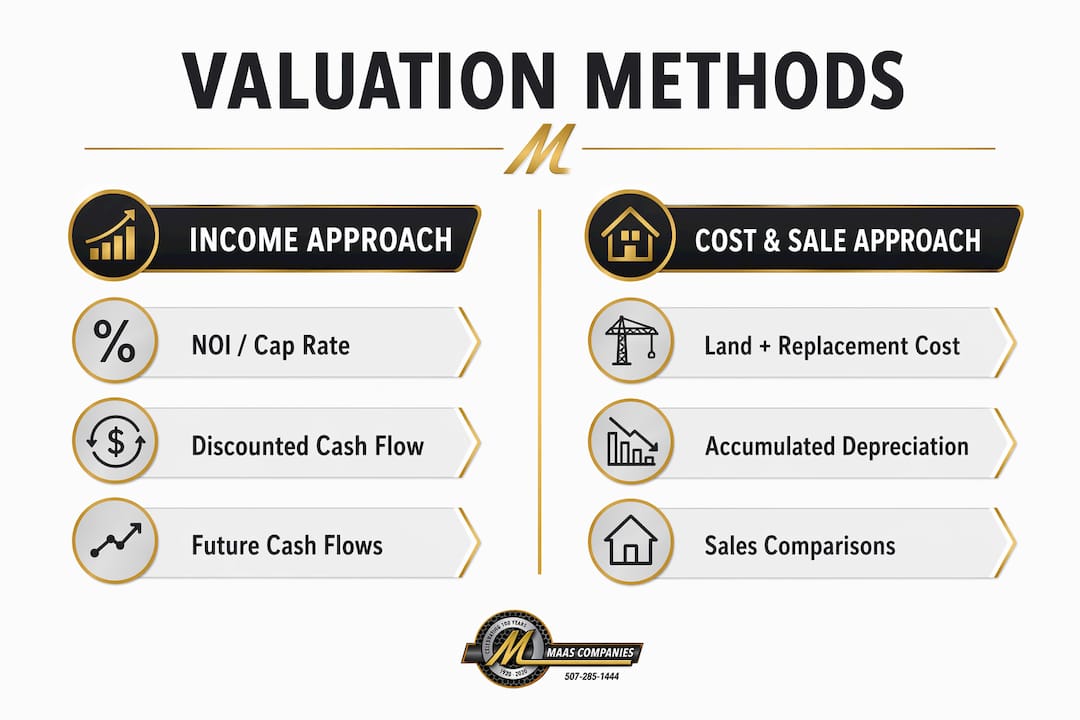
The income approach determines value through the formula: Property Value = NOI / Cap Rate. For an industrial warehouse generating NOI against a typical market cap rate, the valuation is calculated by dividing NOI by the cap rate. The cap rate itself must come from verified local comparable sales, not national averages. Applying a cap rate from a different market or property class can shift value by hundreds of thousands of dollars on a single asset.
DCF analysis goes further by projecting cash flows across the full holding period, discounting them to present value. It captures lease rollover risk, anticipated capital expenditures, and tenant creditworthiness in ways a single-year cap rate snapshot cannot. Sophisticated buyers and lenders increasingly prefer DCF for industrial and multi-tenant commercial assets precisely because it reflects future investment reality rather than a point-in-time income figure.
Cost approach
The cost approach formula is: Property Value = Land Value + Replacement Cost − Accumulated Depreciation. It distinguishes between reproduction cost (an exact replica using original materials) and replacement cost (a modern functional equivalent), and that distinction matters for older industrial plants where original construction methods are no longer standard. This method is most applicable when comparable sales are scarce, for special-purpose facilities, or for insurance valuation purposes.
Sales comparison approach
The market approach benchmarks value against recent sales of comparable properties, adjusted for differences in location, condition, age, parking, and lease terms. For a 15,000-square-foot retail strip center, adjusted comps might produce a value range of $148–$158 per square foot. The method is most reliable in active markets with frequent transactions; for unique industrial facilities or rural commercial properties, comparable data is often too thin to support it as a primary method.
Key metrics to track across all three approaches:
- Net Operating Income (NOI): Gross income minus operating expenses, excluding debt service
- Capitalization rate: NOI divided by property value, reflecting market return expectations
- Debt Service Coverage Ratio (DSCR): Most commercial lenders require a DSCR between 1.20x and 1.30x to confirm sufficient cash flow cushion
- Gross Rent Multiplier (GRM): Property price divided by annual gross rental income; useful for quick screening but does not account for vacancy or expenses
Critical non-structural factors that determine what a property is worth
Physical condition is only one dimension of commercial property value. For industrial plants and multi-tenant commercial assets, the factors below often carry more weight in determining recovery potential.
Tenant quality and lease structure directly set the income stream that drives income capitalization value. A tenant with investment-grade credit on a 10-year triple-net lease commands a lower cap rate (higher value) than a speculative tenant on a short-term gross lease. Lease provisions matter too: rent escalation clauses, expense responsibility (gross vs. net), and renewal options all affect projected cash flow and, by extension, what a buyer will pay.
Infrastructure, accessibility, and demographics shape tenant demand and long-term liquidity. Properties in growing industrial corridors with highway access, rail connectivity, or proximity to distribution hubs carry measurable premiums over comparable structures in declining or isolated markets. These factors are not speculative; they show up in cap rate differentials and in the depth of the buyer pool at auction.
Environmental liabilities and zoning constraints can materially reduce appraised value or block a transaction entirely. Zoning violations, contamination, and deferred maintenance are among the most common reasons asset recovery deals fail to close at expected prices. A Phase I Environmental Site Assessment is standard practice before any commercial disposition; further assessments may be required if recognized environmental conditions are identified. Zoning non-conformities, particularly for industrial properties repurposed over time, require legal review before a value can be reliably established.
How to conduct a commercial property valuation for asset recovery
A structured process reduces the risk of mispricing and protects against post-closing disputes. The steps below reflect best practices for property valuation in industrial and commercial liquidation contexts.
-
Assemble the document package. Collect all executed leases, rent rolls, operating statements for the prior two to three years, property tax bills, utility invoices, maintenance contracts, and capital expenditure records. Incomplete documentation is the single most common cause of valuation delays.
-
Reconstruct NOI from verified sources. Seller pro formas frequently overstate income and understate expenses. NOI must be rebuilt from actual lease agreements, tax bills, utility records, and maintenance contracts. Verify every line item independently before applying a cap rate.
-
Conduct a thorough site inspection. Assess structural condition, mechanical and electrical systems, roof, environmental indicators, and deferred maintenance. Quantify remediation costs as a direct deduction from value. Document everything with photographs and written notes.
-
Review tenant credit and lease terms. Pull financial statements or credit reports for anchor tenants. Identify upcoming lease expirations, renewal options, and any co-tenancy clauses that could trigger rent reductions or early termination rights.
-
Apply multiple valuation approaches. Run income capitalization, DCF, cost approach, and sales comparison in parallel. When results converge, confidence in the value is high. When they diverge significantly, investigate the cause before proceeding.
-
Order an independent appraisal. Third-party appraisals are required by most lenders and are essential in litigation, refinancing, and contested liquidation scenarios. The Appraisal Institute sets the professional standards that govern this work in the United States.
-
Stress-test the valuation. Model a downside scenario: one major tenant vacates, market cap rates expand by 50–100 basis points, or an environmental remediation cost materializes. The resulting value floor is the number that matters most in a recovery context.
Pro Tip: When preparing for a commercial liquidation, Maascompanies recommends completing the document package and NOI reconstruction before engaging any buyer or appraiser. Gaps discovered mid-process erode negotiating leverage and extend carrying costs.
Timing and pricing strategy for commercial property liquidation
Market conditions at the time of sale can shift recovery value as significantly as the underlying asset quality. Pricing strategy must account for where the market is in the economic cycle, not just where it was when the property was last appraised.
- Lease expiration timing: A property with leases expiring within 12 months trades at a discount to one with stable long-term occupancy. Where possible, extend or restructure leases before bringing an asset to market.
- Economic cycle positioning: Cap rates expand during credit tightening cycles, compressing values even when NOI holds steady. If a forced sale cannot be avoided in a high-rate environment, pricing must reflect current buyer return expectations, not historical transaction data.
- Environmental and regulatory changes: Pending zoning changes, new environmental regulations, or infrastructure projects can move value in either direction. Monitor local planning commission activity and factor any material changes into the pricing model.
- Auction precedents and liquidation benchmarks: Maascompanies’ experience across industrial plant dispositions confirms that well-prepared assets with clean documentation and verified NOI consistently outperform distressed comparables at auction, often by a meaningful margin.
- Worst-case scenario pricing: Establish a reserve price based on the stress-tested valuation floor, not the optimistic base case. This protects against a failed auction while leaving room for competitive bidding to drive the final price above the floor.
How to incorporate future development potential into your valuation
Redevelopment value is a distinct layer of value that standard income capitalization does not capture. For industrial sites, former manufacturing facilities, and underutilized commercial land, it can represent the largest component of total recovery value.
The starting point is a zoning and entitlement analysis. Confirm what the site is currently permitted for, what uses could be approved through a variance or rezoning, and what the approval timeline and cost would realistically be. A brownfield site with confirmed residential rezoning potential in a supply-constrained market carries a fundamentally different value than the same acreage in a saturated submarket.
The yield-on-cost method is the standard framework for development scenarios. It calculates the ratio of stabilized NOI after development to total project cost, including acquisition, remediation, and construction. The yield-on-cost calculation compares stabilized NOI after development to the total project cost, providing a key metric for development feasibility. Comparing that yield to prevailing market cap rates for the completed product type tells you whether the development premium is real or theoretical.
For industrial real estate specifically, adaptive reuse for logistics, data center conversion, or mixed-use redevelopment has driven significant value premiums in urban and infill locations. These premiums are buyer-specific and depend on entitlement risk, so they should be presented as a range in the valuation rather than a single figure. A conservative base case anchored to current-use income, with a clearly documented upside scenario tied to a specific development path, gives buyers the information they need to bid with confidence.
Working with Maascompanies on commercial asset recovery

Maascompanies brings decades of experience to the marketing and disposition of industrial plants, commercial buildings, and real estate assets across the United States and internationally. When a plant closure, restructuring, or lender-directed liquidation requires a disciplined valuation and a credible path to market, the process matters as much as the asset itself.
From NOI reconstruction and independent appraisal coordination to targeted buyer outreach and auction execution, Maascompanies manages the full recovery process. Executives and operations leaders who need to move a commercial asset efficiently, with maximum recovery and minimum carrying cost exposure, can review available services or contact the team directly to discuss a specific situation.
Key Takeaways
Accurate commercial property valuation for asset recovery requires forward-looking income analysis, multi-method triangulation, and rigorous due diligence on tenant quality, environmental conditions, and market timing.
| Point | Details |
|---|---|
| Lead with forward NOI | Base valuation on 1-year forward Net Operating Income, not historical figures, to reflect actual income potential. |
| Triangulate across methods | Apply income capitalization, DCF, cost approach, and sales comparison together; divergence signals a risk requiring investigation. |
| Verify NOI independently | Reconstruct NOI from leases, tax bills, and maintenance contracts — seller pro formas frequently overstate income. |
| DSCR is a lender threshold | Most commercial lenders require a DSCR between 1.20x and 1.30x; assets below this range face financing constraints that suppress buyer pool depth. |
| Redevelopment value needs its own analysis | Use yield-on-cost modeling to quantify development upside separately from current-use income value. |
Recommended
- How to Market Surplus Assets for Maximum Recovery | Blog | Insights on Asset Liquidation and Auction Trends
- Why assets go to auction: High-recovery strategies explained | Blog | Insights on Asset Liquidation and Auction Trends
- Maximize Asset Recovery: Top Real Estate Liquidation Methods | Blog | Insights on Asset Liquidation and Auction Trends
- Strategic auctioneers: Maximizing asset recovery in sales | Blog | Insights on Asset Liquidation and Auction Trends