

Blog
Maximize auction recovery: The key role of advertising

TL;DR:
- Effective advertising builds competitive pressure and enhances auction recovery for distressed industrial assets.
- Targeted channels like sector-specific portals and direct outreach outperform general platforms in attracting qualified buyers.
- Tracking KPIs such as bidder registrations and asset inquiries allows optimization and improves future auction results.
Auction results for distressed industrial assets are not predetermined by market conditions alone. The advertising strategy behind each sale carries enormous weight, yet it remains one of the most underestimated variables in the liquidation process. Private equity firms and corporate decision-makers who treat advertising as a line-item afterthought routinely leave significant recovery value on the table. This guide examines why strategic advertising is essential to auction outcomes, which channels deliver the strongest results, how to structure campaigns that attract serious bidders, and how to measure performance so each subsequent sale improves on the last.
Table of Contents
- Why advertising is critical in auctions for distressed assets
- Core advertising channels: What works and why in industrial auctions
- Crafting auction advertising that attracts serious buyers
- Measuring success: How to track and optimize auction advertising
- The hidden levers: What most auction advertising strategies miss
- Partner with auction advertising experts for superior results
- Frequently asked questions
Key Takeaways
| Point | Details |
|---|---|
| Advertising drives results | Well-planned auction advertising greatly boosts bidder turnout and asset recovery, especially for distressed industrial sales. |
| Channel selection matters | Choosing the right mix of trade, digital, and direct marketing channels is crucial for reaching the best buyers. |
| Message quality counts | Clear, detailed auction ads build trust and urgency, directly influencing buyer engagement. |
| Measure and optimize | Tracking key performance indicators lets you refine campaigns for even greater auction success over time. |
Why advertising is critical in auctions for distressed assets
To understand how advertising shapes auction outcomes, it’s important to first see why it’s so central, especially for distressed or specialized assets.
Industrial equipment auctions operate in a narrow market. A surplus CNC machining center, a decommissioned packaging line, or a complete biomass processing facility will not attract casual buyers. The universe of qualified purchasers is limited, geographically dispersed, and often unaware that a specific asset is even available. Without targeted advertising, even high-value machinery may generate only a handful of bids, suppressing the final recovery price far below its true market value.
“Marketing efforts are among the most consequential decisions made during the auction process for surplus manufacturing machinery. The difference between a well-advertised sale and a poorly promoted one can be measured directly in final recovery figures.”
The core function of advertising in this context is to build competitive pressure. When multiple qualified buyers know about an asset simultaneously, they compete against one another. That competition drives prices upward. A single motivated buyer with no competition will bid conservatively. Five motivated buyers who each believe they may lose the asset will push the price to its ceiling. Maximizing asset recovery depends almost entirely on creating that competitive environment through deliberate outreach.
Advertising also projects credibility. A professionally executed campaign signals to potential bidders that the seller is organized, the asset information is reliable, and the auction process will be conducted properly. Buyers who might otherwise hesitate to travel or commit resources to an inspection are more likely to engage when the marketing materials are thorough and authoritative.
Common pitfalls in this area include:
- Relying on legacy buyer lists that have not been updated or verified in years
- Using generic auction platforms that lack industry-specific reach
- Launching advertising too late in the timeline, leaving insufficient time for buyers to arrange inspections, financing, or logistics
- Providing minimal asset detail, which forces serious buyers to self-qualify out of the process
Pro Tip: The quality of your buyer pool matters more than the quantity. One hundred unqualified registrations produce worse outcomes than twenty highly motivated, financially capable bidders who have done their due diligence before the auction opens.
Understanding manufacturing optimization trends also helps sellers position assets accurately, since buyers often evaluate surplus equipment in the context of their own production upgrade cycles.
Core advertising channels: What works and why in industrial auctions
With the importance established, let’s dissect which advertising channels consistently deliver results for asset auctions.
Not all channels perform equally for industrial asset sales. The audience is specialized, the purchase decisions are significant, and buyers require detailed technical information before committing. Auction advertising strategies must be calibrated to reach buyers where they actually search for equipment, not simply where advertising is cheapest or most familiar.
The following comparison outlines the primary channels used in industrial auction campaigns:
| Channel | Reach | Cost | Best for | Key limitation |
|---|---|---|---|---|
| Industry-specific portals | High, targeted | Moderate | Niche and high-value equipment | Requires strong listing quality |
| Direct email outreach | Narrow, precise | Low to moderate | Known buyer segments | List quality is critical |
| Trade publications | Broad, qualified | Moderate to high | Sector-wide awareness | Longer lead times required |
| General auction platforms | Very broad | Low | Commodity-grade equipment | Low buyer qualification |
| Social media (LinkedIn) | Broad, filterable | Moderate | Reaching procurement professionals | Lower purchase intent |
| On-site signage and local media | Hyper-local | Low | Walk-in or regional buyers | Limited geographic reach |
For big-ticket or highly specialized equipment, industry-specific portals and direct email outreach to pre-qualified buyer segments consistently outperform general platforms. A buyer searching a sector-specific portal is already in acquisition mode. That intent translates directly into higher-quality bids. Choosing an auction channel correctly is one of the most consequential early decisions in the campaign planning process.
Here is a step-by-step approach for prioritizing channels in an industrial auction campaign:
- Identify the asset category and likely buyer profile. A food processing line attracts different buyers than a metalworking facility. Define the buyer before selecting the channel.
- Map where that buyer type actively searches. Industry associations, trade publications, and sector-specific portals are the primary discovery points for serious industrial buyers.
- Layer direct outreach on top of passive advertising. Email campaigns to curated lists of known buyers in the relevant sector add precision that broad advertising cannot replicate.
- Supplement with digital advertising on LinkedIn to reach procurement managers and plant engineers who may not be actively searching but would respond to a targeted opportunity.
- Confirm timing for each channel. Trade publications require longer lead times. Email campaigns can launch quickly. Plan accordingly to ensure all channels are active during the peak awareness window.
Staying current with manufacturing trends helps sellers understand which sectors are actively acquiring equipment, allowing for more precise channel targeting.
Crafting auction advertising that attracts serious buyers
Knowing which channels to use, the next step is designing auction ads that convert interest into competitive bidding.
The content of your advertising is as important as its placement. A listing on the right platform will still underperform if the asset description is vague, the photos are poor, or the purchase process is unclear. Serious buyers make rapid decisions about whether to invest time in an opportunity. If the listing does not answer their core questions immediately, they move on.
Effective guidance on how to choose the right auction for industrial equipment consistently emphasizes the importance of complete, accurate, and visually compelling listings as a foundation for buyer confidence.
Every high-performing auction listing should include:
- Detailed specifications. Model numbers, year of manufacture, hours of operation, production capacity, and condition ratings. Buyers need enough information to make a preliminary valuation before committing to an inspection.
- High-resolution photography. Multiple angles, close-ups of key components, and images that honestly represent the asset’s condition. Buyers who feel misled by photos will not return for future auctions.
- Clear auction timeline. Registration deadlines, inspection dates, bidding windows, and removal timelines must be stated explicitly. Ambiguity about logistics is a major deterrent for serious buyers.
- Transparent purchase process. Payment terms, buyer’s premium, removal responsibilities, and any title or compliance considerations should be disclosed upfront.
- Asset history and maintenance records where available. Documentation of prior service increases buyer confidence and supports higher bids.
Common mistakes that suppress bidder engagement include writing generic descriptions that could apply to any piece of equipment, omitting critical specifications that buyers need to assess fit, and failing to communicate urgency. Auction advertising should create a clear sense that the opportunity is time-limited and that qualified buyers who delay may miss it entirely.

Pro Tip: Pair every major asset listing with a dedicated landing page or detailed PDF spec sheet. Buyers who are seriously evaluating a purchase want more information than a standard listing format allows. Giving them a direct path to that detail accelerates their decision-making process.
For complex facility sales, reviewing how specialized campaigns are structured for assets like biomass plant auction advertising provides a useful model for handling multi-asset or multi-site liquidations. Thorough auction preparation also reduces last-minute complications that can derail buyer confidence.
Measuring success: How to track and optimize auction advertising
After launching your campaign, you need clear benchmarks to gauge its effectiveness and a process for improving it each time.
Tracking the performance of auction advertising requires a defined set of key performance indicators (KPIs) that connect marketing activity to auction outcomes. Without measurement, it is impossible to know which channels delivered value, which messages resonated, and where budget was wasted. Surplus sale optimization depends on building this feedback loop into every campaign from the start.
The core KPIs for industrial auction advertising include:
- Bidder registrations. The total number of registered bidders and the rate at which registrations increase as the auction date approaches. A slow registration curve signals that advertising needs to be intensified or redirected.
- Website traffic and asset page views. Traffic to specific asset listing pages indicates awareness and interest. Low traffic on a high-value asset suggests the advertising is not reaching the right audience.
- Inquiry volume. Direct inquiries from potential buyers, including questions about specifications, inspection scheduling, and purchase terms. High inquiry volume predicts competitive bidding.
- Inspection attendance. For on-site auctions, the number of buyers who attend inspection days is a strong predictor of final bidder count.
- Final recovery rate. The ultimate measure: the percentage of appraised or reserve value achieved at auction, compared to prior sales or industry benchmarks.
The following data table illustrates the measurable impact of structured advertising versus minimal promotion for comparable industrial asset sales:
| Metric | Minimal advertising | Structured campaign | Improvement |
|---|---|---|---|
| Registered bidders | 12 | 47 | +292% |
| Asset page views | 340 | 2,180 | +541% |
| Buyer inquiries | 4 | 31 | +675% |
| Inspection attendees | 3 | 18 | +500% |
| Recovery vs. appraised value | 41% | 79% | +38 percentage points |
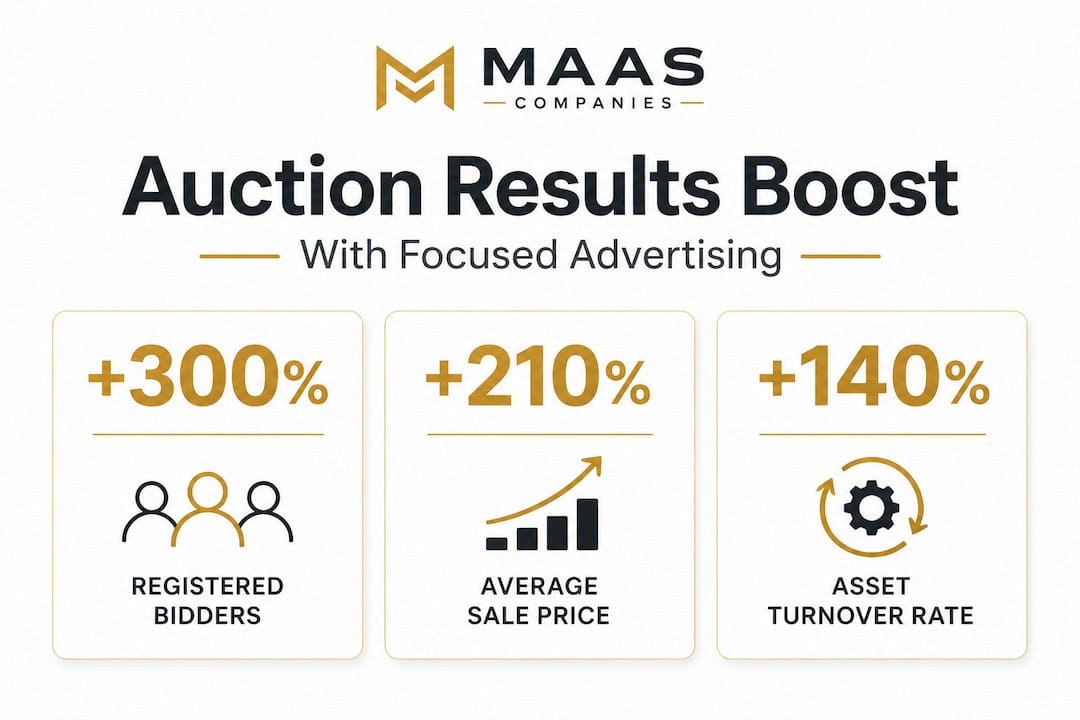
These figures reflect real patterns observed across industrial auction campaigns. The data makes clear that advertising investment is not a cost center but a direct driver of recovery value.
Post-auction feedback is equally important. Surveying registered bidders who did not place bids can reveal whether pricing, asset condition, or logistics deterred participation. Reviewing which advertising channels generated the most registrations helps reallocate budget in future campaigns. Analyzing the gap between registered bidders and active bidders identifies where the conversion process broke down.
To iterate on underperforming campaigns:
- Review channel-level registration data to identify which sources produced the most engaged buyers.
- Assess whether the advertising timeline was sufficient. Campaigns that launched fewer than three weeks before auction consistently underperform.
- Evaluate listing quality against buyer feedback. If inquiries focused on missing specifications, improve asset documentation in future campaigns.
- Test alternative messaging in email subject lines and ad headlines to identify which value propositions generate the highest open and click-through rates.
Understanding broader manufacturing efficiency dynamics helps contextualize why certain asset categories attract more competitive bidding in specific market conditions, which in turn informs messaging strategy.
The hidden levers: What most auction advertising strategies miss
While measurement is foundational, the difference-makers are often less tangible and easily overlooked by even experienced teams.
One of the most persistent myths in auction advertising is the belief that a perfect buyer list guarantees a strong outcome. In practice, over-targeting a narrow list of known buyers creates a ceiling on competition. If every buyer on your list already knows each other, they may coordinate informally or simply recognize that the competitive field is small. Introducing buyers from adjacent industries or geographic markets, buyers who might not have been on your original list, frequently produces the most aggressive bidding.
Timing and repeated exposure matter more than most sellers realize. A single high-impact advertisement placed two weeks before auction will rarely outperform a sustained campaign that begins six to eight weeks out and maintains consistent visibility across multiple channels. Buyers need time to evaluate assets, arrange inspections, secure financing, and obtain internal approvals. Speeding up asset disposition does not mean compressing the advertising window. It means starting the advertising process earlier so that by the time the auction opens, buyers are already prepared to bid.
Word-of-mouth remains an underutilized channel in industrial auctions. When a campaign reaches industry insiders who are not themselves buyers, those individuals often refer the opportunity to colleagues or competitors who are. Building this referral layer into a campaign, through industry association communications, direct outreach to plant managers and procurement directors, and engagement with sector-specific online communities, extends reach beyond what paid advertising alone can achieve.
Seasoned auction marketing professionals also pay close attention to the narrative surrounding an asset. Distressed assets carry an implicit stigma that can suppress buyer confidence if not addressed directly. Framing the sale accurately, acknowledging the asset’s history while emphasizing its operational condition, remaining useful life, and replacement cost advantage, converts hesitant prospects into active bidders. The language of the campaign shapes buyer psychology as much as the channel through which it is delivered.
Partner with auction advertising experts for superior results
If you want the fastest, highest recovery from your industrial asset sales, consider partnering with experts who manage auction advertising from strategy through execution.
Maas Companies Inc. brings decades of international experience in marketing industrial plants, equipment, real estate, and commercial properties to buyers worldwide. Our approach combines aggressive multi-channel advertising with deep industry knowledge, ensuring that every asset sale reaches the right buyers at the right time with the right message.
Whether you are managing a single surplus equipment sale or a full facility liquidation, our team develops tailored advertising strategies designed to maximize competitive bidding and final recovery. Explore our full services portfolio to understand the range of marketing and auction support we provide. If you are ready to move forward, our selling industrial equipment page is the starting point for a consultation with our specialists. We are ready to help you build a campaign that delivers measurable results.
Frequently asked questions
How much can advertising increase auction recovery for distressed assets?
Effective advertising can double or even triple bidder turnout, leading to significant improvement in final sale prices. Structured campaigns routinely achieve recovery rates 30 to 40 percentage points higher than minimally promoted sales.
Which advertising channels should I prioritize for an industrial auction?
Industry-specific digital portals, targeted email outreach, and trade media consistently draw the most qualified bidders. Auction advertising strategies that layer these channels together outperform single-channel approaches in both bidder quality and final recovery.
What are the most common mistakes in auction advertising?
Relying on outdated buyer lists, vague item descriptions, and last-minute advertising are the most common pitfalls. Effective auction advertising requires complete asset documentation, early campaign launch, and channel selection matched to the buyer profile.
How soon should advertising start for a successful industrial auction?
Auction advertising should begin 30 to 60 days in advance, with complex or high-value facility sales benefiting from an even longer runway to allow buyers adequate time for evaluation, inspection, and internal approvals.
What metrics show my auction advertising is working?
Look for consistent growth in registered bidders, asset page views, and direct buyer inquiries in the weeks leading up to the auction. Post-auction analysis of recovery rates against appraised values provides the clearest long-term measure of campaign effectiveness.
Recommended
- Auction strategies for small businesses: Maximize asset recovery | Blog | Insights on Asset Liquidation and Auction Trends
- Why companies auction machinery: maximize asset recovery | Blog | Insights on Asset Liquidation and Auction Trends
- Maximize Asset Recovery: Top Real Estate Liquidation Methods | Blog | Insights on Asset Liquidation and Auction Trends
- How Auctions Help Speed Up Industrial Asset Disposition | Blog | Insights on Asset Liquidation and Auction Trends
- Robert Rupp is a fractional CMO & marketing consultant