
Blog
Role of Private Equity in Asset Sales: Sponsor Playbook
TL;DR:
- Private equity sponsors are responsible for planning and executing asset disposals, choosing sale formats based on timing and risk. Engaging a qualified sale advisor early optimizes recovery, strategic planning, and disposition speed. Maascompanies specializes in industrial asset sales, providing valuation, auction, and logistics support across the United States.
Private equity sponsors are the primary architects of portfolio-company asset dispositions. They set the commercial objective, choose the sale format, align lenders and counsel, and engage sale specialists to protect recovery. The core decision is straightforward: when a portfolio company faces a plant closure, restructuring, or capital reallocation, the sponsor must choose between a marketed auction, a negotiated sale, an Article 9 out-of-court sale, or a Section 363 bankruptcy sale. Each path carries distinct speed, cost, and risk profiles. BCG’s analysis of industrial closures confirms that treating these events as deliberate portfolio strategy, rather than reactive fire sales, unlocks capital and reduces liability exposure.
The immediate recommendation: engage a qualified sale advisor at the first sign of closure or restructuring, before environmental unknowns harden and buyer interest softens. Maascompanies specializes in exactly this work, covering industrial equipment, plant facilities, and commercial real estate across the U.S.
When to run a marketed auction: asset pools with broad buyer appeal, no urgent lender pressure, and 6–12 weeks available for marketing. When to pursue an Article 9 short sale: first-lien lender is driving, speed is critical, and going-concern value must be preserved out of court. When to plan a Section 363 sale: title encumbrances are unresolvable out of court, or creditor disputes require a court-ordered free-and-clear ruling.
Table of Contents
- Who owns each decision in the sale process?
- What does the disposition timeline actually look like?
- Legal and financial trade-offs sponsors must negotiate
- How do you select the right sale advisor?
- Operational tactics that increase net proceeds
- How sponsors have captured value through disciplined disposition
- Key Takeaways
- The case for calling a specialist before you think you need one
- Maascompanies: strategic asset recovery for PE sponsors
- Useful sources for counsel, lenders, and advisors
Who owns each decision in the sale process?
Clear decision rights prevent the gaps that erode recovery. KPMG’s carve-fix-sell analysis shows that sponsors who invest in separation planning and disciplined diligence consistently achieve higher exit multiples than those who treat disposition as an afterthought.
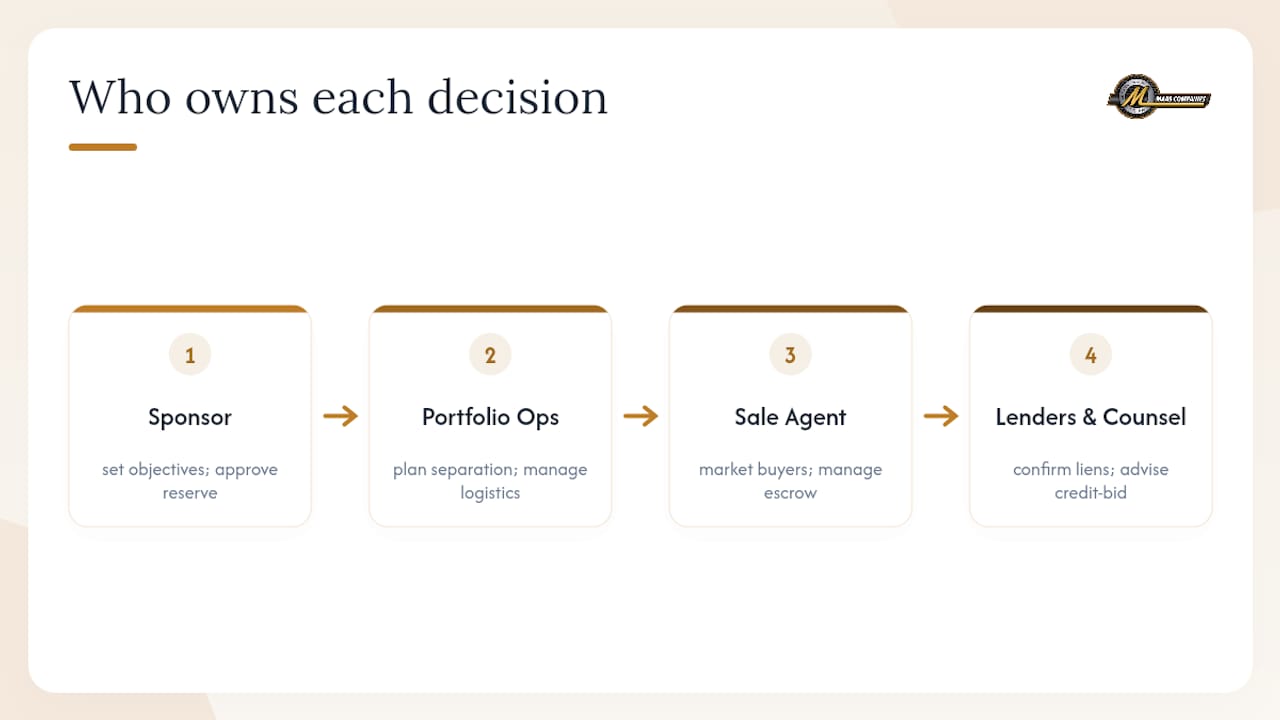
Sponsor: sets the commercial objective, approves reserve prices and sale path, coordinates lender strategy, funds separation costs, and communicates with limited partners as required.
Portfolio management and operations: characterizes assets, leads separation planning, manages safe shutdown and logistics, and provides due-diligence support to the sale agent.
Lenders and counsel: confirm lien positions, determine credit-bid strategy, advise on Article 9 mechanics or bankruptcy counsel when 363 is required, and manage intercreditor dynamics.
Sale agent/auctioneer: delivers market reach, buyer segmentation, valuation methodology, title and encumbrance clearance support, and escrow and settlement management. This is where Maascompanies operates, bringing industrial buyer networks and bespoke marketing to each engagement.
What does the disposition timeline actually look like?
A well-sequenced process protects value at every stage. The phases below apply to a marketed auction; Article 9 and 363 paths compress or extend specific windows.
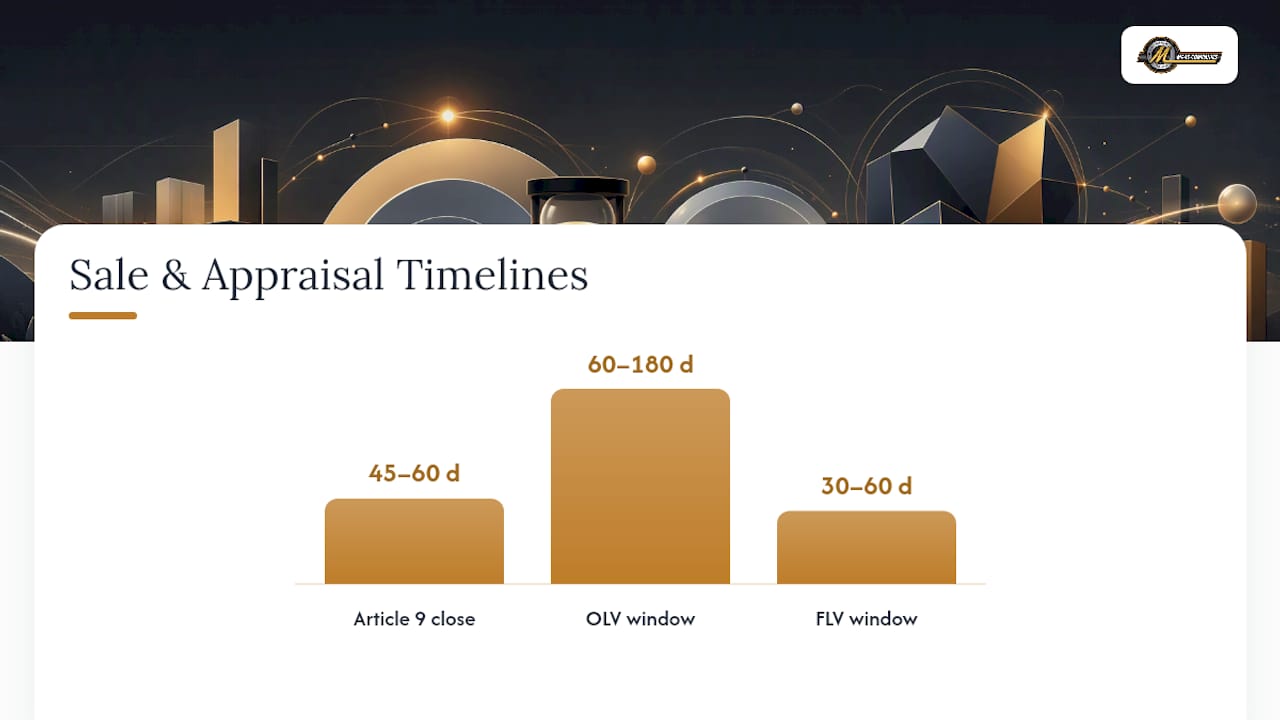
- Valuation and market-testing (weeks 2–6): order equipment appraisals covering FMV (continued use), Orderly Liquidation Value (OLV, typically a 60–180 day sale window), and Forced Liquidation Value (FLV, 30–60 days). CT Acquisitions outlines how OLV-to-price ratios directly affect lender underwriting and reserve-setting decisions.
Critical path items that most often cause delays: environmental Phase I/II reports, title and lien searches, and permit or regulatory hold points. Early asset tagging, secure photography, and serialized equipment lists protect chain-of-custody and accelerate buyer diligence. The Maascompanies process guide provides tactical checklists and milestone sequencing for sponsors planning dispositions. Tracking equipment condition and utilization history before the sale, using a tool like Wells Manager’s downtime tracking framework, strengthens the asset presentation to buyers.
Legal and financial trade-offs sponsors must negotiate
The speed advantage of Article 9 comes with a specific liability: subordinate lien claims may not be extinguished without court involvement. A Section 363 sale provides a bankruptcy-court free-and-clear ruling, but at materially higher cost and delay. Counsel input on which path fits the lien stack is not optional.
A Section 363 sale extinguishes most liens and claims through court order, but sponsors should weigh that certainty against the cost of bankruptcy administration, the risk of plan litigation, and the loss of process control that comes with court supervision. Article 9 is faster and cheaper, but the sponsor and lender bear the risk that a subordinate creditor challenges the sale.
Tax and accounting consequences deserve equal attention. An asset sale at the portfolio-company level triggers recognition of gain or loss on each transferred asset, with allocation among asset classes under IRC Section 1060 affecting the tax burden for both buyer and seller. A stock sale avoids this complexity but may reduce buyer interest when asset-level liabilities are significant. Sponsors should confirm the preferred structure with tax counsel before marketing begins.
Environmental liabilities, warranty exposure, and post-closing holdbacks or escrows are the three most common sources of post-sale disputes. Addressing each in the purchase agreement, rather than leaving them to negotiation at closing, protects the sponsor’s recovery.
How do you select the right sale advisor?
The advisor’s buyer network and marketing discipline are the primary drivers of competitive tension, and competitive tension is what produces premium recoveries. Industrial property disposition considerations vary by asset class, and a generalist advisor rarely has the segment-specific buyer relationships that move industrial equipment or process plant at full value.
Vendor checklist:
- Demonstrated industrial buyer network (manufacturing, energy, processing, healthcare, agriculture)
- Multi-channel marketing capability: targeted outreach, online platforms, print, and industry publications
- In-house appraisal or access to certified appraisers for FMV, OLV, and FLV
- Escrow, settlement, and title-clearance support
- Documented experience with Article 9 and Section 363 matters
- References for comparable asset types and transaction sizes
Key interview questions: What were the OLV-to-realized-price ratios on your last three comparable transactions? How large and how segmented is your buyer database? What does your marketing plan look like for this asset class? What is your realistic timeline to close?
Fee structures matter, but the right question is not “what is your commission rate?” — it is “what is your net recovery track record on assets like mine?” A lower commission on a poorly marketed sale produces less net proceeds than a higher commission on a well-run, competitive auction.
Operational tactics that increase net proceeds
Lotting strategy and buyer segmentation are the two levers sponsors most often underuse. Selling a process plant as a single lot to one buyer is rarely the highest-recovery path; breaking it into targeted lots by buyer type, equipment category, and condition often produces materially better aggregate proceeds. The auction lot configuration guide from Maascompanies covers bidder engagement strategies that maximize competitive tension by asset class.
Modest reconditioning, cleaning, and functional testing of key equipment broadens the buyer pool and supports higher reserve pricing. Storage and staging add value when the marketing window is long enough to justify carrying costs; for rapid Article 9 dispositions, they rarely do. Coordination with operations on make-ready activities, including safety documentation and chain-of-custody records for regulatory-sensitive equipment, protects both the sale process and post-closing liability exposure.
How sponsors have captured value through disciplined disposition
Brookfield’s Chemelex carveout illustrates what disciplined separation planning delivers: early standup of TSAs, an internal operating bench, and a detailed separation plan produced measurable EBITDA improvement and a cleaner sale process. The lesson for sponsors is that separation investment made before marketing begins is recovered in sale proceeds.
In distressed Article 9 scenarios, sponsors who engaged a sale advisor before lender pressure peaked preserved going-concern value by identifying qualified buyers early and structuring a private sale that closed before the asset deteriorated. The alternative, waiting for a court-supervised 363 process, added months of carrying costs and management distraction.
The KPMG carve-fix-sell playbook confirms the pattern: PE sponsors who treat noncore disposals as active value-creation opportunities, investing in separation, operational cleanup, and targeted marketing, consistently achieve higher exit multiples than sponsors who treat disposition as a residual task.
Key Takeaways
Private equity sponsors who engage a qualified sale advisor early, align lenders on sale path, and invest in separation planning consistently achieve higher net recoveries than those who treat asset disposition as a reactive, end-stage task.
| Point | Details |
|---|---|
| Sponsor owns the decision | The PE sponsor sets commercial objectives, approves reserves, and aligns lenders before marketing begins. |
| Article 9 vs 363 trade-off | Article 9 closes in 45–60 days but may leave subordinate claims; 363 provides free-and-clear title at higher cost and delay. |
| Appraisal drives reserve-setting | FMV, OLV (60–180 day window), and FLV (30–60 day window) outputs directly inform lender underwriting and minimum bid levels. |
| Early separation planning pays | Sponsors who invest in TSAs and separation before marketing consistently achieve better proceeds and lower post-closing liability. |
| Maascompanies as sale partner | Maascompanies delivers industrial buyer outreach, appraisal support, Article 9 and auction execution, and title clearance for U.S. dispositions. |
The case for calling a specialist before you think you need one
The conventional wisdom in PE disposition is to engage a sale advisor once the decision to sell is final. That timing is consistently too late. By the time a closure decision is formalized, environmental unknowns have had time to harden, buyer interest in the asset class may have shifted, and lender patience is already strained. The sponsors who achieve the best recoveries engage a specialist at the first sign of restructuring, not after the decision tree has narrowed.
What a specialist like Maascompanies actually delivers is not just marketing reach. It is disciplined valuation that gives lenders and sponsors a credible reserve floor, buyer segmentation that creates competitive tension across trade buyers and strategic acquirers, and project management for the strip-out, logistics, and regulatory coordination that portfolio management teams are rarely staffed to handle. The difference between a well-run disposition and a poorly managed one is not the quality of the assets. It is the quality of the process.
Sponsors who have worked through Article 9 short sales know that the 45–60 day window is only achievable when the advisor, lender, and counsel are already aligned before the process starts. That alignment requires early engagement. Waiting until the lender issues a default notice compresses the timeline in the worst possible way.
Maascompanies: strategic asset recovery for PE sponsors
When a portfolio company faces a plant closure, equipment liquidation, or commercial property disposition, the difference between a reactive sale and a managed recovery comes down to who runs the process and when they start.
Maascompanies brings decades of experience in industrial asset disposition to PE sponsors, lenders, and portfolio executives across the U.S. The firm’s services cover rapid asset appraisals (FMV, OLV, FLV), Article 9 and negotiated-sale execution, marketed auctions for equipment and real estate, TSA and logistics coordination, and title and escrow support. Current active projects, including the Remy International tank manufacturing auction, demonstrate the firm’s execution capability across industrial asset classes.
To request an initial scope call, a sample marketing plan, or a fee estimate for your disposition, contact Maascompanies directly through the website. The engagement starts with a rapid assessment, not a lengthy proposal process.
Useful sources for counsel, lenders, and advisors
- Industrial Asset Closures Are Inevitable. Value Isn’t. | BCG
- Selling a Distressed Asset - Troutman Pepper Locke
- Carve out, fix up, sell off | KPMG
- Transforming a corporate orphan into a carveout champ | Brookfield
- Selling a Manufacturing Company to Private Equity (2026) | CT Acquisitions
- The Private Equity/ABL Guide to Streamlining Transactions - Second Wind Consultants
- Industrial Asset Sale Process: Maximize Recovery in 2026 | Blog | Insights on Asset Liquidation and Auction Trends
Recommended
- Liquidation strategies to maximize distressed asset recovery | Blog | Insights on Asset Liquidation and Auction Trends
- Examples of Successful Asset Dispositions: 2026 Guide | Blog | Insights on Asset Liquidation and Auction Trends
- Asset Sale Benefits 2026: A Strategic Guide for Sellers | Blog | Insights on Asset Liquidation and Auction Trends
- Definition of Bulk Asset Sales for Executives | Blog | Insights on Asset Liquidation and Auction Trends