

Blog
Definition of Bulk Asset Sales for Executives

TL;DR:
- A bulk asset sale involves transferring business assets outside normal operations, triggering required legal and tax notices. Executives must classify and coordinate compliance early to prevent delays, liabilities, and post-closing claims. Proper planning boosts recovery, minimizes risks, and ensures a smooth, compliant disposition process.
A bulk asset sale is the sale, transfer, or assignment of business assets outside the ordinary course of business. That single phrase, “outside the ordinary course,” is the legal trigger that shifts a transaction out of routine commercial activity and into a compliance workflow governed by state creditor-notice rules, tax-administration requirements, and, in some jurisdictions, public-record filings. The New York Department of Taxation and Finance and the New Jersey Division of Taxation both administer distinct bulk-sale frameworks that impose pre-closing notification obligations and potential buyer liability for unpaid seller taxes. Executives planning a plant closure, corporate restructuring, or capital-recovery disposition need to recognize this classification before marketing begins, not after a buyer is under contract.
Table of Contents
- What legally counts as a bulk asset sale in the United States?
- Why this classification is a material executive decision
- How state law and tax administration shape bulk-sale treatment
- When do bulk asset sales typically occur?
- Buyer and seller risks when bulk-sale rules apply
- A practical checklist for executing a compliant bulk asset sale
- Timeline and cost drivers executives should plan for
- How strategic marketing materially improves recovery
- Key Takeaways
- What practitioners consistently get wrong about bulk asset sales
- Maascompanies: strategic asset recovery for complex dispositions
- Useful sources for counsel and deal teams
What legally counts as a bulk asset sale in the United States?
A transaction qualifies as a bulk sale when it transfers business assets in a manner that falls outside the seller’s normal operations. Routine retail sales to customers do not qualify. Selling the plant’s entire equipment inventory to a single buyer during a closure does.
Asset classes commonly covered include:
- Tangible personal property: machinery, equipment, vehicles, store fixtures, and inventory
- Real property: land, buildings, and leasehold interests
- Intangibles: goodwill, patents, copyrights, trademarks, and accounts receivable sold at non-market discounts
- Supplies and materials used in the business
The contrast is straightforward. A manufacturer selling finished goods to distributors every week is acting within the ordinary course of business. That same manufacturer closing its facility and selling all production equipment, raw-material inventory, and the building to a single acquirer is executing a bulk asset sale, regardless of whether the deal is structured as one transaction or several coordinated transfers.
Why this classification is a material executive decision
Three consequences make bulk-sale classification a board-level concern: creditor-notice exposure, post-closing claims against the buyer, and tax-assessment risk for both parties. Bulk-sales laws were created specifically to prevent owners from liquidating assets to avoid creditors, and the compliance obligations that survive in most states reflect that protective purpose.
The CFO, general counsel, operations lead, and lender representatives should all be at the table before a disposition plan is finalized. Lenders with security interests in the assets being sold have direct exposure. General counsel must confirm which state regimes apply and whether notice periods affect the closing timeline. The CFO needs to model the net recovery after escrow holdbacks, legal fees, and any tax-clearance requirements.

Decision metrics executives typically weigh: recovery percentage net of compliance costs, legal exposure from creditor or tax claims, speed of exit relative to carrying costs, and board or lender reporting obligations tied to the transaction structure.
How state law and tax administration shape bulk-sale treatment
State law defines the process and consequences, and the variation across jurisdictions is significant. The historical baseline was UCC Article 6, which imposed buyer-side costs to protect seller creditors and allowed creditor remedies against good-faith purchasers. Most states found that burden disproportionate and repealed or substantially revised Article 6, leaving a patchwork of approaches.
Two broad frameworks now govern most U.S. bulk-sale situations:
- Tax-administration centered: States like New York tie bulk-sale rules to sales-tax collection obligations. Under New York Tax Law §1141©, whenever a sales-tax vendor sells business assets outside the ordinary course, the buyer must notify the Department of Taxation and Finance at least ten days before taking possession or paying, using Form AU-196.10. Failure to comply makes the buyer liable for the seller’s unpaid sales taxes up to the greater of the sale price or fair market value.
- Creditor-protection centered: Traditional bulk-sales regimes require notice to creditors and, in some states, publication or recording of a notice. Non-compliance can expose the buyer to creditor claims or invalidate the sale as against creditors.
Assume a state-level notice or tax workflow may apply until counsel confirms otherwise. Do not assume uniformity.
When do bulk asset sales typically occur?
Common triggers include plant closures, business wind-downs, bankruptcy or insolvency proceedings, corporate restructuring, and mass disposal of surplus equipment or inventory. Transaction structure matters as much as the trigger event. An asset transfer that moves inventory or equipment outside normal operations is more likely to trigger bulk-sale treatment than a stock sale, where assets do not change hands directly.
New York’s administrative guidance illustrates recognizable scenarios: a retiring contractor selling all tools and equipment; a restaurant closing and selling fixtures and kitchen equipment to a new operator; a corporation transferring assets as part of an incorporation or reorganization. Each of these fits the “outside the ordinary course” definition regardless of whether the seller intended to trigger compliance obligations.
Buyer and seller risks when bulk-sale rules apply
Both sides face material post-closing exposure when bulk-sale rules are triggered and compliance steps are skipped or incomplete.
| Risk Category | Buyer Exposure | Seller Exposure |
|---|---|---|
| Creditor claims | Creditors may claim inventory or proceeds; sale may be invalidated | Sale invalidated against creditors; fraudulent-transfer claims |
| Tax liability | Liable for seller’s unpaid sales/use taxes up to sale price or FMV | Tax-assessment risk; penalties for failure to disclose |
| Title defects | Encumbered assets, UCC lien disputes | Secured-creditor payoff disputes delay closing |
| Escrow/holdback | Funds held pending tax clearance; delayed distribution | Proceeds withheld until state releases escrow |
Mitigation requires coordinating lien searches with fraudulent-transfer analysis and escrow mechanics before closing. Practical measures include UCC lien searches, creditor searches, tax-clearance requests, escrow or holdback provisions in the asset purchase agreement, indemnities, and title opinions for real property.
A practical checklist for executing a compliant bulk asset sale
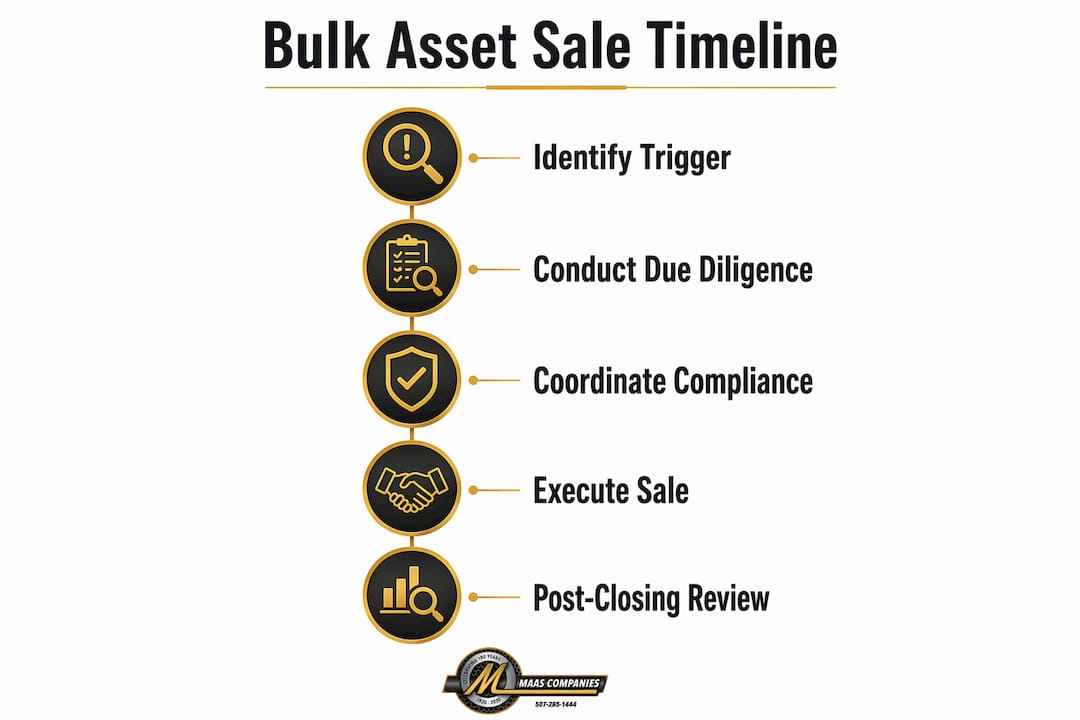
Follow a disciplined diligence, notice, escrow, and closing workflow tailored to the applicable state regime. The sequence below applies broadly; counsel must confirm state-specific variations.
- Classify the transaction. Confirm whether the transfer falls outside the ordinary course and identify which state regimes apply based on asset location and seller status.
- Run creditor and lien searches. Pull UCC filings, tax liens, and judgment searches in every state where assets are located.
- Check tax status. Confirm whether the seller is required to collect sales tax and request a tax-clearance certificate or bulk-sales audit where available.
- Issue required notices. File Form AU-196.10 in New York at least ten days before closing; follow equivalent procedures in other applicable states.
- Establish escrow or holdback. Set aside funds per state instructions to cover potential tax liabilities pending clearance.
- Prepare the documentation package. Asset purchase agreement, bill of sale, asset schedules with serial numbers, creditor affidavit where required, UCC search reports, secured-creditor payoff statements, and environmental reports if real property or heavy equipment is involved.
- Complete public-record filings or publication where state law requires it.
- Close and distribute proceeds after state clearance and creditor-notice periods have run.
- Monitor post-closing compliance. Confirm tax clearances are received and no creditor claims are filed within applicable cure periods.
Pro Tip: Coordinate bulk-sale framing with fraudulent-transfer analysis and UCC lien resolution in the first week of diligence. Surprises at distribution are almost always traceable to liens or tax claims that were discoverable early.
For a detailed auction compliance checklist covering notice and documentation requirements, Maascompanies maintains current guidance for industrial asset dispositions.
Timeline and cost drivers executives should plan for
Simple surplus-equipment sales with no state notice requirements can close in a few weeks. Transactions subject to state notice periods, contested creditor claims, or multi-location footprints routinely take several months. A ten-day pre-closing notice window in New York is a hard minimum; contested tax assessments or creditor disputes can extend that by weeks or months.
Primary cost drivers include legal fees for counsel and lien searches, escrow and title services, marketing and disposition costs, environmental remediation or specialty removal for heavy equipment, advertising or publication costs where required by statute, and carrying costs during notice periods. Multi-state asset footprints multiply each of these. A structured liquidation approach that sequences marketing to align with notice windows reduces carrying costs and preserves recovery.
How strategic marketing materially improves recovery
Targeted technical marketing combined with staged disposition strategies typically recovers materially more than an untargeted, all-at-once clearance. The difference lies in buyer quality and competition.
Maascompanies’ approach segments assets by value and buyer profile. High-value specialty equipment goes through negotiated sale or targeted auction with technical documentation, certified removal quotes, and outreach to qualified industry buyers. Commodity inventory moves through lot sales timed to clear before carrying costs erode net proceeds. Technical asset catalogs with serial numbers, operating hours, and maintenance records attract buyers who pay premiums for verifiable operability.
Marketing tactics that consistently improve outcomes: industry-specific advertising, cross-border buyer sourcing where permitted, staged sale timing aligned with creditor-notice windows, and logistics coordination that reduces buyer friction. For a practical framework, the Maascompanies guide on how to sell industrial equipment covers documentation and buyer-targeting steps in detail.
Pro Tip: Preserve serial-numbered equipment records and original technical manuals through the disposition process. Buyers consistently pay more for assets with documented operating history and verifiable specifications.
Key Takeaways
A bulk asset sale triggers legal and tax compliance obligations the moment the transaction falls outside the ordinary course of business, making early classification the single most consequential step in any industrial disposition.
| Point | Details |
|---|---|
| Core legal trigger | “Outside the ordinary course of business” determines whether bulk-sale rules apply. |
| State law varies significantly | No uniform U.S. regime exists; New York and New Jersey impose distinct tax-linked notice workflows. |
| Buyer liability is real | Buyers who skip notice requirements can be held liable for the seller’s unpaid sales taxes up to the sale price or fair market value. |
| Early diligence prevents delays | Run lien searches, creditor searches, and tax-status checks before marketing begins to avoid closing surprises. |
| Maascompanies as recovery partner | Maascompanies provides staged disposition, technical documentation, and targeted buyer outreach to maximize net proceeds while managing compliance timelines. |
What practitioners consistently get wrong about bulk asset sales
The most common executive mistake is treating bulk-sale compliance as a closing-day checklist item rather than a deal-design constraint. By the time a buyer is under contract and the closing date is set, a missed ten-day notice window or an undiscovered tax lien becomes a renegotiation event, not a formality.
The second failure mode is assuming that because Article 6 was repealed in most states, bulk-sale rules no longer apply. They do, just through different mechanisms: tax-administration statutes in New York and New Jersey, fraudulent-transfer law in states that rely on it as the creditor-protection substitute, and residual bulk-sales acts in states that retained or revised Article 6. The legal architecture changed; the exposure did not.
Classify early. Align stakeholders before marketing begins. Document assets with the precision a buyer’s counsel will require. Sequence marketing to match legal constraints, not the other way around. That sequence is what separates a clean, maximum-recovery disposition from one that closes late, at a discount, with post-closing claims still open.
Maascompanies: strategic asset recovery for complex dispositions
When a plant closure, restructuring, or capital-recovery event triggers a bulk asset sale, the gap between a disciplined disposition and an ad-hoc clearance shows up directly in net proceeds. Maascompanies provides industrial asset recovery services built for exactly that gap: technical asset cataloging, targeted buyer outreach across domestic and international markets, escrow and closing coordination, and logistics management that reduces buyer friction and accelerates timelines.

The practical result is a disposition that runs parallel to your legal compliance workflow rather than behind it. Executives who engage Maascompanies early in the classification process get a marketing plan that aligns with creditor-notice windows, a documented asset schedule ready for buyer due diligence, and access to a qualified buyer network that competes on price. To discuss your disposition and request an asset cataloging proposal, visit the seller services page or review the full Maascompanies services portfolio.
Useful sources for counsel and deal teams
Primary legal and administrative sources that define or explain bulk-sale concepts in the U.S.:
- Cornell LII: Bulk Sale (Wex) — The U.S. commercial-law baseline definition, covering the “outside the ordinary course” trigger and UCC Article 6 context.
- New York Department of Taxation and Finance: Bulk Sales — Administrative guidance on New York’s sales-tax-linked bulk-sale framework, including notice workflows and covered transaction examples.
- N.Y. Comp. Codes R. & Regs. Tit. 20 § 537.5 (Cornell LII) — The New York regulatory text governing seller obligations, audit requests, and bulk-sales tax certificates.
- NJ Division of Taxation: Bulk Sale FAQ — New Jersey’s buyer-protection framework, Form C-9600 requirements, and asset-coverage definitions.
- Uniform Law Commission: Article 6 Repeal/Revision Background — Legislative history explaining why most states repealed or revised Article 6 and what replaced it.
- Nolo: Bulk Sales Law Definition — Plain-language summary of creditor-notice requirements and the consequences of non-compliance for buyers and sellers.
This article provides general information about bulk asset sale classification and compliance in the United States. It is not legal or tax advice. Confirm applicable requirements with qualified legal counsel and the relevant state tax authority for your specific transaction.
Recommended
- What Is a Bulk Sale? A 2026 Guide for Business Professionals | Blog | Insights on Asset Liquidation and Auction Trends
- Liquidation sales explained: Maximize asset recovery | Blog | Insights on Asset Liquidation and Auction Trends
- Asset Sale Benefits 2026: A Strategic Guide for Sellers | Blog | Insights on Asset Liquidation and Auction Trends
- What Is Asset Liquidation: A CFO’s Strategic Guide | Blog | Insights on Asset Liquidation and Auction Trends