

Blog
What Is a Bulk Sale? A 2026 Guide for Business Professionals

TL;DR:
- A bulk sale involves transferring a large portion of a business’s assets outside normal operations, triggering legal and tax notifications. Compliance requires filing specific notices at least 10 days before closing to avoid inheriting unpaid taxes and liabilities. Proper adherence ensures higher asset recovery and legal protection during restructuring or liquidation events.
A bulk sale is defined as the transfer of a substantial portion of a business’s assets outside the ordinary course of that business’s operations, triggering mandatory legal and tax notification requirements designed to protect creditors and tax authorities. Unlike a standard commercial transaction, a bulk sale typically involves inventory, equipment, real property, and intangible assets such as goodwill, patents, or trademarks transferred together or in large part. States including New Jersey, New York, and California maintain active bulk sale statutes that impose strict procedural requirements on both buyers and sellers. For business professionals managing plant closures, restructuring events, or excess inventory situations, understanding the bulk sale definition is not optional. Compliance failures carry direct financial liability.
What is a bulk sale under state law?
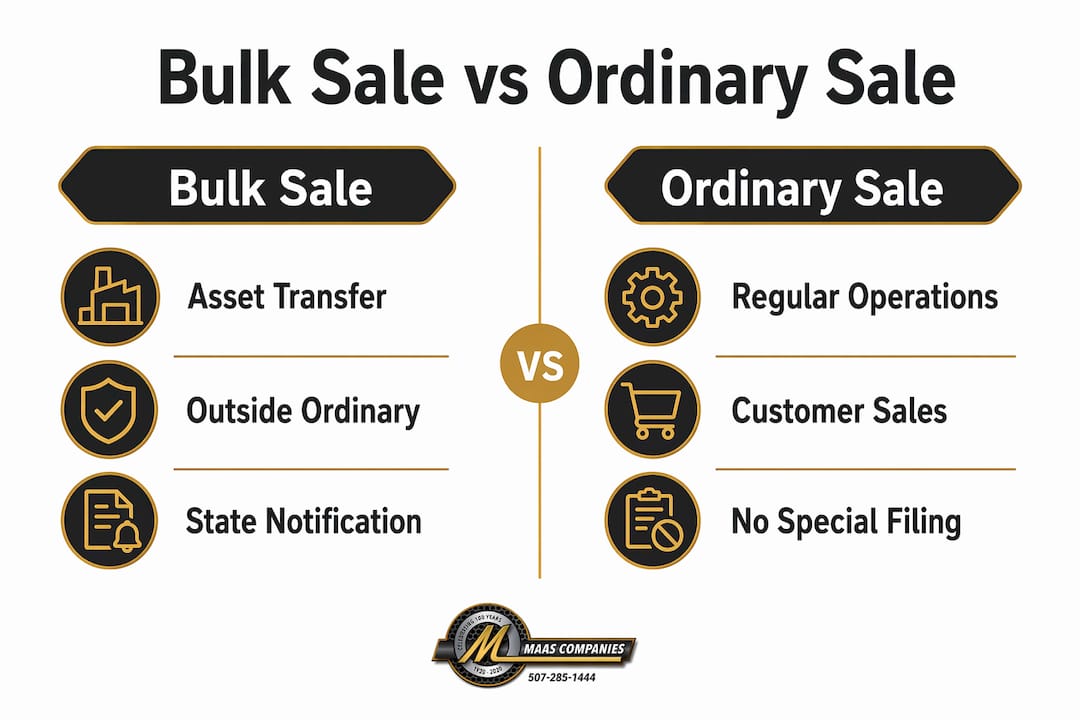
A bulk sale is legally distinguished from ordinary business sales by one central criterion: the transfer occurs outside the normal course of the seller’s business operations. Selling finished goods to retail customers is not a bulk sale. Selling the entire inventory of a closing manufacturing facility is.
State tax guidance from New Jersey and New York specifies that a bulk sale includes inventory, materials, real property, and intangible assets such as goodwill. That scope matters because it captures the full asset base of a business, not just its physical equipment.
The original legal framework governing bulk sales was UCC Article 6, a uniform commercial code provision designed to prevent fraud by business owners who liquidated assets and disappeared before paying creditors and taxes. Most states have since repealed UCC Article 6, but state tax statutes now carry that same protective function. The repeal of UCC Article 6 shifted compliance focus entirely to state tax law, which increased the buyer’s investigative duties rather than reducing them.
The practical result is that bulk sale compliance is now more fragmented and state-specific than it was under a uniform federal framework. Business professionals operating across multiple states must verify the applicable requirements in each jurisdiction before closing.
Key states with active bulk sale requirements
- New Jersey: Requires notification at least 10 business days before closing using Form C-9600, filed with the New Jersey Division of Taxation.
- New York: The New York State Tax Department requires advance notice and may place an escrow hold on sale proceeds to cover outstanding tax liabilities.
- California: Maintains its own bulk sale notification requirements under the California Commercial Code.
Pro Tip: File the required notification as early as possible. Tax authorities in New Jersey and New York can place escrow holds on sale proceeds if outstanding liabilities are identified during the review period. Early filing gives both parties time to resolve issues before closing.
What assets are included in a bulk sale?
Business assets subject to bulk sales include both tangible and intangible property that generates income or loss for the business. The asset scope is broader than most buyers and sellers initially expect.
Tangible assets covered include:
- Equipment, machinery, and tools
- Raw materials and finished inventory
- Furniture, fixtures, and vehicles
- Land and buildings owned by the business
Intangible assets covered include:
- Goodwill and customer lists
- Licenses, permits, and certifications
- Patents, trademarks, and trade names
- Franchise rights and non-compete agreements
The distinction between a bulk sale and an ordinary business transaction centers on whether the sale falls outside ordinary business course, not on the dollar value or volume of the transaction. A retailer selling discounted merchandise during a clearance event is not conducting a bulk sale. That same retailer selling its entire store inventory to a single buyer as part of a closure is.
| Transaction type | Bulk sale? | Reason |
|---|---|---|
| Retailer sells clearance inventory to customers | No | Within ordinary course of business |
| Manufacturer sells all equipment at plant closure | Yes | Outside ordinary course; triggers notification |
| Business owner transfers assets to new corporation | Yes | Asset transfer outside normal operations |
| Wholesaler sells single large order to distributor | No | Normal wholesale transaction |

One frequently overlooked scenario involves business restructuring. Even sole proprietors incorporating and transferring assets to the new entity can trigger bulk sale notification requirements. The legal form of the transaction does not determine whether bulk sale rules apply. The substance of the asset transfer does.
What are the buyer’s and seller’s responsibilities?
Both parties carry distinct legal obligations in a bulk sale, and the consequences of failing to meet them fall on the party that failed, not on the transaction as a whole.
Seller responsibilities include:
- Notifying the relevant state tax authority before closing
- Disclosing all outstanding tax liabilities, creditor claims, and liens
- Filing final tax returns within the required period after the sale
- Cooperating with the buyer’s due diligence on tax clearance status
Buyer responsibilities include:
- Filing the required notification forms (such as New Jersey’s Form C-9600) at least 10 business days before closing
- Verifying the seller’s tax compliance and clearance status
- Establishing escrow arrangements if the tax authority identifies outstanding liabilities
- Confirming that all required filings are complete before releasing sale proceeds
The liability exposure for buyers is the most consequential risk in bulk sale transactions. Purchasers who fail to file the required notification can inherit the seller’s unpaid tax debts, penalties, and interest. That liability does not require any intent or negligence on the buyer’s part. The failure to file is sufficient to trigger it.
Sellers face their own exposure. Final tax returns must be filed within 20 days after the sale closes in New York. Unpaid taxes, penalties, and interest remain the seller’s liability until formally resolved. A tax clearance certificate from the relevant state authority is the only reliable protection.
Pro Tip: Buyers should request a tax clearance certificate from the seller before closing, not after. If the seller cannot produce one, engage the state tax authority directly to determine the outstanding liability before any funds change hands.
Bulk sale procedural failures expose buyers to liability that can exceed the value of the assets acquired. Pre-closing due diligence on the seller’s tax clearance and creditor status is the single most effective way to prevent that outcome.
How do bulk sales function in restructuring and asset recovery?
Bulk sales are the primary legal mechanism through which businesses transfer significant asset portfolios during plant closures, restructuring events, and capital recovery situations. They are not simply large transactions. They are specialized liquidation events with creditor protection as their primary legal purpose.
In practice, bulk sales in industrial and manufacturing contexts follow a predictable sequence:
- Trigger event identified: Plant closure, bankruptcy filing, or restructuring decision creates the need to liquidate assets.
- Asset inventory completed: All tangible and intangible assets are cataloged and valued before any sale process begins.
- Notification filed: The buyer or seller files the required state notification forms at least 10 business days before the scheduled closing date.
- Tax liability review: The state tax authority reviews the seller’s outstanding liabilities and may place an escrow hold on proceeds.
- Escrow established: Funds sufficient to cover identified tax liabilities are held in escrow pending final resolution.
- Closing and distribution: Once tax clearance is confirmed, the transaction closes and proceeds are distributed to the seller and any creditors.
Early coordination between buyer and seller on tax liability resolution is the most reliable way to avoid delays or transaction cancellations. Tax holds placed by state authorities can freeze proceeds for weeks or months if outstanding liabilities are discovered at closing rather than before it.
For business professionals managing industrial plant liquidation, the bulk sale framework also affects recovery value. Assets sold under a compliant bulk sale process attract more qualified buyers because the legal risk is clearly managed. Buyers pay more when they are not absorbing unknown tax liability.
The plant liquidation strategies that produce the highest recovery rates consistently include early bulk sale notification, full asset disclosure, and coordinated tax clearance. Transactions that skip or delay these steps routinely result in escrow holds, reduced buyer confidence, and lower final proceeds.
Key Takeaways
A bulk sale is a legally defined asset transfer outside ordinary business operations, and compliance with state notification requirements is the single most important factor in protecting both parties from inherited tax liability.
| Point | Details |
|---|---|
| Bulk sale definition | Transfer of business assets outside ordinary operations, covering inventory, equipment, real property, and intangibles. |
| Notification deadline | Buyers must file state notification forms at least 10 business days before closing to avoid inheriting seller tax debts. |
| Buyer liability risk | Failure to file required notices can result in the buyer inheriting the seller’s unpaid taxes, penalties, and interest. |
| Asset scope | Both tangible assets and intangibles such as goodwill, patents, and licenses are subject to bulk sale rules. |
| Recovery value | Compliant bulk sale transactions attract more qualified buyers and consistently produce higher asset recovery values. |
The compliance step most professionals underestimate
After working through dozens of industrial asset transactions, the pattern I see most often is not willful noncompliance. It is professionals who genuinely did not know the transaction qualified as a bulk sale until after closing. A sole proprietor transferring assets to a new LLC, a manufacturer selling surplus equipment to a single buyer, a retailer liquidating an entire store location. Each of these triggers bulk sale notification requirements in states like New Jersey and New York, and none of them look like a “bulk sale” in the conventional sense.
The deeper problem is that the repeal of UCC Article 6 removed the uniform framework that once made these rules predictable. State tax statutes now govern, and they vary significantly. A transaction that requires Form C-9600 in New Jersey may require a completely different process in California or no formal filing at all in a state without active bulk sale laws. That fragmentation creates real risk for professionals managing multi-state asset portfolios.
My consistent advice is to treat any significant asset transfer as a potential bulk sale until a qualified attorney confirms otherwise. The cost of that review is trivial compared to the cost of inheriting a seller’s unpaid tax debt. Early tax liability resolution and clear communication between parties are not procedural formalities. They are the foundation of a transaction that actually closes on schedule and at the expected value.
— Vector
Maascompanies and complex bulk asset transactions
Maascompanies brings decades of experience to industrial asset sales, plant closures, and large-scale equipment liquidations where bulk sale compliance is a core part of the transaction structure. The firm manages the full process from asset inventory and valuation through marketing, buyer qualification, and coordinated closing.

For business professionals facing a plant closure, restructuring event, or excess inventory situation, Maascompanies provides the expertise to sell industrial equipment efficiently while managing the legal and tax requirements that protect both parties. Current projects include a biodiesel plant and oilseed processing auction involving multiple facility types and surplus equipment, demonstrating the firm’s capacity for complex, multi-asset transactions. Contact Maascompanies to discuss your asset recovery objectives.
FAQ
What is the bulk sale definition in legal terms?
A bulk sale is the transfer of a significant portion of a business’s assets outside the ordinary course of its operations. State tax laws in New Jersey, New York, and other states require advance notification to protect creditors and tax authorities from fraud.
How many days before closing must a bulk sale be reported?
Buyers must notify the relevant state tax authority at least 10 business days before the scheduled closing date. In New Jersey, this is done using Form C-9600 filed with the New Jersey Division of Taxation.
Can a buyer inherit the seller’s tax debts in a bulk sale?
Yes. If the buyer fails to file the required bulk sale notification, state tax authorities can hold the buyer liable for the seller’s unpaid taxes, penalties, and interest. Proper filing and tax clearance verification are the only reliable protections.
What is the difference between a bulk sale and a wholesale sale?
A wholesale sale is a normal business transaction between a seller and a distributor or retailer. A bulk sale is a transfer of assets outside the ordinary course of business, typically during a closure or restructuring, and triggers specific legal and tax compliance requirements that wholesale transactions do not.
Are intangible assets included in a bulk sale?
Yes. Goodwill, licenses, patents, trademarks, and customer lists are all subject to bulk sale rules alongside physical assets like equipment and inventory. The full asset base of the business is considered, not just its tangible property.
Recommended
- How to Plan Government Asset Sales for Spring 2026 | Blog | Insights on Asset Liquidation and Auction Trends
- Liquidation sales explained: Maximize asset recovery | Blog | Insights on Asset Liquidation and Auction Trends
- Surplus equipment sale guide: maximize asset recovery fast | Blog | Insights on Asset Liquidation and Auction Trends
- Sealed bid sales explained: maximize asset returns | Blog | Insights on Asset Liquidation and Auction Trends