

Blog
The Role of Finance in Auctions: A Strategic Guide

TL;DR:
- Finance plays a crucial role in auctions by enabling participants to bid competitively and secure assets efficiently. Pre-arranged short-term financing, like bridging loans, is essential due to tight deadlines and asset-specific evaluation criteria. Market conditions and prepared financial strategies significantly impact auction outcomes and bidder success.
Finance in auctions is defined as the structured use of capital, credit, and funding mechanisms to enable participants to bid competitively, complete purchases within tight deadlines, and maximize asset recovery value. The role of finance in auctions extends well beyond simply having funds available. It shapes which assets get acquired, at what price, and by whom. Auction participants who integrate financial planning before bidding consistently outperform those who arrange funding after winning. This guide examines how funding mechanisms, market conditions, and financial strategies determine auction outcomes for industrial assets, real estate, and commercial properties.
How do short-term financing options impact auction bidding?
Short-term financing is the primary funding mechanism for auction participants, and bridging loans are the most widely used instrument. A bridging loan provides capital for a defined period, typically 6–18 months, allowing the buyer to complete the auction purchase and then refinance or sell the asset. These loans are purpose-built for the speed and unconventional conditions that define auction markets.
Auction timelines compress the funding window to a degree that eliminates most traditional lending options. Experienced bidders pre-qualify for credit lines before entering the auction room, because typical completion deadlines run 24–72 hours post-sale. Waiting to arrange financing after winning almost guarantees penalties or lost deposits. That reality makes pre-arranged credit a non-negotiable part of any serious bidding strategy.
Short-term lenders evaluate auction finance applications differently from standard mortgage underwriters. Lenders assess asset liquidity and exit plan credibility rather than the borrower’s long-term repayment capacity. A bidder acquiring a surplus manufacturing facility must demonstrate a clear refinance path or sale timeline, not just income stability. This distinction matters because many deals break down on delayed or unrealistic exit assumptions.
Specialist finance also covers assets that fall outside conventional lending criteria. Properties requiring significant refurbishment, industrial equipment with limited comparables, and commercial sites with planning complications all require lenders who understand liquidation value rather than market value. These specialist products exist precisely because standard mortgage criteria cannot accommodate the asset conditions common in auction catalogs.
- Pre-arranged credit lines allow immediate draw-down post-auction
- Bridging loans assess exit strategy credibility, not borrower affordability
- Refurbishment finance combines acquisition and improvement capital in one facility
- Specialist lenders price risk based on asset liquidation value
Pro Tip: Secure a formal credit line approval, not just a preliminary indication, before registering to bid. A formal approval confirms the lender has reviewed the specific asset type and exit plan, which eliminates the most common post-auction funding failure point.
What financial factors influence auction market outcomes?
Monetary policy is the single largest external driver of auction market pricing. Tightening monetary policy creates a two-speed auction market where premium assets strengthen in price while lower-tier assets decline. The price gap between the top and bottom tenth of assets widened by approximately 7.5 percentage points within a single quarter during recent rate tightening cycles. That divergence is not random. It reflects how finance availability concentrates capital toward assets with clear exit strategies and strong liquidity profiles.
“Auctions under restrictive financing conditions become selection-driven markets where premium assets remain visible while weaker assets are withdrawn or negotiated privately.”
Failed auctions carry a measurable financial cost that participants often underestimate. Approximately 20% of auctions end without a sale, and properties that fail at auction incur an average price discount of approximately 1.3% compared to private treaty sales. That discount translates to a financial loss of roughly $9,000–$10,000 at average home price levels. For industrial assets with higher valuations, the equivalent loss scales significantly.
| Market condition | Effect on premium assets | Effect on lower-tier assets |
|---|---|---|
| Rising interest rates | Prices hold or increase | Prices decline, withdrawals rise |
| Tightening credit | Capital concentrates in liquid assets | Financing becomes unavailable |
| Failed auction outcome | Minimal price impact | 1.3% average discount applied |
| Strong monetary policy | Bidder competition intensifies | Participation drops sharply |
Risk premiums also increase after failed auctions. Buyers who re-engage with a previously passed-in asset negotiate from a position of knowledge, understanding that the seller has already accepted market rejection once. That dynamic shifts pricing power toward the buyer and increases the carrying costs the seller must absorb during extended sale timelines. Finance professionals who track auction market dynamics use failed auction data as a pricing signal when modeling acquisition costs.
Which financial strategies optimize bidding success?
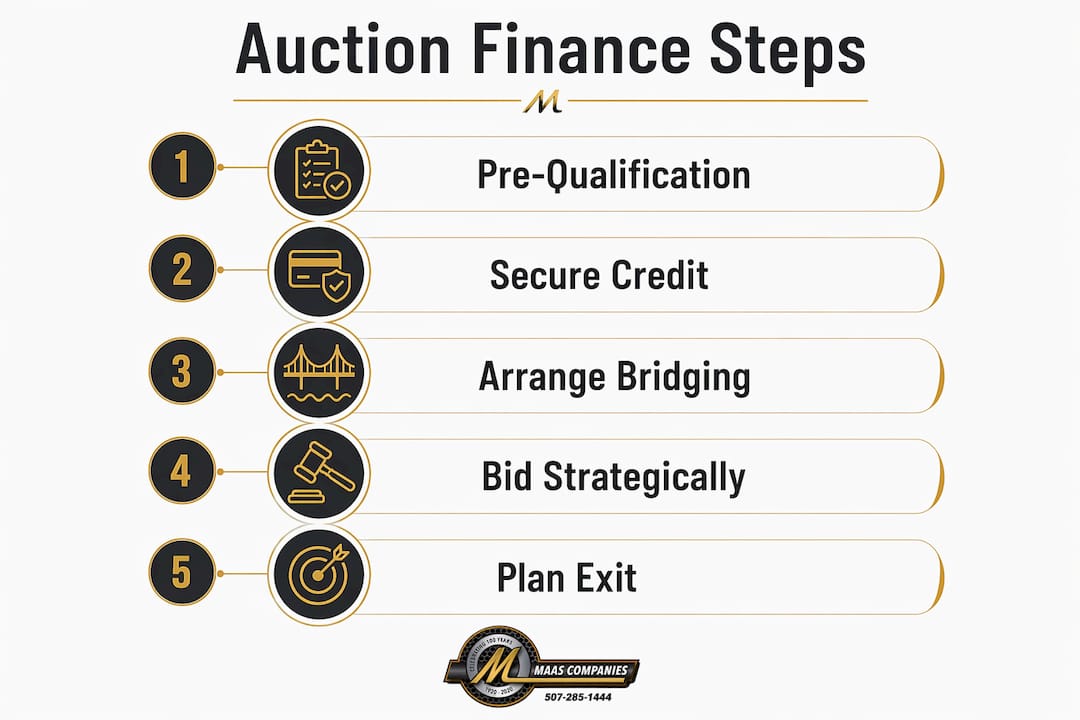
Pre-qualification is the foundation of any effective bidding strategy. Finance professionals advise integrating pre-auction financing strategies with real-time bid modeling to avoid post-auction funding failures. The sequence matters: finance approval first, bid modeling second, and then active participation. Reversing that order introduces capital risk at the worst possible moment.

Refinance stress testing has become standard practice among experienced auction participants. Rising interest rates have shifted investor behavior toward modeling refinance stress tests and rental coverage ratios strictly before bidding. Failure to model these scenarios increases capital requirements and risk exposure if valuations soften between acquisition and exit. A bidder who models only the acquisition cost without stress-testing the refinance environment is operating with incomplete financial analysis.
The following steps define a structured financial approach to auction participation:
- Secure formal credit approval for the asset category and value range before registering to bid.
- Model the exit plan with at least two scenarios: refinance at current rates and outright sale within 12 months.
- Apply rental coverage ratios if the asset generates income, confirming debt service coverage under stress conditions.
- Set a maximum bid ceiling based on the exit plan’s minimum acceptable return, not on auction room momentum.
- Confirm lender acceptance of the specific asset’s condition, title status, and any planning or environmental considerations.
- Arrange deposit funds separately from the credit facility, since most auctions require an immediate deposit of 10% on the day.
Pro Tip: Build your maximum bid from the exit plan backward. Start with the refinance or sale value you need to achieve, subtract costs and profit margin, and work back to the highest price that still makes financial sense. That number is your ceiling, regardless of what happens in the room.
How do auction finance mechanisms enable access to complex assets?
Specialist auction finance enables participants to acquire assets at discounts that are simply unavailable through conventional purchase channels. Bridging and refurbishment finance enables investors to access property discounts up to 45%, with total bridging completions surpassing £10 billion. Speed of finance execution determines whether a participant can secure these discounted assets before competing bidders arrange their own funding.
Industrial assets present the same opportunity at a different scale. A surplus processing plant or manufacturing facility sold through auction often carries a significant discount to replacement cost, reflecting the seller’s need for rapid capital recovery rather than the asset’s operational value. Participants who arrive with committed finance can bid with confidence at prices that reflect this discount. Those without pre-arranged funding cannot act decisively within the completion window.
The finance structure for complex auction assets typically involves two stages:
- Stage one: Short-term bridging finance completes the purchase within the auction deadline, typically drawing on a pre-approved credit facility.
- Stage two: Refinance or sale exits the bridging position once the asset is stabilized, refurbished, or repositioned.
This two-stage approach aligns short-term funding with longer-term exit solutions. Auction finance works as a process where lenders assess asset liquidity and credible exit plans more than borrower affordability. A participant acquiring a biodiesel plant or grain handling facility at auction needs a lender who understands industrial asset liquidation value, not one applying residential mortgage criteria to a commercial transaction. Understanding why companies auction machinery helps buyers anticipate the discount levels and asset conditions they will encounter.
Key Takeaways
Financial preparation before bidding is the single most important determinant of auction success, because capital readiness controls both bid confidence and post-sale completion.
| Point | Details |
|---|---|
| Pre-qualify before bidding | Secure formal credit approval for the asset type before registering, not after winning. |
| Lenders assess exit plans | Short-term lenders evaluate asset liquidity and refinance credibility, not borrower income. |
| Failed auctions carry costs | Unsold assets average a 1.3% price discount versus private treaty, signaling seller distress. |
| Market polarization is real | Tightening monetary policy widens the price gap between premium and lower-tier assets by measurable margins. |
| Speed determines access | Specialist finance with fast execution is the competitive advantage in securing discounted auction assets. |
Finance strategy is where auctions are won or lost
The conventional view treats auction finance as a logistical detail, something to arrange after the excitement of winning a bid. That view is wrong, and it costs participants real money. After working through numerous industrial asset transactions, the pattern is consistent: the participants who treat finance as a pre-bid discipline outperform those who treat it as a post-bid problem.
The market signals embedded in auction finance availability tell you more than the catalog does. When bridging lenders tighten criteria on a specific asset category, that is a direct signal about perceived liquidity risk. When specialist lenders compete aggressively for a deal, that signals strong exit plan credibility. Reading those signals requires integrating financial analysis into the auction preparation process, not separating the two.
The most common mistake I see is bidders who model acquisition cost without modeling the exit. They know what they can pay today but have not confirmed what the asset will be worth in 12 months under refinance conditions. That gap between acquisition confidence and exit uncertainty is where financial risk concentrates. Aligning your finance structure with a realistic, stress-tested exit plan is not conservative thinking. It is the only way to bid with genuine confidence.
Auction markets also reward participants who understand that auctions promote efficiency by transforming subjective valuations into objective price signals. That efficiency works in your favor when your financial analysis is sharper than the room’s. It works against you when you are bidding on momentum rather than modeled returns.
— Vector
Maascompanies and complex auction asset recovery
Maascompanies brings decades of experience to the financial and operational complexity of industrial asset auctions. From surplus processing equipment to full plant dispositions, Maascompanies structures each engagement around maximizing capital recovery for sellers while providing buyers with the asset intelligence needed to bid with confidence.

Current projects include a 3-MGY Biodiesel Plant auction encompassing oilseed processing facilities, grain handling infrastructure, manufacturing and warehouse space, retail fuel stations, and surplus equipment. For participants seeking to apply the financial strategies outlined here, this project represents a direct opportunity to engage with complex industrial assets at auction. Explore Maascompanies’ current project portfolio or contact the team to discuss asset recovery and disposition requirements.
FAQ
What is auction finance and how does it work?
Auction finance is short-term funding, typically a bridging loan, used to complete an auction purchase within the required deadline. Lenders assess the asset’s liquidity and the borrower’s exit plan rather than long-term repayment capacity.
How quickly must auction purchases be completed?
Most auctions require completion within 24–72 hours of the sale, making pre-arranged credit lines the only reliable funding mechanism. Arranging finance after winning a bid almost always results in penalties or forfeited deposits.
Why do failed auctions result in lower prices?
Failed auctions signal seller distress and market rejection, which buyers use as negotiating leverage in subsequent offers. Assets that fail at auction average a 1.3% price discount compared to private treaty sales.
How do interest rates affect auction bidding strategies?
Rising interest rates require bidders to model refinance stress tests and rental coverage ratios before placing any bid. Failure to account for rate conditions increases capital requirements and exposes the buyer to valuation risk at exit.
What types of assets require specialist auction finance?
Assets requiring specialist finance include properties needing refurbishment, industrial equipment with limited market comparables, and commercial sites with planning or environmental complications. Standard mortgage criteria cannot accommodate these asset conditions, so specialist lenders who understand liquidation value are required.
Recommended
- How to Choose the Right Auction for Industrial Equipment | Blog | Insights on Asset Liquidation and Auction Trends
- Auction absentee bidding: strategies for industrial equipment | Blog | Insights on Asset Liquidation and Auction Trends
- Auction strategies for small businesses: Maximize asset recovery | Blog | Insights on Asset Liquidation and Auction Trends
- How Auctions Help Speed Up Industrial Asset Disposition | Blog | Insights on Asset Liquidation and Auction Trends