

Blog
What Is the Sale Closure Process? A 2026 Guide

TL;DR:
- The sale closure process involves a structured sequence of steps to finalize and legally complete a transaction. It spans approximately 60 to 120 days and includes phases such as due diligence, contract signing, financing, and ownership transfer. Effective discipline and clear ownership throughout these phases significantly improve the chances of successfully closing deals.
The sale closure process is defined as the structured sequence of actions businesses follow to finalize and legally conclude a sales transaction, converting negotiated agreements into completed deals. Known formally as the sales finalization process, it encompasses due diligence, contract execution, financing confirmation, and ownership transfer. For decision-makers managing industrial assets, commercial properties, or complex acquisitions, mastering this process directly determines whether a deal generates revenue or collapses at the final stage. The difference between a closed deal and a failed one often comes down to process discipline, not negotiation skill.
What is the sale closure process, and what are its core steps?
The sale closure process follows a defined sequence of phases, each with specific deliverables and decision points. Closing a typical SME acquisition spans 60–120 days, with 90 days as the recommended planning average. That range reflects the complexity of aligning legal, financial, and operational workstreams simultaneously.
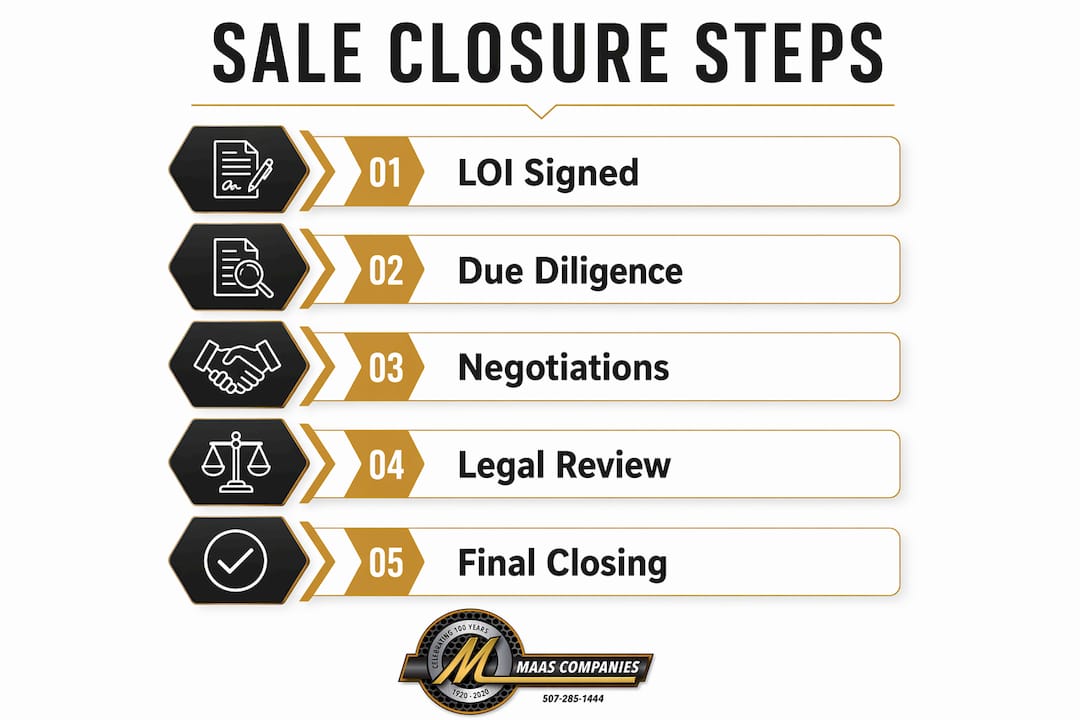
The process unfolds in six sequential stages:
-
Letter of Intent (LOI) signing. The buyer and seller agree on key terms in a non-binding document. The LOI typically triggers an exclusivity period, preventing the seller from negotiating with other parties while due diligence proceeds.
-
Due diligence review. The buyer examines financial records, contracts, liabilities, environmental reports, and operational data. This phase commonly runs 30–60 days and is where most deal-threatening issues surface.
-
Purchase agreement development. Legal counsel drafts the binding contract. The purchase agreement covers assets, price, warranties, indemnifications, and closing conditions, often spanning 40–80 pages. Every representation and warranty negotiated here carries post-closing legal weight.
-
Financing finalization. The buyer secures committed funding, whether through lender approval, equity confirmation, or internal capital allocation. Delays at this stage are among the most common causes of timeline overruns.
-
Third-party consents and regulatory approvals. Landlord consents, lender releases, government permits, and franchisor approvals must be obtained before closing day. Each consent introduces a dependency outside the buyer-seller relationship.
-
Closing day execution. Parties sign final documents, wire transfers are confirmed, and ownership formally transfers. Experienced dealmakers use signature escrow to collect signatures before funds arrive, eliminating last-minute delays caused by missing authorizations.
| Phase | Typical Duration | Key Output |
|---|---|---|
| LOI and exclusivity | 1–2 weeks | Signed LOI, exclusivity agreement |
| Due diligence | 30–60 days | Diligence report, issue log |
| Purchase agreement | 2–4 weeks | Executed purchase agreement |
| Financing and consents | 2–6 weeks | Lender commitment, third-party approvals |
| Closing day | 1 day | Wire confirmation, ownership transfer |
Which sales closing techniques improve success rates?
Closing techniques are tools that help buyers commit after trust and discovery work are already complete. Closing techniques do not replace established trust and discovery work. They bridge the final mental gap between a buyer who is interested and one who has signed.
The most effective techniques for B2B environments include:
- Next-Step Close. The seller secures a calendar-bookable next action before ending any conversation. Failing to secure a next step causes a 71% decrease in overall deal close rates. This single technique has more measurable impact than any other closing method.
- Summary Close. The seller restates the agreed benefits and terms, then asks for the decision. This technique works well when buyers have expressed multiple concerns that have been addressed over several meetings.
- Question Close. The seller asks a direct question that surfaces the buyer’s remaining objection. “What would need to be true for you to move forward this week?” forces a specific answer rather than a vague delay.
- Direct Ask. The seller simply asks for the business. Many deals stall because the seller never explicitly requests a commitment.
High-performing sales reps secure next-step commitments 53% more often than slower closers. That correlation reflects a discipline, not a personality trait. Matching the technique to the buyer’s communication style also matters. A detail-oriented buyer responds to the Summary Close. A decisive buyer responds to the Direct Ask.
Pro Tip: Before ending any sales call or meeting, confirm the next scheduled action in writing. A verbal agreement to “talk next week” is not a next step. A calendar invite with an agenda is.

Critical deal success factors are established during discovery, making closing techniques effective only when built on solid groundwork. Skipping thorough discovery and relying on technique alone produces pressure, not commitment.
What are the common challenges and risks in the sales finalization process?
The period between LOI signing and closing day is the most volatile phase of any transaction. Approximately 50% of deals that reach the LOI stage fail to close. That figure reflects the gap between agreeing on terms in principle and executing every legal, financial, and operational requirement in practice.
The most common risk factors include:
- Due diligence discoveries. Undisclosed liabilities, environmental issues, or revenue concentration in a single customer can cause buyers to renegotiate or walk away entirely.
- Financing contingencies. Lender conditions change. Appraisals come in below purchase price. Buyers lose committed capital. Each scenario can collapse a deal that appeared certain.
- Third-party approval delays. A landlord who takes six weeks to approve an assignment, or a regulator who requests additional documentation, can push a closing past a buyer’s financing commitment expiration.
- Deal fatigue. Extended timelines erode momentum. Both parties grow weary of the process, and minor issues take on outsized importance.
The final seven days before closing, known as the “whirlwind” phase, present the highest emotional volatility and the greatest risk of deal derailment. Experienced dealmakers avoid last-minute drama by using signature escrow, where documents are signed earlier but held until funds are confirmed, minimizing risk on closing day.
The LOI initiates a 30–60 day intensive period of negotiations, due diligence, and consents where half of deals fail despite initial agreement. That statistic underscores why the post-LOI phase requires as much attention as the negotiation that preceded it.
Pro Tip: Conduct a final inventory and asset verification within 48 hours of closing day. Discrepancies discovered after wire transfer create expensive post-closing disputes that damage relationships and consume legal resources.
For industrial asset transactions, the due diligence and risk mitigation requirements in final negotiation phases require specialized operational knowledge that generalist advisors often lack.
How can businesses apply best practices to close deals efficiently?
Treating closing as a disciplined, cross-functional operation that orchestrates stakeholder alignment and risk mitigation enables predictable revenues and fewer deal failures. That means closing is not the responsibility of the sales team alone. Legal, finance, operations, and senior leadership each own specific workstreams.
The following practices produce consistent results across industries:
-
Conduct rigorous discovery early. Issues surfaced during discovery are negotiating points. Issues surfaced during due diligence are deal threats. The more thoroughly a seller understands their own asset, liability, and operational profile before going to market, the fewer surprises derail the closing phase.
-
Secure explicit next steps at every interaction. Every meeting, call, and email exchange should end with a confirmed, scheduled next action. This applies to both sales conversations and legal or financial coordination calls.
-
Build a closing checklist and assign owners. Each deliverable, including consent letters, lender confirmations, title searches, and final financial statements, should have a named owner and a deadline. Unassigned tasks do not get completed.
-
Establish communication protocols. Define who communicates with whom, at what frequency, and through which channels. Miscommunication between buyer and seller counsel is a leading cause of closing delays.
-
Plan for post-closing transition. Ownership transfer is not the end of the process. Transition plans covering staff, customer relationships, vendor contracts, and operational handoffs determine whether the deal creates the value both parties expected.
For sellers managing industrial plant sale timelines and documentation requirements, a structured checklist approach reduces the risk of missing critical deliverables in the final weeks before closing.
Pro Tip: Assign a single point of contact on each side of the transaction to coordinate all closing communications. Fragmented communication across multiple contacts on either side is the fastest way to create confusion and delay.
Matching closing technique to buyer communication style improves natural progression to commitment without pressure. The same principle applies to cross-functional coordination. Align your internal communication style to the decision-making culture of the counterparty.
Key Takeaways
The sale closure process succeeds when legal, financial, and operational workstreams are coordinated as a single disciplined operation, not managed as separate tasks.
| Point | Details |
|---|---|
| Define the process clearly | Sale closure spans LOI signing through ownership transfer, typically 60–120 days for SME acquisitions. |
| Prioritize next-step discipline | Failing to secure a scheduled next step reduces close rates by 71%; top reps secure next steps 53% more often. |
| Manage post-LOI risk actively | Half of all deals that reach LOI stage fail to close; due diligence and financing phases require dedicated oversight. |
| Use signature escrow | Collecting signatures before closing day eliminates last-minute delays caused by missing authorizations. |
| Treat closing as cross-functional | Assign named owners to every deliverable and establish clear communication protocols across legal, finance, and operations. |
What experience has taught me about closing deals that actually stick
Most organizations treat the sale closure process as the finish line. The deals I have seen fail most often did not collapse because of bad negotiation. They collapsed because no one owned the process between the LOI and the wire transfer. That gap, those 60–90 days of due diligence, consents, and document preparation, is where discipline separates completed transactions from expensive near-misses.
The professionals who close consistently share one habit. They treat every interaction as a process step with a defined output, not a conversation. They do not leave a meeting without a confirmed next action. They do not send a document without confirming receipt and a review deadline. That level of operational rigor feels excessive until you watch a deal fall apart in the final week because a consent letter was never followed up on.
For industrial and commercial asset transactions specifically, the closing phase requires coordination across environmental, legal, operational, and financial workstreams simultaneously. Generalist approaches do not hold up under that complexity. The organizations that close reliably build specialized teams or engage partners who have executed these transactions before and know where the risks concentrate.
Closing is not a skill. It is a system. Build the system first, then apply the techniques.
— Vector
Maascompanies and the asset sale closure process
Maascompanies brings decades of experience managing the full sale closure cycle for industrial plants, commercial real estate, and surplus equipment across international markets.

When a plant closure, restructuring, or capital recovery event triggers an asset sale, the closing process requires more than a buyer and a contract. It requires coordinated marketing, qualified buyer development, legal documentation support, and closing-day execution. Maascompanies manages each phase with the operational discipline that complex asset transactions demand. Professionals managing surplus equipment or facility dispositions can review active industrial auction projects or connect directly through the sell industrial equipment service page to discuss recovery options tailored to their specific asset profile.
FAQ
What is the sale closure process in simple terms?
The sale closure process is the structured sequence of steps that converts a negotiated agreement into a legally completed transaction, covering due diligence, contract execution, financing, and ownership transfer.
How long does the sale closure process typically take?
Closing a typical SME acquisition spans 60–120 days, with 90 days as the recommended planning average, depending on the complexity of due diligence and third-party approvals required.
Why do so many deals fail after the LOI is signed?
Approximately 50% of deals that reach the LOI stage fail to close, most often due to issues uncovered during due diligence, financing contingencies, or delays in obtaining third-party consents.
What is the most effective sales closing technique?
The Next-Step Close is the most measurable technique. Failing to secure a calendar-bookable next step before ending a sales call causes a 71% decrease in overall deal close rates.
What is a sales agreement in the context of deal closure?
A sales agreement, also called a purchase agreement, is the binding contract that defines the assets, price, warranties, indemnifications, and conditions that must be satisfied before ownership transfers. It typically spans 40–80 pages in complex transactions.
Recommended
- Liquidate Surplus Inventory Process: A 2026 Guide | Blog | Insights on Asset Liquidation and Auction Trends
- What Is a Bulk Sale? A 2026 Guide for Business Professionals | Blog | Insights on Asset Liquidation and Auction Trends
- Liquidation sales explained: Maximize asset recovery | Blog | Insights on Asset Liquidation and Auction Trends
- Bankruptcy Asset Sale Procedures: A 2026 Guide | Blog | Insights on Asset Liquidation and Auction Trends