

Blog
How to Assess Real Estate Deals: A Professional Guide

Assessing real estate deals requires simultaneous command of quantitative metrics and qualitative judgment. The core financial measures every investor must calculate are Net Operating Income (NOI), Capitalization Rate (Cap Rate), Cash-on-Cash Return, Debt Service Coverage Ratio (DSCR), Cash Flow, and total return (Internal Rate of Return, IRR). Beyond the numbers, deal viability depends on the quality of the people involved, local market conditions, and the financing climate. Property valuation methods, including comparable sales analysis and After Repair Value (ARV), anchor the quantitative side, while the Real Estate Diamond framework introduced by Harvard Business School Professor Arthur Segel, provides a structured lens for the qualitative side. A deal that passes only the financial screen but fails on market conditions or capital availability is not a sound investment.
Key components of a thorough deal assessment include:
- Financial metrics: NOI, Cap Rate, Cash-on-Cash Return, DSCR, Cash Flow, and IRR
- Valuation methods: Comparable sales, income approach, and ARV for value-add or distressed assets
- Qualitative factors: Seller motivation, tenant quality, broker relationships, and local economic trends
- Capital conditions: Loan availability, interest rate environment, and lender underwriting criteria
- Investment type: Rental, fix-and-flip, BRRRR, commercial, or mixed-use, each with distinct analysis requirements
- Deal customization: Stress-tested assumptions for rent, vacancy, operating expenses, and financing terms
How to assess real estate deals using core financial metrics
The most reliable starting point in real estate deal analysis is NOI, calculated as gross rental income minus all operating expenses, excluding debt service. NOI tells you what the property earns before financing costs enter the picture. From NOI, you derive the Cap Rate by dividing NOI by the property’s purchase price or current market value, expressed as a percentage. Cap Rate enables direct comparison across properties regardless of financing structure.
Cash-on-Cash Return measures the annual pre-tax cash flow against the total cash invested, making it the most relevant metric for investors using leverage. A property generating $12,000 in annual cash flow on $120,000 of invested equity produces a 10% Cash-on-Cash Return. DSCR, calculated as NOI divided by annual debt service, tells lenders and investors whether the property’s income covers its mortgage obligations. DSCR loans typically require 1.20x to 1.30x coverage to fund deals, meaning the property must generate at least $1.20 in NOI for every $1.00 of debt payment.
Cash Flow analysis demands careful expense normalization. Turnover costs, including cleaning, painting, repairs, and 2–4 weeks of vacancy downtime, are frequently under-accounted for, which inflates projected NOI and leads to deal failures post-acquisition. Property tax reassessment is another critical variable: after purchase, tax bills can increase 40%–100%, which can flip a positive cash flow to negative. Both items must be modeled before finalizing any offer.
For value-add and distressed assets, ARV drives the analysis. The Maximum Allowable Offer (MAO) formula is: (ARV × 70%) minus repair costs. This reserves roughly 30% of ARV to cover profit, closing costs, and carrying costs, providing a conservative ceiling for the purchase price.
| Metric | Formula | Purpose |
|---|---|---|
| NOI | Gross Income − Operating Expenses | Measures property earning power before debt |
| Cap Rate | NOI ÷ Property Value | Enables cross-property comparison |
| Cash-on-Cash Return | Annual Cash Flow ÷ Cash Invested | Measures return on equity deployed |
| DSCR | NOI ÷ Annual Debt Service | Assesses debt repayment capacity |
| Cash Flow | Gross Income − All Expenses (including debt service) | Measures net income available to owner |
| MAO (ARV method) | (ARV × 70%) − Repair Costs | Sets maximum purchase price for distressed assets |
| IRR | Discounted cash flows over hold period | Measures efficiency of capital over time |
Pro Tip: Never rely on pro forma rents when calculating NOI. Verified rental income should be based on current executed leases or 3–5 comparable market rents. Using projected rents inflates returns and is the most common error in rental property analysis.
Qualitative factors that determine whether a deal actually works
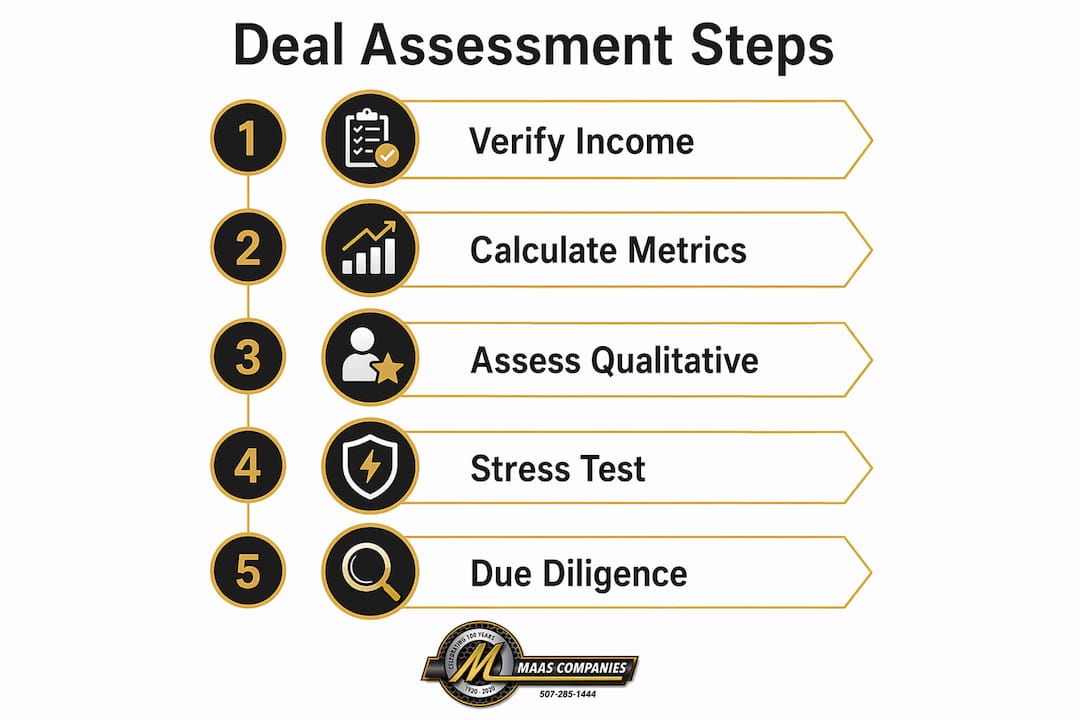
Local market knowledge is not a supplement to quantitative analysis. It is a prerequisite. Automated valuation tools are necessary but insufficient without direct knowledge of tenant demand, neighborhood trajectory, and economic drivers. A property with a 7% Cap Rate in a market with declining employment and rising vacancy is a fundamentally different risk than the same Cap Rate in a supply-constrained metro.

The people involved in a transaction carry weight that no spreadsheet captures. Seller motivation affects negotiating leverage and deal structure. Tenant quality determines income reliability. Broker relationships influence deal flow and access to off-market opportunities. Harvard Business School Professor Arthur Segel, who introduced the Real Estate Diamond framework, notes that real estate’s flexible deal structure makes every transaction a negotiation and the quality of those relationships directly affects outcomes.
Capital market conditions set the ceiling on what a deal can support. Loan availability, underwriting criteria, and prevailing interest rates all shift the effective cost of capital. A deal that pencils at 5% financing may not work at 7%. Monitoring lender appetite, particularly for asset types like industrial or mixed-use, is part of evaluating property investments at a professional level.
Key qualitative assessment points:
- Verify seller motivation and any distress signals that affect negotiating position
- Assess tenant credit quality, lease terms, and renewal probability
- Evaluate local employment trends, population growth, and absorption rates
- Identify any zoning, environmental, or regulatory constraints on the asset
- Confirm capital availability for the specific asset class and geography
- Review broker track record and alignment of interests in the transaction
How to customize deal parameters and use analysis tools effectively
No two deals share identical assumptions. Setting the right inputs for rent, vacancy, operating expenses, and financing terms requires direct market research, not default figures from a generic template. Vacancy assumptions, for example, should reflect the submarket’s actual absorption rate, not a standard 5% placeholder. Operating expense ratios vary by property age, asset class, and management structure.

Scenario analysis and stress testing are where disciplined investors separate viable deals from marginal ones. Stress test scenarios should include a 10% rent decline, doubling vacancy to 14%, and a 1% interest rate increase. A deal that cannot remain cash flow-positive under these conditions carries fragility that may not be acceptable depending on your risk tolerance and hold period.
Pro Tip: Analytical platforms accelerate deal screening, but they do not replace investor judgment. Use software to generate initial screens and flag outliers, then apply manual review to any deal that clears the first filter. Aligning your investment and financial goals before setting deal parameters prevents chasing metrics that do not match your actual capital deployment strategy.
Best practices for deal parameter customization:
- Source rent comparables from active listings and recent lease transactions, not listing averages
- Model property tax at the post-reassessment rate, not the current owner’s bill
- Include a capital expenditure reserve appropriate to the property’s age and condition
- Run at least three scenarios: base case, downside, and severe stress
- Recalculate DSCR and Cash-on-Cash Return under each scenario before finalizing an offer
- Document all assumption sources so the analysis can be audited or updated as conditions change
Types of real estate investments and how deal analysis varies by category
Each investment category demands a different analytical emphasis. Understanding those differences prevents applying the wrong framework to a deal.
- Rental properties (single-family and multifamily): Cash-on-Cash Return and DSCR are the primary screens, but analysis should also integrate Cash Flow and total return (IRR). Expense normalization, including turnover costs and property management fees, is critical. The 1% Rule suggests monthly rent should equal at least 1% of the purchase price; deals below 0.8% face rejection from most lenders and experienced investors.
- Fix-and-flip: ARV and the MAO formula drive the analysis. Holding costs, financing costs, and contractor reliability are the primary risk variables. Speed of execution directly affects profitability.
- BRRRR (Buy, Rehab, Rent, Refinance, Repeat): Combines flip-style ARV analysis with long-term rental underwriting. The refinance appraisal is the critical variable; if the post-rehab value does not support the target loan amount, capital remains trapped in the deal.
- Commercial and industrial: NOI, Cap Rate, Cash Flow, and lease structure dominate. Tenant credit quality, lease term length, and triple-net versus gross lease structures determine income predictability. Industrial real estate checklist considerations include environmental compliance, clear height, and loading dock access.
- Mixed-use: Requires separate income and expense analysis for each use component. Retail vacancy risk and residential demand must be modeled independently before blending into a combined NOI.
Applying the Real Estate Diamond framework to strategic deal evaluation
The Real Estate Diamond framework, developed by Harvard Business School Professor Arthur Segel, organizes deal analysis around four interconnected factors: the physical product, the people involved, the external environment, and the capital markets. No single factor operates in isolation. A strong physical asset in a deteriorating market environment with constrained capital access is a weaker deal than its metrics suggest.
The product assessment covers physical condition, location quality, infrastructure soundness, and local supply and demand. The people dimension addresses seller, tenant, lender, and broker relationships, recognizing that deal structure flexibility in real estate makes relationship quality a direct driver of returns. The external environment captures factors outside investor control: demographic shifts, regulatory changes, and macroeconomic conditions. Capital markets analysis determines how the deal will be financed and at what cost.
Experienced investors prioritize deal fit with their strategy over raw numbers, factoring in risk tolerance, capital availability, and hold period before committing. A property with attractive Cap Rate metrics that misaligns with an investor’s hold strategy or liquidity needs should be passed over.
Expert evaluation checkpoints using the Diamond framework:
- Confirm the physical asset’s condition through independent inspection, not seller disclosure alone
- Map all key relationships and identify any conflicts of interest before proceeding
- Assess external environment risks: zoning changes, infrastructure plans, and demographic trends
- Verify capital market access for the specific asset type, including lender appetite and loan terms
- Synthesize quantitative outputs with qualitative findings before making a final offer decision
- Align the deal’s hold period and exit strategy with your portfolio’s capital deployment timeline
Timeline and costs to factor into every deal assessment
Deal assessment is not free, and the timeline from initial screen to closing carries real carrying costs. A typical acquisition process for a commercial or industrial asset runs 60–120 days from letter of intent to close, depending on due diligence complexity, title work, and financing approval timelines. Each day in that window represents holding costs on any bridge financing or earnest money deployed.
Assessment-related costs include third-party appraisal fees, environmental phase I and phase II reports, title search and insurance, legal review, and inspection fees. For industrial or specialized assets, equipment appraisals and zoning compliance reviews add to the cost and timeline. These costs are not recoverable if the deal falls through, so they must be weighed against deal probability before committing to full due diligence expenditure. Phasing due diligence, starting with lower-cost desktop analysis before ordering expensive field reports, is standard practice among experienced investors. For guidance on appraising industrial assets, the complexity of specialized property types makes professional appraisal a non-negotiable line item.
Risk assessment and mitigation strategies for real estate deals
Every deal carries identifiable and manageable risks. The discipline is in quantifying them before closing, not discovering them afterward. Market risk, credit risk, physical risk, and financing risk each require a specific mitigation approach.
Market risk is addressed through stress testing, as described earlier, and through conservative vacancy and rent assumptions grounded in verified submarket data. Credit risk, particularly in commercial deals, requires tenant financial review and lease structure analysis. A single-tenant net lease to a creditworthy national tenant carries fundamentally different risk than a multi-tenant retail strip with month-to-month occupancies. Physical risk is mitigated through independent inspection, environmental review, and capital expenditure reserves sized to the asset’s age and condition. Financing risk requires modeling the deal’s DSCR and Cash-on-Cash Return across a range of interest rate scenarios, given that a 0.5% rate change can swing annual debt service by thousands, altering deal viability entirely.
Concentration risk is often overlooked. Investors who deploy capital into a single asset class, geography, or tenant type amplify the impact of any single adverse event. Portfolio-level thinking, even on individual deal decisions, reduces this exposure.
Due diligence checklist: legal, title, and physical inspection
Due diligence is the process of verifying every material assumption made during deal analysis. A failed due diligence finding does not necessarily kill a deal, but it must be repriced into the offer or addressed through a contingency.
Legal review covers entity structure, existing contracts, litigation history, and any encumbrances on the property. Lease abstracts for all existing tenants must be reviewed for assignment restrictions, co-tenancy clauses, and termination rights that could affect income post-acquisition.
Title review confirms clean ownership transfer and identifies any liens, easements, or encroachments that affect use or value. Title insurance protects against undiscovered claims, but it does not substitute for a thorough title search before closing.
Physical inspection should be conducted by a licensed inspector with experience in the specific asset class. For industrial properties, this includes structural assessment, roof condition, HVAC systems, electrical capacity, and environmental compliance. Any deferred maintenance identified during inspection must be repriced into the acquisition cost and capital expenditure reserve.
Financial verification during due diligence confirms that actual rent rolls, operating statements, and tax records match the seller’s representations. Discrepancies between represented and actual income are grounds for renegotiation or withdrawal.
How financing options and loan structures affect deal value
Financing is not a passive input in real estate deal analysis. The loan structure directly determines cash flow, return on equity, and exit flexibility. Conventional loans, DSCR loans, bridge loans, and seller financing each carry different costs, qualification criteria, and risk profiles.
DSCR loans underwrite to the property’s income rather than the borrower’s personal income, making them the standard tool for investment property acquisition. As noted, most lenders require 1.20x to 1.30x DSCR coverage. Bridge loans provide short-term capital for value-add or transitional assets but carry higher rates and fees that must be modeled into the deal’s carrying costs. Seller financing, when available, can reduce upfront capital requirements and provide more flexible terms, but it introduces counterparty risk that requires legal structuring.
Interest rate sensitivity is a first-order concern in any leveraged deal. A deal underwritten at a specific rate must be stress-tested at higher rates before commitment. Prepayment penalties, loan assumption provisions, and recourse versus non-recourse structures all affect exit strategy flexibility and should be reviewed by legal counsel before closing. For complex industrial or commercial transactions, the industrial plant sale checklist framework provides a useful reference for aligning financing structure with asset recovery objectives.
Working with Maascompanies on complex real estate deal assessment

Maascompanies brings decades of experience to the assessment and marketing of industrial plants, commercial properties, and specialized real estate assets across the United States and internationally. When a deal involves distressed assets, plant closures, or complex multi-asset portfolios, the analytical framework described in this guide must be executed with precision and market knowledge that generic platforms cannot provide. Maascompanies applies rigorous financial and qualitative analysis to maximize recovery value for sellers and provide buyers with credible, verified deal parameters.
For investors and lenders evaluating complex asset recovery opportunities, view current auction projects to see active deals where thorough assessment directly drives recovery outcomes.
Key Takeaways
Accurate real estate deal assessment requires integrating verified financial metrics, stress-tested scenarios, qualitative market factors, and thorough due diligence before any offer is made.
| Point | Details |
|---|---|
| NOI and Cap Rate are the foundation | Calculate NOI from verified income and normalized expenses before deriving Cap Rate or DSCR. |
| Tax reassessment is a deal-breaker risk | Post-purchase property taxes can rise significantly, potentially flipping positive cash flow to negative if not modeled upfront. |
| Stress test before committing | Test scenarios including a rent decline, increased vacancy, and a rise in interest rates to confirm deal resilience. |
| The MAO formula protects your margin | Use (ARV × 70%) minus repair costs to set a conservative maximum offer on distressed or value-add assets. |
| Qualitative factors carry equal weight | The Real Estate Diamond framework requires assessing product, people, environment, and capital markets together, not in isolation. |
Recommended
- Real Estate Disposal Guide for Business Decision-Makers | Blog | Insights on Asset Liquidation and Auction Trends
- Commercial Property Sale Guide for Investors and Owners | Blog | Insights on Asset Liquidation and Auction Trends
- Step-by-step asset auction guide for maximizing recovery | Blog | Insights on Asset Liquidation and Auction Trends
- Why Conduct Equipment Appraisals: A Corporate Finance Guide | Blog | Insights on Asset Liquidation and Auction Trends