

Blog
Industrial Property Marketing Guide 2026: Maximize Recovery

Set the end state first. Every subsequent decision — enforcement pathway, remediation scope, sale channel, and marketing timeline — flows from that single executive choice. BCG reports that companies may face closure decisions affecting up to one in three industrial assets this decade, and that treating closures as a portfolio strategy protects and creates financial, operational, and reputational value. This property marketing guide for 2026 is built for executives, lenders, private-equity firms, and government clients who need a disciplined, decision-focused playbook.
Three immediate actions:
- Lock the site end state (remediate, sell as-is, repurpose, or redevelop) with executive sponsor sign-off.
- Retain jurisdictional counsel to confirm the enforcement pathway — receivership, UCC Article 9, Section 363, or judicial foreclosure.
- Begin asset characterization and marketing scoping with a qualified marketing partner such as Maas Companies.
Success metrics to track from day one: net recovery percentage against appraised value, days-to-close by lot or phase, and compliance milestone delivery against the regulatory schedule.
Key Takeaways
A disciplined 2026 industrial property disposition program begins with a locked end state and a confirmed enforcement pathway — every other decision, from marketing channel to contract structure, depends on those two choices.
| Point | Details |
|---|---|
| Lock end state first | Define remediate, sell, repurpose, or redevelop before scoping marketing or remediation. |
| Enforcement pathway is a recovery lever | Receivership, UCC Article 9, Section 363, and judicial foreclosure each produce different net recovery, speed, and litigation risk. |
| Marketing lead times are fixed constraints | Small equipment packages need 2–4 weeks; whole-plant programs require 3–6 months of marketing lead time. |
| Financial dashboard protects cash | Track forecast net proceeds, capex-to-close, remediation provisions, and days-to-close in one integrated view. |
| Maascompanies as strategic partner | Maascompanies provides auction, negotiated-sale, and marketing execution services to maximize recovery for corporate, lender, and government clients. |
Table of Contents
- What is your desired end state, and how does it drive strategy?
- Which enforcement and disposition pathway maximizes your recovery?
- How do you inventory and value assets before marketing?
- How do you select a sale channel and run a marketing program that reaches buyers?
- How should you structure sale contracts to protect proceeds?
- What financial controls protect cash during a disposition program?
- What does a critical-path timeline look like for an industrial sale program?
- How do you manage compliance, community, and cybersecurity risk during marketing?
- Why reframing closure as strategy creates measurable value
- Maas Companies: a strategic partner for disposition programs
- Sources
What is your desired end state, and how does it drive strategy?
Backward planning is the discipline that separates high-recovery programs from reactive ones. Define the end state before scoping remediation, selecting a sale channel, or engaging buyers.
Four primary end states and their strategic implications:
- Remediate and sell as-is. Scope environmental work to meet transfer standards; price residual risk into the sale or disclose it with an as-is disclaimer. Buyer pool: industrial redevelopers and opportunistic investors.
- Sell operating assets in place. Preserve equipment in operating condition; target strategic buyers who can restart or repurpose production. Requires tighter removal windows and buyer prequalification.
- Repurpose for alternative use. Logistics, data center, or light-industrial conversion. Engage developers early; their input on utility capacity and floor-load specs can reduce remediation scope materially.
- Redevelop for energy or mixed use. Renewable-energy developers and municipal partners often require long lead times for permitting. Early engagement preserves optionality and can generate premium offers.
Translate the chosen end state into measurable success metrics: a regulator-approved remediation date, a target net-proceeds floor, and a land-transfer deadline. These become the gates that govern every downstream decision.
Pro Tip: Engage two or three prospective future owners during the characterization phase, before marketing formally opens. Their feedback on site constraints often reduces remediation scope and accelerates the sale timeline.
- Commercial value vs. remediation cost: if remediation exceeds residual land value, a negotiated sale with buyer indemnity may recover more than a clean-title transfer.
- Seasonal environmental windows (wetland surveys, soil sampling) must be mapped to the marketing calendar or they become critical-path delays.
- Buyer-specific premiums are real: an energy developer may pay above salvage value for transmission access; a logistics operator may pay for clear-span square footage alone.
Which enforcement and disposition pathway maximizes your recovery?
Enforcement mechanism choice materially changes net recovery, timeline, and litigation exposure — select with counsel based on collateral type and jurisdiction.
- Court-appointed receivership. A receiver takes control of the asset, preserves value, and manages the sale under court supervision. Suitable for complex multi-asset portfolios or contested situations. Timeline varies by court docket.
- UCC Article 9 disposition. Applies to personal property. Requires commercially reasonable notice and a commercially reasonable sale process. Faster than judicial routes but vulnerable to challenge if notice or process is deficient.
- Section 363 sale. Bankruptcy-court-supervised auction that can transfer assets free and clear of liens and claims. Credit-bidding by secured lenders is a key feature. Attracts a broad buyer pool and provides strong title protection.
- Judicial foreclosure. Real-estate-centric; timeline and redemption rights vary significantly by state. Slower but provides clear title through court order.
Jurisdictional callouts: Connecticut’s Uniform Commercial Real Estate Receivership Act (UCRERA) provides a structured receivership framework with defined receiver powers. New York’s Single Action Rule limits lenders to one enforcement action — choosing foreclosure may waive deficiency rights on personal property. Underutilized Connecticut tools — assignment of rents, prejudgment attachments, and replevin — can materially increase recovery when deployed alongside foreclosure.
Procedural errors on notice or sale process can void proceeds or expose deficiency claims. Retain specialized counsel before selecting a pathway, not after.
How do you inventory and value assets before marketing?
Complete asset characterization before marketing opens. Gaps discovered mid-campaign suppress bids and extend timelines.
Inventory scope:
- Real estate parcels, title, and encumbrance status
- Building systems: electrical, HVAC, utilities, structural condition
- Machinery and equipment: run-lists, age, maintenance logs, OEM documentation
- Spare parts, raw materials, and finished inventory
- Intellectual property: patents, licenses, proprietary processes
Technical profiling requirements:
- Hazardous-materials inventory (asbestos, lead, PCBs)
- Phase I and Phase II environmental site assessments
- Subsurface and soil data where contamination is suspected
- Utility termination constraints and decommissioning requirements
- Removal access, crane paths, and logistics constraints
Valuation separates real estate from personal property. Real estate is appraised on market comparables and income potential; personal property is valued on salvage, replacement-cost avoidance, and buyer-specific premiums. A steel press worth scrap value to a generalist may command a strategic premium from a buyer who needs that exact tonnage capacity.
Document package for buyers: environmental reports, equipment run-lists, maintenance logs, title documents, active permits, and removal timelines. A complete package reduces buyer due-diligence time and supports higher, faster bids.
How do you select a sale channel and run a marketing program that reaches buyers?
Match sale channel to asset liquidity and strategic objectives. Industrial auction marketing requires targeted buyer segmentation, clear technical information, and realistic lead times — generally, marketing lead times span a few weeks for small equipment packages and several months for whole-plant programs.
Buyer personas and acquisition motivations:
- Industrial operators and dealers. Seek specific equipment at market price; respond to technical specs and condition reports.
- International resellers. Price-sensitive; activated by targeted email campaigns and catalog distribution in their home markets.
- Developers and energy players. Evaluate land, utilities, and permitting potential; require early engagement and site data.
- Private-equity turnaround investors. Assess enterprise value; need financial data, operational history, and clean title.
Outreach sequence for a whole-plant program:
- Build targeted buyer lists by SIC code, equipment type, and geography.
- Deploy email campaigns with technical catalogs and inspection invitations.
- Run paid search and SEO targeting technical equipment terms.
- Execute LinkedIn outreach to procurement and operations decision-makers.
- Place direct calls to strategic buyers identified through industry networks.
- Distribute print and digital catalogs to dealer and reseller networks.
Channel-specific tactics: online and hybrid auctions drive price discovery and speed; confidential data rooms support negotiated sales for sensitive transfers; pre-pack and stalking-horse strategies in Section 363 proceedings attract committed buyers before the auction opens.
Pro Tip: Align inspection windows, dismantling schedules, and marketing campaign peaks. A buyer who cannot inspect during the campaign window will not bid at full value.
Maascompanies deploys audience segmentation, technical content production, logistics coordination, and international buyer activation as integrated components of every disposition program.
How should you structure sale contracts to protect proceeds?
Align the contract model to scope certainty. Lump-sum contracts work where scope is fixed and measurable; unit-rate or time-and-material structures suit removal work with variable scope; hybrid models with performance incentives improve outcomes on safety, schedule, and environmental compliance.
Contract terms checklist:
- Buyer payment timing and escrow mechanics
- Credit-bidding rights for secured lenders
- Removal windows with liquidated damages for overruns
- Buyer indemnities for post-transfer environmental claims
- As-is disclaimers or limited warranties, clearly scoped
- Title transfer triggers tied to payment receipt and removal completion
Bidder prequalification criteria: safety record, demonstrated removal capability, environmental compliance history, and financial capacity to close. Prequalification reduces buyer-default risk and protects the sale timeline.
Holdbacks tied to removal completion and site restoration give sellers a financial lever without requiring litigation. Structure them as a percentage of the purchase price held in escrow, released against third-party inspection sign-off.
What financial controls protect cash during a disposition program?
Adopt probabilistic cost estimation and an integrated dashboard to track P&L, cash flow, provisions, and schedule in one place. A single-point cost estimate for remediation or removal is almost always wrong; a range with scenario modeling is more defensible and supports better board reporting. For practical financial architecture guidance, CFOs managing closures should establish gates before funds are released.
Dashboard fields to track:
- Forecast net proceeds by lot and in aggregate
- Capex-to-close: removal, remediation, and carrying costs
- Remediation provisions and contingency draw-down rate
- Days-to-close by phase
- KPI by lot or asset category
- Stakeholder and regulatory milestone status
Execution controls: release funds against verified invoice milestones, not calendar dates. Tie escrow disbursements to removal completion confirmed by independent inspection. Tax timing matters — write-off timing for removed assets and treatment of remediation costs as capital or operating expense should be confirmed with tax counsel before the program begins.
Recommended reporting cadence: weekly operational review with the program manager; monthly executive review against the financial dashboard; quarterly board update on provisions and net-recovery forecast.

What does a critical-path timeline look like for an industrial sale program?
An end-to-end program runs from scoping through characterization, marketing, sale, removal, and close. Structured liquidation programs for small asset bundles typically complete in 4–8 weeks; whole-plant programs run 3–6 months, with long-lead items — environmental permits, regulatory approvals, and utility disconnections — often determining the critical path.
Owner responsibility matrix:
- Executive sponsor: end-state approval, financial gates, board reporting
- Legal counsel: enforcement pathway, title, contract review, regulatory filings
- Operations: asset access, safety protocols, utility management
- Marketing partner: buyer outreach, catalog production, auction management
- Environmental contractor: Phase I/II, remediation, permit applications
- Logistics: removal sequencing, carrier coordination, site restoration
Gates checklist:
- End-state and budget approved by executive sponsor
- Counsel retained; enforcement pathway confirmed
- Asset characterization complete; document package assembled
- Marketing partner engaged; buyer list and campaign calendar set
- Inspection windows scheduled; safety protocols in place
- Bids received; buyer prequalification confirmed
- Escrow funded; title transfer documents executed
- Removal complete; site inspection signed off; escrow released
How do you manage compliance, community, and cybersecurity risk during marketing?
Integrate compliance, community engagement, and data security into the marketing plan from the start. Treating them as afterthoughts creates delays, litigation exposure, and reputational damage that suppresses buyer confidence.
Risk matrix by category:
- Environmental liabilities: undisclosed contamination discovered during buyer due diligence is the single most common cause of bid withdrawal. Commission Phase II assessments before marketing opens.
- Permit dependencies: utility disconnection permits, demolition permits, and environmental closure approvals can each add weeks. Map them to the critical path.
- Worker safety during inspections and removal: OSHA compliance during buyer inspections is the seller’s responsibility. Appoint a site safety officer for all inspection events.
- Community relations: plant closures affect local employment and tax base. Appoint a single spokesperson; communicate timeline and transition support proactively.
- Data and cybersecurity: buyer data rooms containing financial records, IP, and operational data require access controls, redaction of sensitive fields, and vendor due diligence on the platform provider.
Pro Tip: Redact employee personal data, customer contracts, and proprietary process parameters from buyer data rooms before granting access. A data-room breach during marketing creates both regulatory exposure and buyer distrust.
Escalate to counsel immediately when title defects surface, contamination exceeds disclosure thresholds, litigation is threatened, or the transaction involves cross-border buyers subject to CFIUS review.
Why reframing closure as strategy creates measurable value
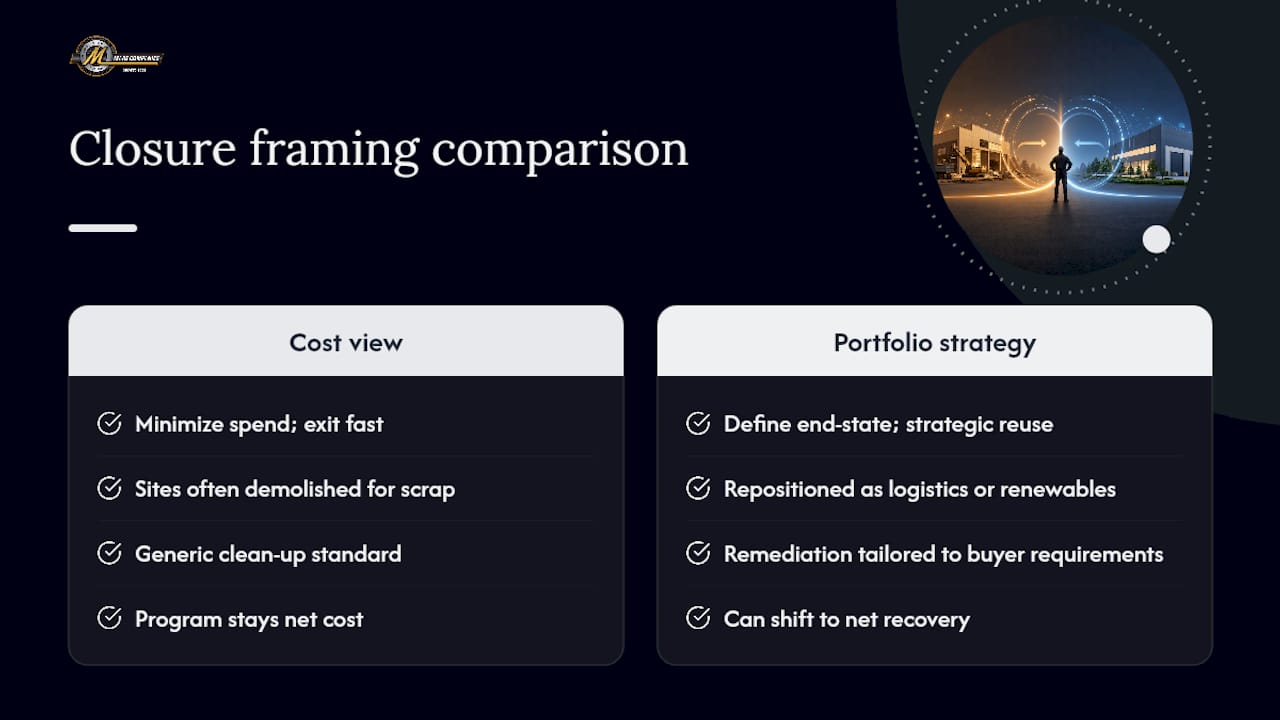
The conventional view treats plant closure as a cost-containment exercise: minimize spend, exit quickly, and move on. That framing consistently leaves value on the table.
When closure is treated as a portfolio strategy — with a defined end state, a disciplined financial architecture, and a marketing program that reaches the right buyers — the outcomes are materially different. Sites that might have been demolished for scrap have been repositioned as logistics hubs or renewable-energy installations, generating proceeds that exceed remediation costs. Early end-state clarity reduces the remediation scope because the future owner’s requirements, not a generic clean-up standard, define the work. That distinction alone can shift a program from net cost to net recovery.
The financial and reputational case is equally clear. Carrying costs accumulate on idle assets: insurance, security, property taxes, and environmental monitoring. Every month of delay is a quantifiable loss. A well-run disposition program compresses that timeline and converts a liability into a capital event.
Executives who own this process — rather than delegating it entirely to legal or operations — consistently achieve better outcomes. The end-state decision is a strategic one, and it belongs at the executive level.
Maas Companies: a strategic partner for disposition programs
Maascompanies delivers auction and negotiated-sale services, marketing strategy, and full execution support for industrial plant and equipment dispositions — from single-asset sales to multi-site closure programs.

The service portfolio covers marketing strategy and buyer outreach, technical cataloging and lotting, logistics and removal coordination, and Section 363 and receivership sale support. Maascompanies brings international buyer networks and industry-specific marketing expertise to every engagement, with a track record across manufacturing, energy, healthcare, hospitality, and government surplus programs.
To request a consultation or proposal for your disposition program, visit the Maas services page or submit an inquiry through the seller intake form.
Sources
- Industrial Asset Closures Are Inevitable. Value Isn’t. | BCG
- When Workouts Fail: Strategic Enforcement to Maximize Recovery | Shipman & Goodwin LLP
- How industrial auctions work: From asset inventory to final sale
- Maximizing Recovery in Connecticut Commercial Foreclosures by Leveraging Underutilized Collection Strategies - Neubert, Pepe & Monteith, P.C.
Consult specialized legal counsel for jurisdiction-specific enforcement pathway selection. Rules governing receivership powers, UCC notice requirements, redemption periods, and credit-bidding rights vary by state and collateral type. This article provides general informational guidance and is not a substitute for legal advice.
Recommended
- Industrial Property Sales Explained for Investors in 2026 | Blog | Insights on Asset Liquidation and Auction Trends
- 2026 Commercial Property Trends: Asset Recovery Action Plan | Blog | Insights on Asset Liquidation and Auction Trends
- Bidding strategies for maximizing asset recovery in 2026 | Blog | Insights on Asset Liquidation and Auction Trends
- How to Market Surplus Assets for Maximum Recovery | Blog | Insights on Asset Liquidation and Auction Trends