
Blog
Bidding strategies for maximizing asset recovery in 2026

TL;DR:
- Proper strategy and structured bidding outperform aggressive bidding for distressed assets.
- Stalking horse bids, credit bids, and open auctions each have distinct protections and risks.
- An orderly liquidation process yields 5-10% higher recovery compared to fire sales.
Many private equity firms and CFOs assume that distressed asset auctions are won purely through aggressive bidding. In reality, the right strategy matters far more than the highest bid. Firms that approach these sales with a disciplined framework, including proper bid protections and structured timelines, consistently outperform those that treat every auction as a pure price competition. In fact, 5-10% higher recovery is achievable when orderly liquidation is prioritized over fire sales. This guide breaks down the core bidding strategies, common pitfalls, and proven approaches that PE firms and CFOs can apply immediately.
Table of Contents
- What makes distressed asset auctions unique?
- Core bidding strategies in distressed asset sales
- Risks and pitfalls in bidding for distressed assets
- Maximizing asset recovery: Real-world approaches and outcomes
- A smarter approach: What most asset recovery guides miss
- Work with experts to capture maximum value
- Frequently asked questions
Key Takeaways
| Point | Details |
|---|---|
| Strategic bidding matters | Choosing the right bidding strategy can increase asset recovery by as much as 5-10 percent. |
| Stalking horse and credit bids | These approaches shape auction outcomes and offer distinct advantages in distressed asset sales. |
| Mitigate risks early | Conduct rigorous due diligence and set clear bid protections to avoid costly auction pitfalls. |
| Orderly liquidation outperforms | Orderly processes typically yield better results than rushed fire sales for distressed industrial assets. |
What makes distressed asset auctions unique?
Distressed asset auctions operate under rules and pressures that standard commercial sales simply do not face. When a company enters bankruptcy or financial distress, the sale process is often governed by legal frameworks that impose strict timelines, creditor oversight, and court approval requirements. Understanding this environment is the first step toward building a winning strategy.
Under Section 363 of the U.S. Bankruptcy Code, a court-supervised sale process allows a debtor to sell assets free and clear of most liens and encumbrances. This structure creates both opportunity and constraint. Buyers benefit from cleaner title transfers, but they must also operate within compressed auction timelines and comply with bidding procedures approved by the court.
One of the most consequential features of these auctions is the stalking horse bid. Stalking horse bids set the floor price in distressed asset auctions under Section 363, providing initial bidders with protections like 1-3% breakup fees, expense reimbursements, and first-mover due diligence advantages. For PE firms, this mechanism offers a structured entry point with meaningful downside protection.
The primary objectives in a distressed sale are value preservation, process transparency, and execution speed. Balancing all three requires both legal awareness and market discipline.
Distressed auctions also differ from traditional sales in several practical ways:
- Time pressure: Court-imposed deadlines compress due diligence windows, often to days rather than weeks.
- Creditor participation: Secured and unsecured creditors actively monitor bids and can object to sale terms.
- Regulatory oversight: Court approval is required, adding procedural steps that affect asset disposition speed.
- Asset condition uncertainty: Distressed companies may have deferred maintenance, incomplete records, or encumbered equipment.
- Competing bidder incentives: Rival bidders may have strategic motivations beyond pure financial return, such as eliminating a competitor.
For CFOs managing industrial asset portfolios, maximizing asset recovery in this environment requires more than a strong balance sheet. It requires a clear process and experienced execution.
Core bidding strategies in distressed asset sales
With the landscape set, it is time to compare the core strategies available and how each positions your company for the best recovery.
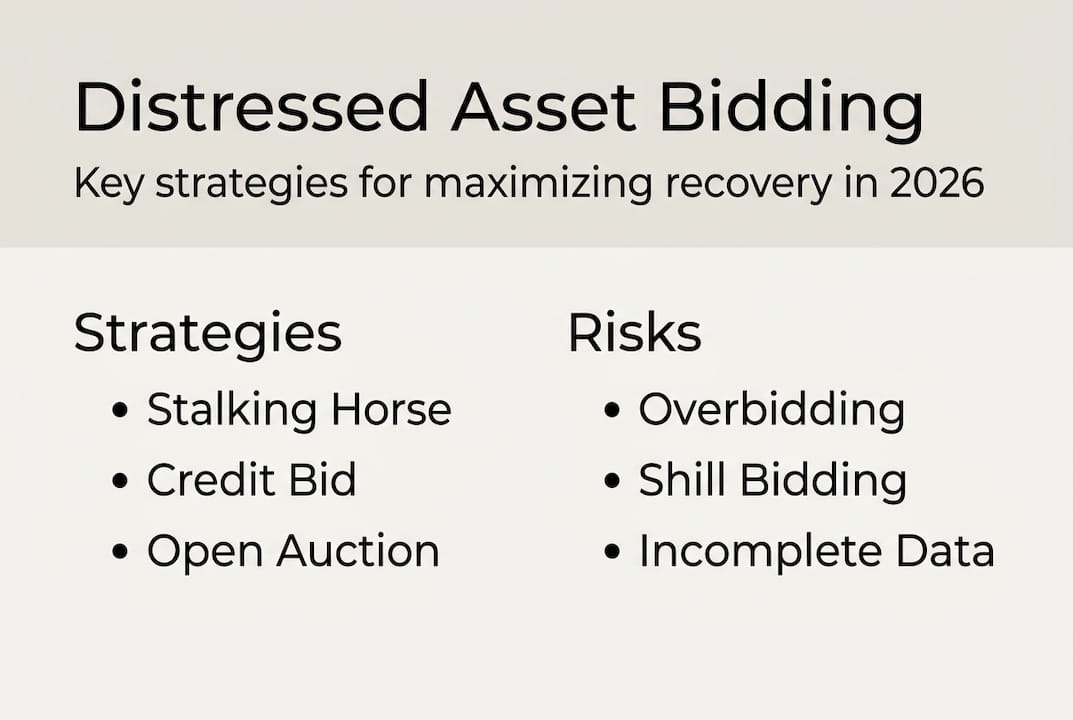
Three primary strategies dominate distressed asset bidding: the stalking horse bid, the credit bid, and open competitive bidding. Each carries distinct mechanics, protections, and risk profiles.
Stalking horse bids involve a pre-negotiated agreement between the debtor and an initial buyer, establishing a floor price before the open auction begins. The stalking horse bidder gains early access to due diligence materials and negotiates bid protections, including breakup fees typically ranging from 1-3% of the purchase price. The trade-off is that the stalking horse position requires significant upfront work and exposes the bidder to being outbid at the final auction.
Credit bids allow secured creditors to bid up to the face value of their debt without using cash. This is a powerful tool for lenders who hold collateralized positions, but edge cases include credit bidding risks such as expedited timelines in rapidly deteriorating assets and shill bidding manipulation.

Open competitive bidding creates transparent price discovery and can generate strong recovery when multiple qualified buyers participate. However, without a stalking horse floor, there is no guaranteed minimum, and thin buyer pools can result in depressed outcomes.
To evaluate which strategy fits your situation, consider these steps:
- Assess the asset’s liquidity and market demand before selecting a strategy.
- Determine whether your firm holds secured debt that enables a credit bid.
- Evaluate whether the timeline allows for stalking horse negotiation.
- Review auction strategy basics to align your approach with asset type.
- Consult legal counsel to confirm bid protection terms are court-approvable.
| Strategy | Bidder protections | Risk level | Typical recovery outcome |
|---|---|---|---|
| Stalking horse bid | Breakup fee, expense reimbursement | Medium | Above floor, competitive |
| Credit bid | Debt offset, no cash required | Low to medium | At or near debt face value |
| Open competitive bid | None | Higher | Variable, market-dependent |
Pro Tip: Use bid protections not just as insurance but as a negotiation tool. A well-structured breakup fee signals serious intent to the court and can discourage weaker competing bids, giving you a cleaner path to closing. Review liquidation strategies to see how this plays out in industrial plant scenarios.
Risks and pitfalls in bidding for distressed assets
Knowing your options is critical, but recognizing the potential traps ensures you avoid costly errors.
Distressed asset auctions carry a specific set of risks that can erode value quickly if not managed proactively. The most common mistake is overbidding driven by competitive pressure rather than asset fundamentals. When multiple PE firms enter a bidding war, the final price can exceed intrinsic value, turning a promising acquisition into a write-down.
Emotional decision-making compounds this risk. Auction environments are designed to create urgency, and that urgency can push bidders past their pre-set valuation limits. Discipline requires that your bid cap be set before the auction opens, not during it.
Shill bidding is a more nuanced threat. Shill bidding manipulation involves fictitious bids placed to inflate prices artificially, and while court-supervised auctions have procedural safeguards, the risk is not zero, particularly in less regulated secondary market sales.
Accelerated timelines create valuation risk as well. When assets are deteriorating rapidly, compressed due diligence windows make accurate appraisal difficult. Buyers who skip independent valuations to meet deadlines often discover post-closing liabilities that were not priced into the bid.
Defensive tactics for both bidders and sellers include:
- Set a hard bid cap based on independent asset appraisal before entering any auction.
- Require qualified bidder verification to reduce the risk of shill or non-serious participants.
- Engage expert auction support early to manage timeline and marketing exposure.
- Review all bidding procedures filed with the court before submitting any deposit or letter of intent.
- Monitor auction pitfalls specific to industrial equipment, where condition variance is high.
Pro Tip: Request a full asset condition report and environmental assessment before the stalking horse agreement is finalized. Discovering a remediation liability after signing a breakup fee agreement is a costly position to unwind.
Maximizing asset recovery: Real-world approaches and outcomes
To move from risk avoidance to value creation, let’s look at proven approaches and practical results from recent distressed asset sales.
The difference between a fire sale and an orderly liquidation is not always obvious from the outside, but the financial impact is significant. Orderly liquidation delivers 5-10% higher recovery compared to fire sales, a gap that translates directly to creditor distributions and equity recovery for PE sponsors.
The key driver of that premium is competitive tension. Orderly processes allow sufficient marketing time to attract multiple qualified buyers, which prevents any single bidder from acquiring assets at a steep discount simply because no alternatives existed. Fire sales, by contrast, compress marketing windows to days, limiting buyer awareness and participation.
Pairing the right bidding approach with the right market conditions requires a structured framework:
| Asset type | Market condition | Recommended approach |
|---|---|---|
| Specialized industrial equipment | Thin buyer pool | Stalking horse with broad marketing |
| General manufacturing assets | Active secondary market | Open competitive bidding |
| Real estate with encumbrances | Secured lender present | Credit bid with stalking horse backup |
| Mixed asset portfolio | Uncertain demand | Phased auction with reserve pricing |
Post-sale value realization also matters. The auction closing is not the endpoint. Follow these steps to capture full value:
- Confirm all liens and encumbrances are discharged at closing per the court order.
- Execute asset transfer documentation promptly to avoid carrying costs.
- Coordinate with buyers on equipment removal timelines to minimize site liability.
- Reconcile final bid amounts against reserve estimates to evaluate strategy performance.
- Review equipment liquidation outcomes to benchmark your results against comparable sales.
For CFOs, the practical lesson is clear. Investing in a structured, well-marketed auction process consistently outperforms the short-term appeal of a fast, informal sale. The 5-10% recovery premium is not theoretical. It reflects the measurable impact of preparation, marketing reach, and competitive bidder participation.
A smarter approach: What most asset recovery guides miss
Most guides on distressed asset bidding focus heavily on competitive dynamics, as if the highest number of bidders automatically produces the best result. Our experience in industrial liquidation tells a different story.
The firms that consistently achieve strong recoveries are not the ones who generate the most bidding activity. They are the ones who set the right floor, negotiate meaningful bid protections, and commit early with thorough due diligence. A well-structured stalking horse position with a 2% breakup fee often produces better outcomes than an open auction with ten underprepared bidders.
Process discipline is consistently undervalued. When you control the auction timeline, the marketing reach, and the qualified bidder pool, you control the outcome. Chasing last-minute bargains in rapidly deteriorating auctions is a low-probability strategy that experienced buyers avoid.
What industrial auction advantages show repeatedly is that committed buyers who engage early, understand the asset, and structure their bid protections carefully outperform reactive bidders. Early commitment is not a disadvantage. It is a strategic position.
Work with experts to capture maximum value
If you are ready to implement the most effective bidding strategy, expert support can deliver a measurable edge.
Maximizing recovery in distressed asset situations requires more than strategic intent. It requires experienced execution across marketing, valuation, auction management, and buyer outreach. Maas Companies brings decades of industrial liquidation expertise to every engagement, helping PE firms and CFOs structure processes that attract qualified buyers and generate competitive tension.
Whether you are looking to sell industrial equipment or need full-service support from valuation through closing, our team is positioned to help you achieve the strongest possible outcome. Explore our expert auction services to see how a structured, professionally managed process translates directly into higher recovery for your stakeholders.
Frequently asked questions
What is a stalking horse bid and why does it matter?
A stalking horse bid sets the minimum price in a distressed asset auction under Section 363, providing protections for the first bidder and creating a price floor that ensures fair competition and prevents below-market outcomes.
How can PE firms or CFOs avoid outbidding costs and auction manipulation?
Thorough due diligence, pre-set bid caps, and careful review of auction procedures help limit costs and reduce exposure to shill bidding risks and expedited timeline traps.
What’s the advantage of an orderly liquidation over a fire sale?
Orderly liquidation typically delivers a 5-10% recovery premium over fire sales by allowing adequate marketing time to attract multiple qualified buyers and generate genuine competitive tension.
Do credit bids always win in distressed asset auctions?
Credit bids provide significant leverage for secured creditors but do not guarantee a win if higher cash offers are submitted or if the asset value is contested by other parties in the proceeding.
Recommended
- Auction strategies for small businesses: Maximize asset recovery | Blog | Insights on Asset Liquidation and Auction Trends
- Maximize Asset Recovery: Top Real Estate Liquidation Methods | Blog | Insights on Asset Liquidation and Auction Trends
- How Auctions Help Speed Up Industrial Asset Disposition | Blog | Insights on Asset Liquidation and Auction Trends
- How to Plan Government Asset Sales for Spring 2026 | Blog | Insights on Asset Liquidation and Auction Trends
- 2026 shipping container market trends for bigger ROI