
Blog
Surplus assets: identify categories and maximize recovery

TL;DR:
- Many distressed industrial organizations overlook recoverable capital by not systematically identifying surplus assets sitting idle. Surplus assets are items no longer needed for current operations, which retain measurable market value despite being redundant or obsolete. Effective classification and targeted liquidation strategies can significantly enhance recovery, especially for machinery, vehicles, real estate, and inventory.
Idle equipment sitting on a shop floor, a warehouse no longer aligned with operations, a fleet of forklifts no longer used after a line consolidation. These are not just operational inconveniences. They are recoverable capital that many distressed industrial organizations fail to capture because they lack a structured framework for identifying, categorizing, and monetizing what they have. For CFOs, COOs, and asset managers navigating restructuring or downsizing, knowing exactly what constitutes a surplus asset and how to act on it can be the difference between a marginal recovery and a significant one.
Table of Contents
- What qualifies as a surplus asset?
- Industrial surplus asset categories and real-world examples
- Head-to-head: Comparing surplus asset liquidation value by category
- Selecting the best disposition strategy for each surplus asset type
- What most CFOs miss when managing surplus assets
- Maximize recovery with expert surplus asset liquidation
- Frequently asked questions
Key Takeaways
| Point | Details |
|---|---|
| Clear surplus identification | Correctly defining surplus assets is crucial for maximizing financial recovery during disposition. |
| Category-driven value | Different types of surplus assets yield different recovery rates and require tailored approaches. |
| Strategic liquidation methods | Aligning each surplus asset with the right disposition strategy speeds up cash recovery and minimizes loss. |
| Expert partnership | Working with experienced asset liquidation specialists leads to greater and faster returns. |
What qualifies as a surplus asset?
Now that the need is clear, it is essential to define exactly what falls under the category of surplus assets. Precision here matters, because misclassification can lead to audit complications, understated insurance liabilities, and missed liquidation opportunities.
Surplus assets are assets no longer needed for core business operations and can include machinery, vehicles, inventory, or real estate. That definition is intentionally broad, because the range of qualifying assets in an industrial setting is wide. The key criterion is that the asset no longer contributes to revenue generation or operational efficiency in its current state.
Surplus does not mean worthless. In most industrial portfolios, surplus assets retain measurable market value, and the failure to extract that value represents a direct cost to the organization.
A common misconception is that only broken or fully depreciated equipment qualifies as surplus. In practice, surplus often includes assets that are fully functional but have become redundant due to process changes, capacity reductions, or technology upgrades. A working press that was used for a product line that no longer exists is surplus. A conveyor system that was oversized for a facility reconfiguration is surplus. The operational status of the asset is secondary to whether the business still needs it.
Proper classification also matters for compliance and financial reporting. Assets that are incorrectly kept on the active balance sheet can inflate carrying costs, distort insurance coverage requirements, and complicate audits. Understanding asset recovery basics helps financial leaders establish clear criteria for what gets classified, what gets redeployed, and what gets sold.
Key characteristics that qualify an asset as surplus include:
- No active role in current production or service delivery
- No planned redeployment within a reasonable operational window
- Generating carrying costs such as storage, insurance, or maintenance without producing return
- Superseded by newer technology, regulatory requirements, or operational changes
- Associated with a closed, consolidated, or discontinued business unit
Pro Tip: When conducting a surplus classification audit, cross-reference your fixed asset register against current production schedules and facility layouts. Assets that appear on the register but are absent from any active workflow are strong candidates for immediate surplus designation.
Reviewing plant recovery strategies provides additional frameworks for how leading organizations structure these audits during restructuring phases.
Industrial surplus asset categories and real-world examples
With the definition established, let’s explore the primary categories and concrete examples that industrial leaders encounter. Understanding these categories in detail enables faster, more accurate inventory and a stronger foundation for calculating potential recovery value.
Surplus assets range from redundant equipment and underutilized vehicles to raw materials and real estate, covering four primary categories that appear consistently across distressed industrial portfolios.
Machinery and equipment represent the most common and often highest-value category. Examples include idle CNC machines after a product redesign, press brakes left behind after a metal fabrication line closes, unused conveyor systems from a plant consolidation, and packaging equipment that was replaced during an automation upgrade. These assets are often large, specialized, and in demand among secondary buyers in specific industries.
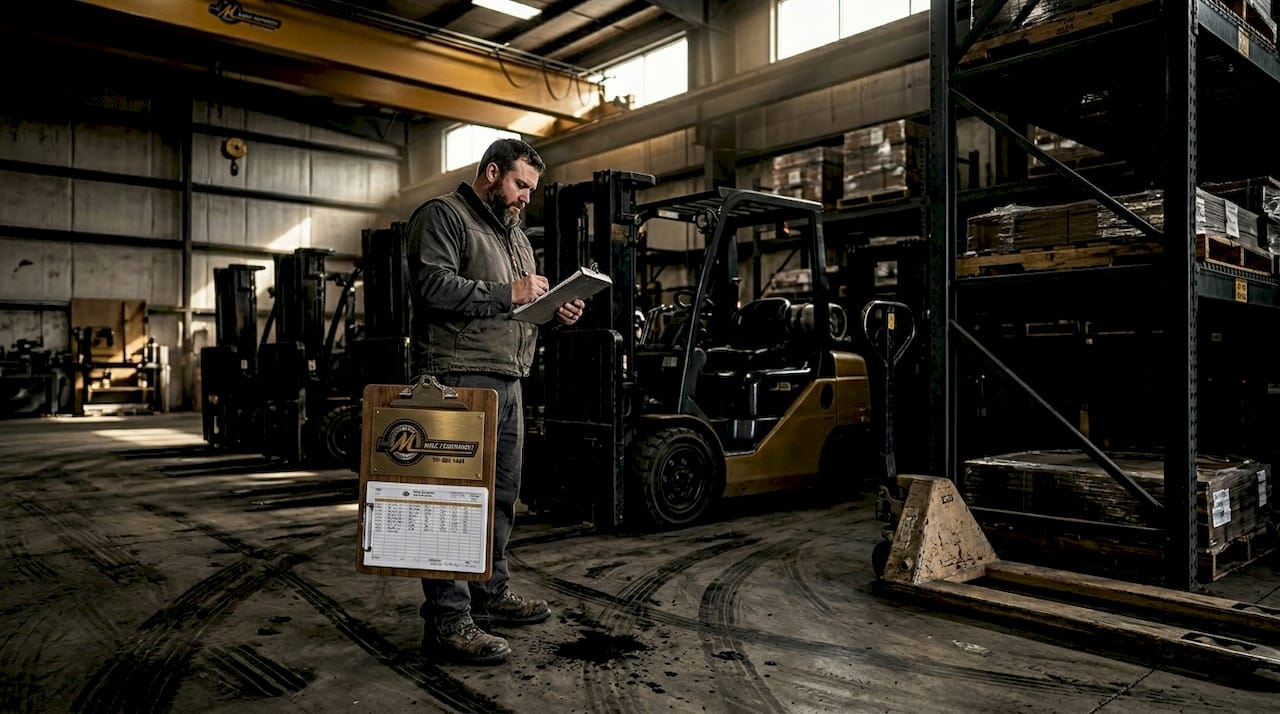
Vehicles and fleet assets include forklifts, pallet jacks, overhead cranes, haul trucks, and specialty transport vehicles. A manufacturing site that reduces warehouse throughput by 40 percent may find it has double the lift truck capacity it needs. Those excess units are surplus, and the resale market for industrial vehicles is well-established and active.
Real estate and facilities form a third category that is easy to overlook but can represent the largest single recovery opportunity. Unused warehouses, redundant production buildings, surplus land parcels adjacent to operating facilities, and under-leased commercial properties all qualify. Organizations that have consolidated operations from multiple sites frequently carry real estate that no longer serves a functional purpose.
Excess and obsolete inventory includes raw materials purchased for discontinued products, spare parts for equipment that has been retired, finished goods that no longer move, and consumables that exceeded actual demand. This category carries particular urgency because inventory value depreciates faster than capital equipment.
| Category | Common examples | Liquidation notes |
|---|---|---|
| Machinery and equipment | CNC machines, presses, conveyors, packaging lines | High buyer demand; auction performs well |
| Vehicles and fleet | Forklifts, cranes, haul trucks, pallet jacks | Active resale market; condition drives value |
| Real estate and facilities | Warehouses, production buildings, land parcels | Private sale or broker often preferred |
| Excess inventory | Raw materials, spare parts, finished goods | Fast depreciation; prioritize early action |
Reviewing surplus equipment types provides additional detail on how buyers evaluate each category and what documentation improves recovery rates. For a full operational guide to preparing assets for market, the surplus sale guide covers pre-sale preparation steps that directly affect final pricing.
Head-to-head: Comparing surplus asset liquidation value by category
Understanding categories is useful, but direct comparisons are essential for prioritizing complex portfolios. When time and resources are limited, knowing which asset types generate the fastest and highest recovery allows financial leaders to sequence liquidation activity with purpose.
Machinery and equipment often produce higher immediate liquidation value relative to inventory or vehicles, primarily because the industrial equipment market is deep, global, and capable of absorbing specialized assets at competitive prices.
| Category | Avg. recovery rate | Speed of sale | Key challenges |
|---|---|---|---|
| Machinery and equipment | 40 to 70% of FMV | Moderate to fast | Requires rigging, transport logistics |
| Vehicles and fleet | 30 to 60% of FMV | Fast | Condition variability; fleet documentation |
| Real estate and facilities | 60 to 90% of FMV | Slow to moderate | Market conditions; regulatory approval |
| Excess inventory | 10 to 40% of FMV | Variable | Rapid depreciation; buyer specialization |
FMV = fair market value
Recovery rate is not the only metric that matters. Speed of sale directly affects net recovery when carrying costs are factored in. A warehouse generating $15,000 per month in taxes, insurance, and maintenance costs that takes 18 months to sell has effectively lost $270,000 in value before the transaction closes. In contrast, machinery auctioned within 60 days may recover a lower percentage of FMV but deliver a better net result once carrying costs are removed from the equation.
Here is a practical prioritization framework for sequencing liquidation across a mixed portfolio:
- Identify and act on inventory first. Excess raw materials and finished goods depreciate the fastest and often carry storage costs. Moving this category quickly, even at lower recovery rates, reduces ongoing drag.
- Schedule equipment and machinery next. These assets have strong market demand and benefit from preparation time for documentation, photographs, and condition reports that improve auction results.
- Address vehicles in parallel with equipment. Fleet assets move quickly through established resale channels and do not require the same level of preparation lead time.
- Position real estate for a longer disposition cycle. Real estate typically yields the highest recovery rate but requires the most time. Initiating the process early in a restructuring timeline ensures it does not become a bottleneck.
The auction value benefits for industrial equipment are well-documented, particularly when the auction is marketed to a global buyer base rather than a local one. Wider exposure translates directly into more competitive bidding and stronger final prices.
Selecting the best disposition strategy for each surplus asset type
With category strengths and weaknesses compared, it is time to link each asset type with the most effective path to liquidation. Selecting the wrong method for a specific asset type is one of the most common and costly errors in surplus asset management.
Asset disposition methods should be matched to asset type, with auctions favored for machinery, private sale preferred for high-value real estate, and redeployment considered first for specialty equipment that retains internal utility. This matching principle is not rigid, but it reflects where market conditions and buyer behavior create the most favorable outcomes for each category.
Optimal disposition strategies by category:
- Machinery and equipment: Industrial auctions, particularly those with strong online bidding platforms and global marketing reach, consistently outperform private sales for standard industrial equipment. Specialty or one-of-a-kind equipment may benefit from targeted direct sales to specific industry buyers.
- Vehicles and fleet: Dealer sales, fleet auctions, and online remarketing platforms all perform well for vehicles with documented service histories. Older units with higher hours or mileage may be better suited to salvage or parts buyers.
- Real estate and facilities: Private brokered sales or negotiated transactions with strategic buyers yield the highest recovery. Industrial real estate has a specialized buyer pool, and broad auction formats often underperform compared to targeted outreach.
- Excess inventory: Liquidation buyers, commodity brokers, and industry-specific resellers are the most efficient channel for moving raw materials and spare parts. Finished goods may be sold through wholesale channels depending on the product type.
Pro Tip: Before committing to liquidation for specialty equipment, evaluate whether any assets can be redeployed to another business unit or leased to a third party. Redeployment eliminates transaction costs entirely, and even a short-term lease on an idle asset generates cash while you develop a longer-term disposition plan.
Pitfalls to avoid in method selection include rushing to market without adequate documentation, listing assets during seasonal demand slumps in the relevant industry, and failing to account for removal and transport costs that the buyer may require the seller to cover. These factors directly affect net recovery and should be built into the financial model before committing to a disposition approach. To maximize asset recovery across all categories, preparation and timing are as important as channel selection.
What most CFOs miss when managing surplus assets
Most organizations treat surplus asset management as a reactive exercise. A plant closes, a product line is discontinued, or a merger eliminates duplicate capacity, and only then does the organization begin to assess what it has. By that point, carrying costs have already accumulated, asset conditions may have deteriorated, and the window for maximum recovery has often partially closed.
The more effective approach is systematic and recurring. Organizations that conduct formal idle asset audits on a scheduled basis, rather than waiting for a triggering event, consistently identify recovery opportunities earlier, when asset values are higher and market timing can be managed deliberately. This is not a novel concept, but it is one that finance teams under operational pressure consistently deprioritize until the cost becomes undeniable.
There is also a meaningful ESG dimension that financial leaders increasingly need to factor in. Surplus assets that are properly liquidated rather than stored, scrapped, or abandoned support circular economy goals and reduce the environmental liability associated with improper disposal. Buyers who acquire surplus industrial equipment and extend its productive life contribute to measurable sustainability outcomes. Organizations can document these outcomes as part of their ESG reporting, which adds an institutional value layer on top of the direct financial recovery.
Plant recovery insights show that the most successful outcomes result from aligning liquidation timelines with business continuity needs. Selling too aggressively before an operational transition is complete can create gaps in production capacity. Waiting too long allows carrying costs to erode net recovery. The optimal approach maps asset disposition milestones directly to the operational transition schedule, treating liquidation as a parallel workstream rather than an afterthought.
The organizations that extract the most value from surplus asset programs are the ones that treat them as a strategic function, not a cleanup task.
Maximize recovery with expert surplus asset liquidation
Managing a complex portfolio of surplus industrial assets requires more than a list of categories and strategies. It requires market intelligence, buyer relationships, and the execution capability to move assets efficiently across multiple channels simultaneously.

Maas Companies brings decades of experience managing surplus asset programs across the full range of industrial categories, from heavy machinery and processing equipment to commercial real estate and excess inventory. Our team combines aggressive, targeted marketing with deep industry knowledge to ensure that every asset reaches the right buyers at the right time. Whether you are selling surplus equipment from a single facility or managing a multi-site disposition program, we provide the structure, the market access, and the expertise to protect your recovery. Explore the full Maas services portfolio to understand how we can be engaged for your specific asset recovery needs.
Frequently asked questions
What are three common examples of surplus assets in manufacturing?
Excess machinery, outdated vehicles, and underutilized real estate are typical surplus assets found in manufacturing environments, representing the three most frequently encountered categories in industrial liquidation programs.
How do you identify surplus assets in an industrial plant?
Surplus assets can be identified by reviewing the fixed asset register and cross-referencing it against active production workflows, flagging any items that are unused, no longer required, or functionally obsolete.
Which liquidation method offers the fastest recovery for surplus machinery?
Auctions provide the fastest recovery and most competitive market pricing for surplus machinery, particularly when the auction is marketed to a broad industrial buyer base with strong online bidding access.
Can surplus assets include real estate?
Yes. Surplus real estate such as unused warehouses or redundant production sites qualifies as surplus and is a common and often high-value component of industrial asset portfolios.
Recommended
- Surplus equipment sale guide: maximize asset recovery fast | Blog | Insights on Asset Liquidation and Auction Trends
- Auction strategies for small businesses: Maximize asset recovery | Blog | Insights on Asset Liquidation and Auction Trends
- Maximize Asset Recovery: Top Real Estate Liquidation Methods | Blog | Insights on Asset Liquidation and Auction Trends
- Liquidation sales explained: Maximize asset recovery | Blog | Insights on Asset Liquidation and Auction Trends
- Lost Items in Storage Auction? We Can Help | Cut The Lock
- Unclaimed storage: your options, rules, and recovery