

Blog
How to Manage a Facility Closure: Safe, Compliant, and Recovery-Focused

Managing a facility closure starts with one decision: appoint a dedicated closure project manager before anything else moves. That single action prevents the operational drift that turns a manageable shutdown into a costly, compliance-exposed event. Once that person is in place, three tasks must happen in parallel: form a cross-functional closing team (legal, EHS, operations, finance), secure data and value-bearing assets immediately, and determine whether any regulatory notification is required within the first 72 hours.
- Form the closing team. Include legal, EHS, finance, HR, and operations leads. Assign a formal charter with authority to pause conflicting operational tasks.
- Secure assets and records. Freeze critical records, lock down IT systems, and conduct a preliminary walk-through to identify high-value or regulated materials before anything is moved or disposed of.
- Notify regulators if required. Certain facilities trigger mandatory advance notice windows — some advance closure notices are required under EPA rules. Determine your obligations on day one.
When possible, begin the closure planning window immediately after the decision is made. If your facility handles hazardous materials, operates under environmental permits, or employs more than 100 workers, contact internal legal and compliance counsel before any public announcement.
Key Takeaways
A compliant, recovery-focused facility closure requires a dedicated project manager, a physical inventory completed in the first two weeks, regulatory notifications issued on statutory deadlines, and airtight chain-of-custody documentation from inventory through final disposition.
| Point | Details |
|---|---|
| Appoint a closure PM immediately | A single accountable owner with formal authority prevents operational drift and compliance gaps. |
| Physical inventory before anything moves | Walk-throughs surface undocumented assets; asset management records alone are not sufficient. |
| Calendar regulatory deadlines on day one | EPA advance notice windows and employee notice requirements under the WARN Act mandate advance notification periods. |
| Structured disposition maximizes recovery | Timing, bundling, and early buyer outreach consistently produce better outcomes than ad hoc disposal. |
| Maascompanies for commercial-grade recovery | Maascompanies manages the full disposition lifecycle — inventory, marketing, auction, and compliance documentation — for industrial closures. |
Table of Contents
- What counts as a facility closure — and which scenario applies to you?
- How to manage facility closure: a phased roadmap from decision to post-closure
- Regulatory and compliance requirements for U.S. facility closures
- How to maximize asset recovery during a facility closure
- Physical decommissioning: EHS controls, hazardous materials, and site safety
- Personnel transitions, stakeholder communications, and community considerations
- Documentation, retention, and post-closure obligations
- Practical closure checklist and a 12-week sample timeline
- Financial impact assessment and budgeting for closure costs
- Legal considerations for contracts, leases, and third-party agreements
- What experienced practitioners know about facility closures
- Maascompanies: strategic asset recovery for facility closures
- Sources
What counts as a facility closure — and which scenario applies to you?
“Facility closure” covers a wider range of situations than most operations leaders initially assume. At its broadest, it refers to the permanent or indefinite cessation of operations at a specific location, but the regulatory and logistical obligations vary significantly depending on how the closure is structured.
Common closure types include:
- Full shutdown: All operations cease permanently. The site is vacated, permits are closed, and the property is either sold, returned to a landlord, or remediated.
- Relocation or consolidation: Operations transfer to another site. Equipment is redeployed or sold; the original facility is handed back or decommissioned.
- Partial decommission: A production line, wing, or building is taken offline while the rest of the facility remains active.
- Bankruptcy or court-ordered closure: A trustee or lender directs the wind-down. Asset disposition is often accelerated and subject to court oversight.
- Lease surrender: The organization exits a leased property at or before lease expiration, requiring restoration to original condition in many cases.
- Environmental remediation closure: Contamination or regulatory action forces shutdown; remediation and post-closure monitoring obligations may extend for years.
Three diagnostic questions help you classify your situation before building a plan:
- Full or partial? A partial closure still requires a scoped inventory and regulatory review for the affected area.
- Are regulated materials present? Hazardous waste, asbestos, PCBs, or controlled substances trigger federal and state notification requirements that govern your timeline.
- What lease or permit constraints apply? Lease restoration clauses, permit transfer requirements, and lender covenants can each impose hard deadlines that override your preferred schedule.
For education-sector closures, California’s Department of Education recommends district advisory committees and a two-step public hearing process to guide decisions and allow community input — a model that reflects broader best practices for any closure affecting a public constituency.
How to manage facility closure: a phased roadmap from decision to post-closure
Treating a facility shutdown as a risk-managed project — rather than a sequential checklist — is what separates closures that finish on time and on budget from those that generate regulatory findings and unrecovered asset value. Project management practitioners consistently recommend assigning owners to each identified risk and tracking mitigations actively throughout decommissioning.
Phase 1: Decision and scoping (Weeks 1–2)
- Appoint a closure project manager with formal authority.
- Conduct a physical walk-through and preliminary inventory — asset management records alone routinely miss undocumented equipment.
- Identify all regulated materials, active permits, and lease obligations.
- Establish a closure budget and preliminary timeline.
- Determine regulatory notification requirements and calendar hard deadlines.
Phase 2: Planning and compliance (Weeks 2–6)
- Develop a written closure plan covering regulatory, EHS, asset disposition, and communications workstreams.
- Engage legal counsel to review lease terms, vendor contracts, and employment obligations.
- Issue required regulatory notifications (see Section 4 for federal timelines).
- Procure environmental and decommissioning contractors; execute vendor agreements.
- Finalize asset disposition strategy: redeploy, negotiate sale, auction, or recycle.
Phase 3: Decommissioning and asset disposition (Weeks 4–10)
- Execute lockout/tagout (LOTO) and utility isolation procedures.
- Remove and manifest hazardous materials through licensed treatment, storage, and disposal facilities (TSDFs).
- Complete asset inventory, condition assessment, and valuation.
- Execute disposition: internal transfer, negotiated sale, or structured auction.
- Conduct site cleaning, decontamination, and final inspections.
Phase 4: Final verification and handback (Weeks 10–12+)
- Obtain independent professional engineer (PE) certification where required.
- Complete permit closures and transfers.
- Execute property handback per lease terms.
- Compile and archive all closure documentation.
Phase 5: Post-closure obligations (Ongoing)
- File post-closure reports with regulators.
- Maintain required monitoring (groundwater, air, or other media) where applicable.
- Retain records per applicable retention schedules.
| Milestone | Typical Owner | Sample Timeframe |
|---|---|---|
| Closure decision and PM appointment | Executive leadership | Day 1 |
| Physical inventory complete | Operations / EHS | Weeks 1–2 |
| Regulatory notifications issued | EHS / Legal | Weeks 1–4 (deadline-driven) |
| Hazardous material removal complete | EHS / Licensed contractor | Weeks 4–8 |
| Asset disposition executed | Operations / Asset recovery partner | Weeks 4–10 |
| PE certification submitted | Independent engineer | Within 60 days post-closure |
| Property handback | Facilities / Legal | Per lease terms |
| Post-closure monitoring initiated | EHS | Per permit conditions |
Small facilities with no regulated materials can often compress this to 6–8 weeks. Complex industrial sites — labs, chemical plants, healthcare facilities — routinely require 6–18 months. Antea Group’s decommissioning guidance notes that organized plans prepared a year or more in advance consistently reduce budget overruns and regulatory surprises.
Regulatory and compliance requirements for U.S. facility closures
Compliance gaps during closure are among the most expensive mistakes an organization can make — fines, remediation orders, and permit violations can exceed the cost of the closure itself. The following federal frameworks most commonly apply.
U.S. EPA — RCRA and CERCLA
Facilities that generate, treat, store, or dispose of hazardous waste are subject to Resource Conservation and Recovery Act (RCRA) closure requirements. EPA guidance specifies that regulated facilities must provide advance closure notice — commonly 60 days for facilities with treatment units and 45 days for others — and submit an independent professional engineer’s written certification within 60 days of completing closure activities. CERCLA liability can attach to contaminated sites regardless of who caused the contamination, making early environmental assessment non-negotiable.
OSHA
OSHA standards govern worker safety throughout decommissioning. Key obligations include lockout/tagout (29 CFR 1910.147), confined-space entry (29 CFR 1910.146), hazard communication (29 CFR 1910.1200), and personal protective equipment requirements. OSHA’s hazardous materials standards also apply to flammable liquid handling and storage during decommissioning. LOTO training must be documented and verified before any energy-isolation work begins.
DOT
If hazardous materials are transported off-site during closure — including waste, chemicals, or compressed gases — DOT regulations under 49 CFR govern packaging, labeling, manifesting, and carrier qualification. Improper transport documentation is a common compliance gap in facility closures.
Industry-specific obligations
- Healthcare: State health department notifications, controlled substance DEA deregistration, medical record retention (typically 7–10 years), and biomedical waste disposal certifications.
- Schools: State education agency notifications, student record transfer, and community engagement processes. California’s two-step public meeting model is a widely referenced benchmark.
- TSDFs: Full RCRA closure plan submission, financial assurance demonstration, and post-closure care period (often 30 years for landfills).
- Food and beverage / life sciences: FDA deregistration, product recall procedures, and GMP decommissioning documentation.
Regulatory compliance checklist:
- [ ] Advance closure notice submitted to EPA (45 or 60 days, depending on unit type)
- [ ] State environmental agency notified per applicable state rules
- [ ] OSHA LOTO and confined-space procedures documented and trained
- [ ] DOT hazardous material transport manifests prepared
- [ ] Independent PE certification scheduled
- [ ] Waste manifests and TSDF disposal records retained
- [ ] Certificates of destruction obtained for regulated materials
- [ ] Survey plats and site maps updated
- [ ] Permit closure or transfer applications filed
- [ ] Industry-specific notifications completed (DEA, FDA, state health, education agency)
Pro Tip: When multiple notifications are required simultaneously, prioritize those with the shortest statutory windows first — EPA’s 45-day notice for certain units and WARN Act employee notices (60 days) are the most commonly missed. Build a notification calendar on day one and assign a single owner to track each deadline. Refer to the Federal Register for regulatory history when preparing closure plans that affect permits.
How to maximize asset recovery during a facility closure
Asset disposition is where most organizations leave significant value on the table. A structured approach — from physical inventory through final sale — consistently produces better recovery than ad hoc disposal, and it creates the chain-of-custody documentation that lenders, auditors, and regulators require.
Process flow:
- Physical inventory: Walk every square foot. Asset management systems routinely miss equipment that was moved, modified, or never formally recorded. Document make, model, serial number, condition, and location.
- Condition assessment: Grade each asset (operational, repairable, scrap). Condition drives both valuation and the appropriate disposition channel.
- Market valuation: Obtain fair market value and orderly liquidation value estimates. These figures inform the disposition strategy and support lender or court reporting requirements.
- Disposition decision: Choose the channel that fits each asset class — internal redeployment, negotiated private sale, public auction, recycling, or certified destruction.
- Execution and documentation: Maintain chain-of-custody records for every asset from inventory through final disposition. This documentation supports insurance claims, tax reporting, and regulatory audits.
Tactics to improve recovery:
- Time remarketing to coincide with active buyer demand in your industry — post-shutdown markets for specialized equipment can be thin if you wait too long.
- Bundle complementary assets (a production line versus individual components) when buyers in your sector prefer turnkey packages; sell individually when the secondary market is deep.
- Pre-clean and service high-value equipment before marketing — presentation affects perceived value and buyer confidence.
- For IT assets, follow a standardized inventory → backup → certified destruction → remarketing workflow. NIST 800-88 compliant wiping or physical destruction is required for drives containing sensitive data; retain certificates of destruction for a multi-year period consistent with best practices.
- Document all data destruction with certificates and chain-of-custody logs — this protects the organization from data-breach liability after the facility closes.
Pro Tip: Engaging an experienced asset recovery partner early — before disposition decisions are made — typically produces better outcomes than bringing one in after internal attempts have already narrowed the buyer pool. Early engagement allows proper marketing lead time, broader buyer outreach, and more competitive bidding.
For a detailed breakdown of disposition channels and their trade-offs, the types of industrial asset disposition guide covers inventory, decommissioning, and sale options across equipment categories. Organizations evaluating whether to monetize idle assets before a formal closure decision should also review the case for monetizing idle equipment.
Physical decommissioning: EHS controls, hazardous materials, and site safety
Physical decommissioning is the highest-risk phase of any closure — both for worker safety and for environmental liability. CRB’s shutdown guidance recommends in-person walk-downs to verify electrical and utility configurations, mandatory LOTO training, centralized subcontractor coordination, and pairing internal site expertise with specialized shutdown teams. That hybrid model reduces schedule risk while preserving the institutional knowledge that external contractors alone cannot replicate.
Decommissioning checklist:
- [ ] Lockout/tagout (LOTO) procedures documented, trained, and verified for all energy sources
- [ ] Utilities isolated in sequence: electrical, gas, steam, compressed air, process fluids
- [ ] Confined-space entry permits issued and atmospheric testing completed before entry
- [ ] PPE requirements established and enforced by task and zone
- [ ] Hazardous materials segregated by waste stream (RCRA hazardous, universal waste, non-hazardous)
- [ ] Licensed TSDF selected and waste manifests prepared
- [ ] Asbestos, lead paint, and PCB surveys completed; abatement contractors engaged if required
- [ ] Flammable liquid storage addressed per NFPA 30 requirements before removal
- [ ] Contractor safety briefings conducted daily during active decommissioning
- [ ] Site logistics plan separating pedestrian and heavy equipment traffic zones
- [ ] Contractor-provided certifications collected: abatement completion, waste manifests, LOTO verification, confined-space clearance
Environmental liability insurance is worth evaluating before decommissioning begins, particularly for sites with unknown contamination history. Coverage for construction and environmental liability can protect against remediation cost overruns that emerge after the closure is otherwise complete.
Personnel transitions, stakeholder communications, and community considerations
Communication failures during closure generate legal exposure and reputational damage that outlast the closure itself. The sequence and content of communications matter as much as the substance.
Communication timeline tied to closure milestones:
- Internal leadership notice: Immediately after the closure decision — before any external disclosure.
- Employee notice: As required by the WARN Act (60 days for covered employers with 100+ employees), or earlier when operationally feasible.
- Union notification: Concurrent with or immediately following employee notice; collective bargaining obligations may require negotiation before implementation.
- Regulator notifications: Per statutory deadlines (see Section 4).
- Vendor and lessor notice: Early enough to allow contract wind-down and avoid automatic renewal clauses.
- Customer and community messaging: Timed to follow employee and regulator notifications; coordinate with legal to avoid premature disclosure.
Stakeholder communication matrix:
| Audience | Core Message | Recommended Owner |
|---|---|---|
| Employees | Timeline, severance, transition support | HR / Legal |
| Unions | Bargaining obligations, timeline | Labor counsel / HR |
| Regulators | Closure notice, compliance plan | EHS / Legal |
| Lenders | Asset disposition plan, recovery timeline | CFO / Legal |
| Lessor | Lease wind-down, restoration plan | Facilities / Legal |
| Customers | Service continuity or transition plan | Operations / Sales |
| Community | Impact, transition support, timeline | Executive / PR |
WARN Act compliance deserves particular attention. Covered employers — generally those with 100 or more full-time employees — must provide 60 days’ written notice before a plant closing or mass layoff. Exceptions exist for unforeseeable business circumstances and faltering companies, but relying on an exception without documented legal analysis is a significant risk. Document every communication in writing and retain copies as part of the closure record.
For closures affecting vulnerable populations — care facilities, schools, healthcare settings — research on care-home closures shows that well-paced transitions with active engagement of residents and families reduce distress and can improve medium-term outcomes. Time and direct communication are the two variables that matter most.
Pro Tip: For school closures, California’s guidance recommends using the Facility Inspection Tool to assess building condition and engaging district advisory committees early. Even outside California, a structured community input process reduces opposition and creates a documented record of good-faith engagement.
Documentation, retention, and post-closure obligations
Documentation is the closure’s legal and financial record. Gaps in recordkeeping create audit exposure, complicate insurance claims, and can trigger regulatory findings years after the site is vacated.
Records to preserve:
- Written closure plan and all amendments
- Independent PE certification (required for regulated facilities)
- Survey plats and updated site maps
- Waste manifests and TSDF disposal confirmations
- Certificates of destruction for regulated materials and IT assets
- Asset disposition logs: inventory records, condition assessments, valuations, sale records
- Chain-of-custody documentation for all disposed assets
- All regulatory correspondence and notifications
- Contractor certifications: abatement, LOTO verification, confined-space clearance
- Employee WARN Act notices and acknowledgments
- Lease surrender documentation and landlord sign-off
Retention guidance: Hazardous waste records under RCRA generally require a minimum three-year retention period from the date of the record, though many organizations retain closure-related records for 10 years or longer given the potential for long-tail liability. IT asset certificates of destruction are typically retained for several years. Consult legal counsel for jurisdiction- and industry-specific requirements.
Post-closure tasks:
- File post-closure certification with EPA and applicable state agencies within required windows.
- Complete final property inspection with the landlord and document condition in writing.
- Transfer or formally close all active permits (air, water, hazardous waste, business licenses).
- Initiate any required ongoing monitoring programs (groundwater, air emissions) and budget for their duration.
- Notify insurance carriers of the closure and adjust coverage accordingly.
- Retain a point of contact for regulatory inquiries for the duration of any post-closure monitoring period.
For property-specific disposition and handback steps, the commercial property liquidation guide for manufacturing firms covers lease restoration requirements and lender coordination in detail.
Practical closure checklist and a 12-week sample timeline
The checklist below is organized by phase. Adapt the scope to your facility: small, low-hazard closures can compress Phases 1–3 into 4–6 weeks; complex industrial or regulated sites should expand the timeline to 6–18 months and treat each phase as a separate project workstream.
Phase-based closure checklist
Phase 1 — Decision and scoping
- [ ] Appoint closure PM and form closing team
- [ ] Conduct physical walk-through and preliminary inventory
- [ ] Identify regulated materials and active permits
- [ ] Establish closure budget and preliminary timeline
- [ ] Calendar all regulatory notification deadlines
Phase 2 — Planning and compliance
- [ ] Develop written closure plan
- [ ] Engage legal counsel (lease, contracts, employment)
- [ ] Issue regulatory notifications
- [ ] Procure EHS and decommissioning contractors
- [ ] Finalize asset disposition strategy
Phase 3 — Decommissioning and asset disposition
- [ ] Execute LOTO and utility isolation
- [ ] Remove and manifest hazardous materials
- [ ] Complete full asset inventory and valuation
- [ ] Execute disposition (redeploy, sell, auction, recycle)
- [ ] Complete site cleaning and decontamination
Phase 4 — Verification and handback
- [ ] Obtain PE certification (if required)
- [ ] Close or transfer permits
- [ ] Execute property handback
- [ ] Compile and archive all closure records
Phase 5 — Post-closure
- [ ] File post-closure reports
- [ ] Initiate monitoring programs
- [ ] Maintain records per retention schedule
12-week sample timeline
| Week | Regulatory | Assets | Communications | Decommissioning |
|---|---|---|---|---|
| 1 | Identify notification deadlines; begin EPA/state scoping | Physical inventory begins | Internal leadership notice | Walk-through; LOTO plan drafted |
| 2 | Draft closure plan; confirm RCRA applicability | Inventory complete; condition assessment begins | Employee notice (WARN Act if applicable) | Contractor procurement begins |
| 3–4 | Submit regulatory notifications | Valuation complete; disposition strategy finalized | Vendor and lessor notices | LOTO training; utility isolation plan |
| 5–6 | Confirm receipt; respond to agency questions | Disposition marketing launched | Customer and community messaging | Hazmat removal begins |
| 7–8 | Monitor compliance; address agency requests | Auction or negotiated sale executed | Ongoing stakeholder updates | Site cleaning; decontamination |
| 9–10 | Prepare PE certification package | Asset transfer and documentation complete | Final employee transition support | Final inspections |
| 11 | Submit PE certification | Disposition records archived | Lessor final walkthrough scheduled | Site cleared |
| 12 | Post-closure filings initiated | Recovery reporting to lender/board | Closure announcement (if public) | Property handback |
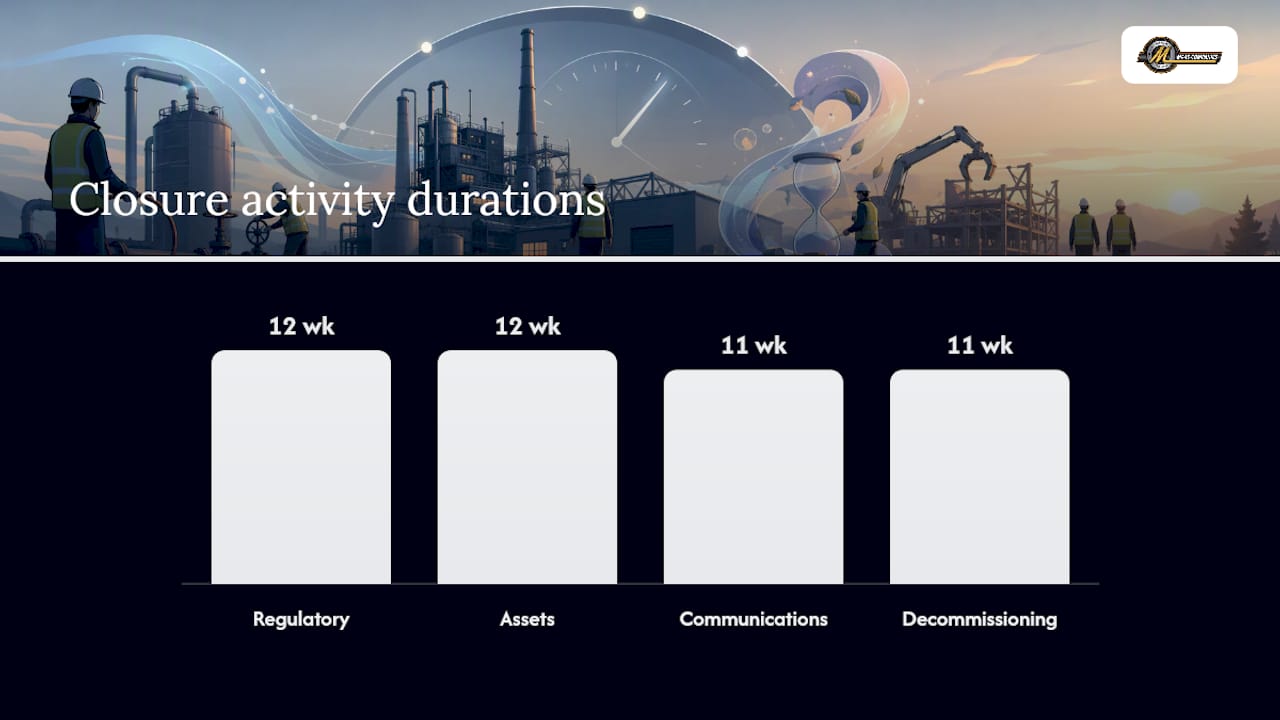
Scaling notes: Emergency closures (bankruptcy, safety order) may compress this to 2–4 weeks — prioritize regulatory notifications, asset security, and LOTO above all else. For facilities with groundwater monitoring or long-tail remediation obligations, post-closure activities extend well beyond Week 12 and require a separate monitoring plan and budget.
Financial impact assessment and budgeting for closure costs
Closure costs are routinely underestimated because organizations budget for the obvious line items — contractor fees, moving costs, final payroll — and miss the carrying costs that accumulate during a prolonged wind-down. A complete financial assessment covers both direct closure costs and the ongoing liability of a facility that is no longer generating revenue.
Direct closure cost categories:
- Environmental assessment and remediation (Phase I/II ESAs, abatement, remediation)
- Decommissioning and demolition contractor fees
- Hazardous waste disposal and manifesting
- Asset disposition costs (appraisal, marketing, auction fees)
- Legal fees (lease negotiation, regulatory counsel, employment law)
- HR costs (severance, WARN Act compliance, outplacement)
- Permit closure and transfer fees
- PE certification and engineering fees
- Site restoration per lease terms
Carrying costs during wind-down:
- Lease or mortgage payments on a non-operating facility
- Utilities, security, and insurance on a vacant site
- Ongoing regulatory monitoring costs
- Staff retained through closure (closure PM, EHS, security)
The equipment liquidation recovery guide for CFOs provides financial modeling considerations for recovery projections and how to present asset disposition outcomes to lenders and boards.
Organizations that skip the contingency line consistently face cost overruns when environmental findings or permit complications extend the timeline.
Legal considerations for contracts, leases, and third-party agreements
Legal exposure during closure extends well beyond employment law. Every active contract, lease, and third-party agreement must be reviewed before the closure plan is finalized, because termination rights, notice periods, and restoration obligations vary significantly by agreement.
Lease agreements: Most commercial and industrial leases include restoration clauses requiring the tenant to return the property to its original condition, remove tenant improvements, and repair any damage. Failure to comply can result in the landlord withholding the security deposit and pursuing additional damages. Review the lease for: notice period required to terminate, restoration scope, permitted assignment or sublease rights, and any early-termination penalties.
Vendor and supplier contracts: Identify all contracts with automatic renewal clauses and calendar their notice deadlines immediately. Contracts for utilities, maintenance, security, and specialized services often renew automatically if not terminated within a defined window — missing that window extends carrying costs and creates contractual liability.
Customer agreements: Review service agreements, supply contracts, and warranties for termination provisions, transition obligations, and liability for non-performance. Some contracts require the organization to provide transition services or source alternative suppliers before terminating.
Equipment leases and financing agreements: Leased equipment must be returned per the lease terms; financed equipment may require lender consent before disposition. Confirm whether any equipment is subject to a UCC lien before selling or transferring it — disposing of encumbered assets without lender consent creates significant legal exposure.
Insurance: Notify all carriers of the closure. General liability, property, and environmental policies may require endorsements or riders to maintain coverage during the wind-down period. Directors and officers (D&O) coverage is particularly relevant for bankruptcy-related closures.
Engaging legal counsel to conduct a contract audit in the first two weeks of the closure process is one of the highest-return investments an organization can make. Undiscovered obligations routinely add weeks to the timeline and six-figure costs to the budget.
What experienced practitioners know about facility closures
The most consistent finding across complex industrial closures is that value leakage is almost always a process failure, not a market failure. Equipment that sells for a fraction of its worth rarely does so because buyers aren’t there — it does so because the organization ran out of time, skipped the inventory, or brought in a disposition partner after the buyer pool had already been exhausted by informal inquiries.
Three operational lessons stand out from structured industrial asset disposition projects:
First, the closure PM is not optional. Without a single accountable owner, closure tasks compete with ongoing operational priorities and lose. The PM needs formal authority — including the ability to redirect staff and pause conflicting work — and a direct reporting line to executive leadership. Facilities that treat the PM role as a part-time assignment consistently experience timeline overruns and compliance gaps.
Second, the physical inventory must happen immediately. Asset management systems are a starting point, not a source of truth. Walk-throughs on complex industrial sites routinely surface equipment that was moved, modified, or never formally recorded — assets that represent real recovery value if identified early and marketed properly. Waiting until decommissioning is underway to conduct the inventory compresses the disposition window and reduces recovery.
Third, centralized vendor management pays for itself. Organizations managing multiple simultaneous closures, or a single complex site with many contractors, benefit significantly from a single coordination point for subcontractors. CRB’s shutdown research confirms that a centralized construction management model reduces schedule risk and safety incidents compared to fragmented contractor management.

The question of when to engage external specialists versus relying on internal resources has a practical answer: use internal expertise for site knowledge, institutional context, and regulatory history; bring in external specialists for asset marketing, environmental remediation, and decommissioning execution. The hybrid model consistently outperforms either extreme.
Maascompanies: strategic asset recovery for facility closures
When a closure involves commercial-grade equipment, industrial real estate, or a mixed asset portfolio, the difference between a structured disposition and an ad hoc sell-off is measurable in recovery dollars and timeline weeks.

Maascompanies brings decades of experience managing asset recovery for plant closures, corporate restructurings, lender-ordered liquidations, and court-directed wind-downs across manufacturing, energy, healthcare, education, and agriculture. The service model covers the full disposition lifecycle: physical inventory support, independent market valuation, targeted buyer outreach, auction and negotiated sale execution, and chain-of-custody documentation for lender and regulatory reporting. Clients receive centralized project management and a single point of accountability from inventory through final settlement — not a marketplace listing and a hope.
For organizations ready to move from closure decision to recovery execution, the Maascompanies services portfolio outlines the full range of engagement options. To discuss your specific closure scope and timeline, contact the team directly to request a discovery consultation.
Sources
The sources below are the authoritative U.S. references to consult when preparing closure plans, drafting regulatory notifications, and briefing legal and compliance counsel. Cite these directly in your closure documentation.
- Closure and post-closure care requirements for hazardous waste treatment, storage, and disposal facilities
- Improving outcomes when care homes close
- Closure and school consolidation guidance — California Department of Education
Recommended
- Plan Better Industrial Closures With Expert Auction Help | Blog | Insights on Asset Liquidation and Auction Trends
- Facility Liquidation Strategies That Keep Transitions on Track | Blog | Insights on Asset Liquidation and Auction Trends
- Top Asset Disposition Solutions for Plant Closures | Blog | Insights on Asset Liquidation and Auction Trends
- Streamline Commercial Property Liquidation: Steps for Manufacturing Firms | Blog | Insights on Asset Liquidation and Auction Trends