

Blog
Reserve Price Strategy: Protecting Recovery Without Killing Bids

Set a confidential reserve at a realistic floor, below full valuation, and let competitive bidding do the rest. Three rules govern that decision every time: keep the reserve low enough to leave room for buyer’s premium and fee erosion, coordinate the starting bid so it never signals the floor, and adjust the number based on the number of serious bidders you can realistically expect. The stepwise method for calculating that number sits below, along with the seller checklist you can hand to counsel or an in-house transaction team before the gavel falls.
Key Takeaways
An effective reserve price strategy sets a confidential floor below full valuation, adjusted for fees and bidder count, to protect recovery without discouraging competitive bidding.
| Point | Details |
|---|---|
| Reserve is confidential | The minimum acceptable price stays hidden from bidders and creates no obligation to sell below it. |
| Fewer bidders raise reserve importance | Research shows reserves lift revenue most in low-bidder settings and matter less as competition grows. |
| Unmet reserve isn’t final | Auctioneers commonly broker post-auction negotiation with the high bidder before relisting. |
| Fees must factor into the floor | Buyer’s premium, commission, and taxes should be built into the gross reserve, not treated as an afterthought. |
| Maascompanies sets reserves collaboratively | For industrial and institutional assets, Maascompanies pairs market comparables with bidder-count estimates to build a defensible reserve band. |
Table of Contents
- Reserve Price Strategy: Definitions and Mechanics
- What Happens If the Reserve Isn’t Met
- How to Set an Effective Reserve Price
- Advantages and Disadvantages of Reserve Pricing
- Auctioneer Role, Fees, and Reserve Timing Rules
- How Reserve Pricing Shapes Bidder Behavior
- What the Research Says About Reserve Pricing
- Seller Checklist for Reserve Price Strategy
- How Maascompanies Supports Your Reserve Strategy
- Frequently Asked Questions
- Sources
Reserve Price Strategy: Definitions and Mechanics
A reserve price is the confidential minimum a seller will accept. It is not disclosed to bidders and does not create an obligation to sell if the top bid falls short, a distinction spelled out clearly in Law Insider’s reserve price clause. The starting bid is the public opening figure designed to generate interest. The guide price or estimate is a market range, often published, that helps bidders calibrate. Investopedia notes that many platforms display a “reserve not met” status until bidding clears the floor.
- Bid below reserve: lot shows unmet status, no sale obligation.
- Bid at or above reserve: sale is triggered automatically.
- Auction houses typically set reserves at or below the published low estimate, according to Christie’s auction guidance.
Pro Tip: Never let your starting bid sit close to your reserve. A wide gap between the two keeps bidders engaged long enough for competitive momentum to build past your floor.
What Happens If the Reserve Isn’t Met
Missing the reserve doesn’t end the transaction. It shifts the process into a negotiation phase that most sellers underestimate going in.
- The lot is passed or “bought in,” meaning no sale occurs at the gavel.
- The auctioneer typically contacts the high bidder to explore a negotiated sale, a common workflow described by Municibid.
- If negotiation fails, the seller decides between relisting, private treaty sale, or holding inventory.
Every unsold lot carries real cost: storage, re-marketing fees, and delayed capital recovery. Pro Tip: Set an acceptable negotiation window (for example, within 5 to 10 percent of reserve) before the auction starts, so your team can approve a post-sale offer within hours, not weeks.
How to Set an Effective Reserve Price
A defensible reserve comes from a calculation, not a gut feeling. Here’s the sequence institutional sellers use.
- Confirm valuation. Pull recent comparables, weigh condition, provenance, and current market sentiment for that asset class.
- Convert target net recovery into a gross reserve. Account for buyer’s premium, seller commission, applicable taxes, and the cost of relisting if the lot fails to sell.
- Adjust for bidder count. Fewer expected bidders means the reserve carries more weight in protecting price; a deep bidder pool lets you set the floor lower and trust competition to lift the final price. Stanford research on reserve price effects confirms this bidder-count dependence directly.
- Coordinate the starting bid and marketing message so early interest builds without hinting at the confidential floor.
Pro Tip: A reserve set 10 to 15 percent below appraised value, adjusted for fee erosion, is a reasonable starting band for most industrial equipment. Sellers weighing this against absentee bidding logistics can review strategies for industrial equipment auctions for how bidder demand shapes the same math.
Advantages and Disadvantages of Reserve Pricing
A reserve protects the seller’s downside, but it comes at a cost in participation. Weigh both sides before committing to a number.
- Advantage: Establishes a legal floor. No obligation to sell below it.
- Advantage: Signals seriousness and quality, useful for rare or high-value single lots.
- Disadvantage: Can suppress bidder turnout if perceived as too high.
- Disadvantage: Risk of an unsold lot, which delays recovery and adds carrying costs.
Industry guidance on reserve versus absolute auctions recommends reserves for irreplaceable or high-value single assets, and no-reserve formats for broad-interest inventory like estate contents or bulk equipment lots.
| Decision Factor | Favors Reserve | Favors No-Reserve |
|---|---|---|
| Asset rarity | High | Low |
| Fiduciary duty involved | Yes | No |
| Expected bidder pool | Small | Large |
Auctioneer Role, Fees, and Reserve Timing Rules
The auctioneer manages disclosure, timing, and the mechanics of reserve enforcement, but the seller must confirm every rule in writing before consignment.
- Seller commission, VAT where applicable, listing fees, and buyer’s premium all reduce net proceeds and must factor into the gross reserve figure.
- Reserves can generally be lowered before a stated deadline; raising a reserve once live bidding starts is not standard practice.
- Confirm anti-sniping or time-extension policies, such as a 15-minute extension rule, since these affect how late bids interact with your reserve.
Pro Tip: Get the reserve-change deadline and extension policy in writing from the auctioneer before the listing goes live. Verbal assurances create disputes when a lot comes in close to the floor.
How Reserve Pricing Shapes Bidder Behavior
Bidders respond to signals, not just numbers. A visible high starting bid anchors expectations downward and often suppresses competitive bidding before it starts.
- A low, public starting bid combined with a hidden reserve tends to draw more participants into the room.
- Once bidders are engaged, competitive momentum, sometimes called auction fever, frequently pushes prices past the confidential floor.
- Municibid’s practitioner guidance recommends low opening bids specifically to build this momentum while the actual reserve stays hidden.
The tactic that works consistently: pair a modest starting bid with strong marketing reach and a reserve nobody sees. Buyers evaluating this dynamic from the other side can review tips for buying used machinery to understand how bidding incentives play out in practice.
What the Research Says About Reserve Pricing
The evidence on reserves is not one-sided, and treating it as a fixed rule misreads the data. Controlled experiments and field studies referenced in Stanford’s reserve price research show reserves raise expected revenue in low-bidder settings, but that lift shrinks as competition among bidders grows. A separate study on procurement auctions found that theory-guided reserve setting outperforms arbitrary reserves, particularly in thin markets.
For industrial equipment, Maascompanies applies this by triangulating market comparables, estimating realistic bidder counts for the specific asset category, and setting the reserve collaboratively with the client rather than as a unilateral number. A single injection-molding line with three known buyers globally gets a different reserve treatment than a fleet of forklifts with dozens of active regional bidders.
A realistic reserve band, not a single inflexible number, gives sellers room to balance capital recovery against the risk of an unsold lot. For low-liquidity industrial assets, that flexibility often determines whether a sale clears at all.
Sellers running larger disposition programs can see this framework applied at scale in machinery auction strategies for maximizing asset recovery.
Seller Checklist for Reserve Price Strategy
- Before the sale: confirm valuation, calculate fee-adjusted net recovery, set a reserve band (not a single number), lock in the deadline for changing the reserve, and brief the auctioneer in writing.
- During the sale: monitor bidder turnout in real time, track whether the reserve is met, and confirm negotiation authority if it isn’t.
- After the sale: if unsold, negotiate within your preset band (commonly within 5 to 10 percent of reserve), decide between relisting or private treaty sale, and document lessons for the next disposition event.
- Approvals: designate who signs off on any post-auction offer below reserve, typically finance leadership or legal counsel for institutional sellers.
A Practitioner’s View on Reserve Strategy
Reserve setting works best as a collaborative exercise, not a number pulled from a spreadsheet in isolation. For high-value, low-liquidity industrial assets, Maascompanies favors a confidential floor set modestly below full valuation, paired with aggressive, targeted marketing to widen the bidder pool before the sale opens. That combination protects downside without choking off the competitive tension that actually drives recovery.

How Maascompanies Supports Your Reserve Strategy
Setting the right reserve takes more than a formula. It takes market intelligence on your specific asset category, a realistic read on bidder demand, and a marketing plan built to reach buyers who don’t yet know your lot exists.

Maascompanies works as a strategic asset recovery partner for plant closures, restructuring events, and surplus equipment programs, not a listing marketplace. Our team builds valuations from market comparables, structures reserve bands around fee-adjusted net recovery targets, and manages post-auction negotiation when a reserve isn’t met on the first pass. For sellers weighing lot-level tradeoffs, our guide on maximizing value across industrial asset sales walks through the same decisions in more depth. If you’re planning a disposition and need a reserve strategy built around your actual recovery target, request a consultation on selling industrial equipment and our team will walk through valuation and timeline options with you directly.
Frequently Asked Questions
What is the difference between a starting bid and a reserve price? The starting bid is the public opening figure meant to draw interest. The reserve price is the confidential minimum the seller will actually accept, and the two rarely match.
What is the 15-minute rule in auctions? Many online and live auction platforms extend bidding by a set window, often 15 minutes, whenever a bid lands near the closing time. This prevents last-second sniping and gives serious bidders a fair chance to respond, so confirm this policy with your auctioneer before setting a reserve strategy around expected close times.
Can a seller change the reserve price after listing? Lowering a reserve before a stated deadline is generally permitted. Raising it once live bidding has started is not standard practice and can expose the seller to disputes.
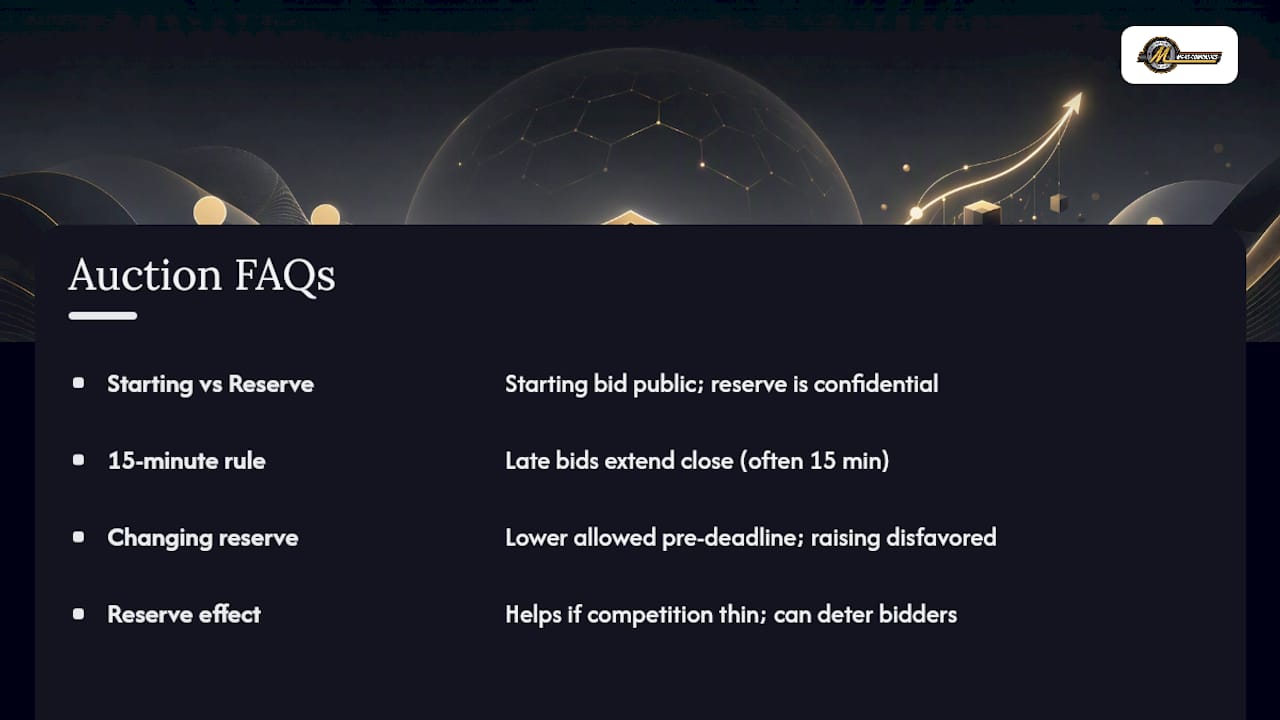
Does a reserve price guarantee a higher final sale price? Not always. Stanford’s research shows reserves raise expected revenue mainly when bidder competition is thin; in deep bidder pools, an overly high reserve can suppress participation and reduce the odds of a sale entirely.
Sources
- Reserve Price clause — Law Insider
- Reserve price effects — Stanford (research paper)
- Reserve Price: What It Means and How It Works in Auctions — Investopedia
- What is a reserve — Christie’s Auction Help Library
- What is a reserve price — Municibid Support
Recommended
- What Is an Auction Reserve? A Guide for Investors | Blog | Insights on Asset Liquidation and Auction Trends
- Bidding strategies for maximizing asset recovery in 2026 | Blog | Insights on Asset Liquidation and Auction Trends
- Why assets go to auction: High-recovery strategies explained | Blog | Insights on Asset Liquidation and Auction Trends
- Auction bidding tips: Win more distressed asset auctions | Blog | Insights on Asset Liquidation and Auction Trends