

Blog
What Is a Sale Announcement? A Guide for Business Professionals

TL;DR:
- A sale announcement is a formal communication that informs stakeholders about a business or asset sale, affecting trust, legal compliance, and recovery. Timing and delivery are critical, with different windows for business transfers, liquidations, and flash sales to ensure effectiveness. Proper planning, including joint announcements and early retention bonuses, reduces leaks and maintains stakeholder confidence.
A sale announcement is the formal communication that notifies stakeholders of the intent or completion of selling a business, its assets, or specific properties. In mergers and acquisitions (M&A), asset liquidation, and commercial real estate transactions, this communication is known more precisely as a “notice of sale” or “sale notice.” The timing, content, and delivery method of a sale announcement directly affect deal integrity, employee retention, and asset recovery outcomes. Professionals who treat this communication as an afterthought routinely face trust erosion, talent loss, and reduced bidder interest.
What is a sale announcement and why does it matter?
A sale announcement is a structured, deliberate message delivered to a defined group of stakeholders at a carefully chosen moment in the transaction process. The audience typically includes employees, investors, customers, lenders, and regulatory bodies. Each group has different concerns, different legal rights to information, and different potential reactions to the news.

The announcement serves three core functions. First, it establishes the factual record of the transaction for legal and regulatory purposes. Second, it manages the expectations of people whose livelihoods or investments are affected. Third, it signals to the market that assets or operations are available, which directly influences bidder participation and final recovery values.
Poor announcements carry measurable costs. Tiered notifications sent to executives first, then managers, then employees commonly cause leaks and destroy trust before the official message reaches the full workforce. Rumors fill the information gap faster than any communication plan can recover. The result is talent flight, customer uncertainty, and a weakened negotiating position.
The importance of sale announcements extends beyond internal morale. For asset liquidation specifically, structured sale messaging preserves business value during transition by informing bidders and stakeholders with enough lead time to act. A well-prepared notice generates competitive bidding. A vague or delayed notice generates silence.
When should you make a sale announcement?
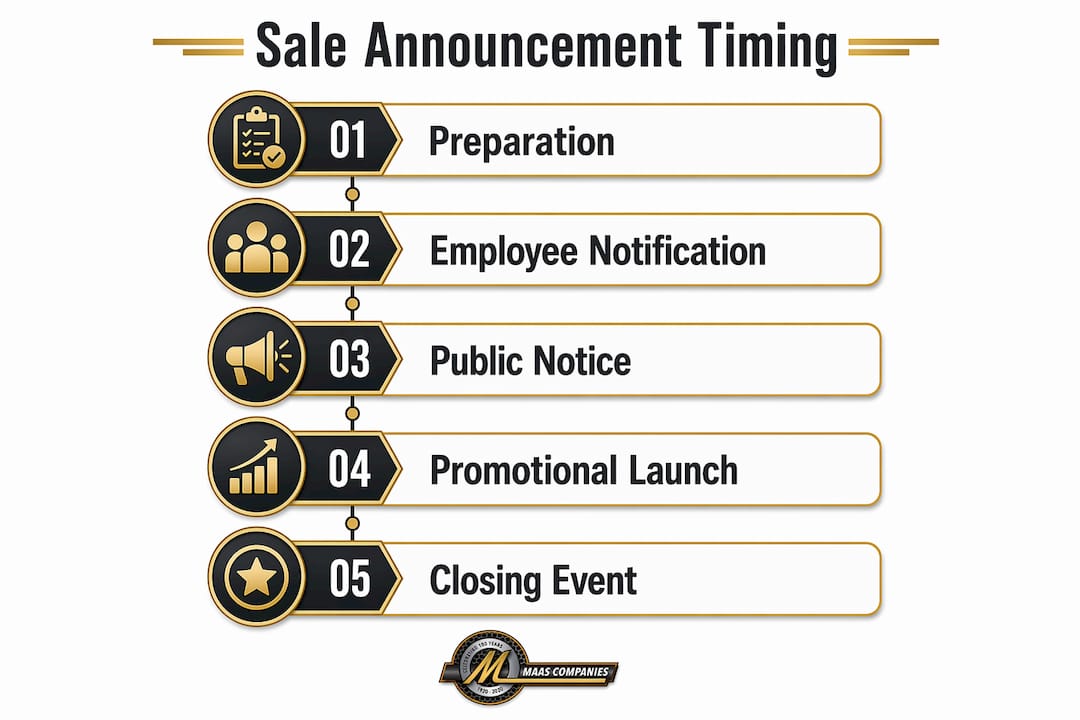
Timing is the single most consequential variable in sale announcement planning. The right window depends on the type of transaction.
Business sales to employees
Most M&A professionals recommend announcing to employees 30–60 days before closing, after due diligence is complete and a letter of intent (LOI) has been signed. Announcing earlier risks deal failure if the transaction collapses. Announcing later harms trust and gives employees less time to process the change.
Public and legal notice requirements
Asset liquidation sales carry specific legal disclosure obligations. A notice of sale must formally detail the terms, procedures, and critical dates of the liquidation to meet transparency and legal defensibility standards. Failing to meet these requirements exposes sellers to legal challenge and can invalidate the sale process entirely.
The Worker Adjustment and Retraining Notification Act (WARN Act) requires 60 days’ notice for mass layoffs but generally does not apply to business sales where employment continues under the new owner. Sellers should confirm applicability with legal counsel before finalizing their announcement timeline.
Promotional and flash sale timing
For retail or commercial flash sales, the timing calculus is different. Flash sale announcements require urgency manufacturing starting at least 7 days before the event for maximum impact. Press releases achieve best media engagement when distributed mid-week mornings, specifically Tuesday or Wednesday between 8 and 10 AM, with localized content variants to optimize regional coverage.
| Sale type | Recommended announcement window | Key requirement |
|---|---|---|
| Business sale (M&A) | 30–60 days before closing | After LOI and due diligence |
| Asset liquidation | Per legal notice requirements | Formal terms and dates required |
| Flash sale | 7 days before, press release 24 hours prior | Urgency hooks and hard deadlines |
| Real estate auction | Per state disclosure laws | Public notice in approved publications |
Pro Tip: For flash sales, distribute an embargoed press release to media contacts 24 hours before launch. This enables journalists to prepare coverage that publishes the moment the sale opens, maximizing first-hour traffic and bidder participation.
How to craft and communicate a sale announcement effectively
Effective sale announcements address the questions stakeholders are already asking before they ask them. Employees need clarity on job security, company culture under new ownership, and what the transition timeline looks like. Investors need confirmation of deal terms and continuity of operations. Customers need assurance that service levels will not drop.
The structure of a strong announcement covers four elements:
- Who is buying and why. Identify the buyer and state their intent for the business or assets clearly.
- What changes and what stays the same. Address operational continuity, leadership, and any planned restructuring.
- The timeline. Give specific dates for closing, transition milestones, and any follow-up communications.
- Where to direct questions. Assign a named contact or communication channel for stakeholder inquiries.
Channel selection matters as much as content. In-person meetings with employees outperform email for business sales because they allow real-time questions and demonstrate respect for the workforce. Press releases serve investor and media audiences. Formal written notices fulfill legal obligations for asset sales. A joint announcement featuring both seller and buyer fosters stability and reassures employees that leadership is aligned on the transition.
Retention is a practical concern that must be addressed before the announcement, not after. Retention bonuses finalized as part of the definitive agreement before the employee announcement help prevent turnover and retain key staff who might otherwise leave the moment they hear the news. Sellers who wait until after the announcement to negotiate retention packages often find that their most valuable employees have already begun looking elsewhere.
Pro Tip: Conduct a simultaneous all-employee announcement rather than a tiered rollout. Simultaneous delivery eliminates the leak window that tiered notifications create and ensures every employee hears the same message at the same time.
Special considerations for asset liquidation sale announcements
Asset liquidation announcements operate under a distinct set of rules compared to business sale communications. The primary audience shifts from employees and customers to bidders, creditors, and regulatory bodies. The goal shifts from managing human continuity to maximizing recovery value.
A formal notice of sale for liquidation purposes must include the following:
- The specific assets being sold, with descriptions sufficient for bidders to assess value
- The sale method (auction, sealed bid, negotiated sale, or online platform)
- Critical dates including inspection periods, bid deadlines, and closing dates
- Terms of sale, including payment requirements and buyer’s premium if applicable
- Contact information for the auctioneer or sale administrator
Maintaining operational stability during the announcement period is a practical priority. When employees and customers learn that assets are being liquidated, uncertainty about ongoing operations can accelerate the very disruption sellers are trying to avoid. Clear communication about what continues to operate, what is being sold, and when the transition occurs reduces that uncertainty.
Maascompanies structures liquidation announcements as part of a broader asset disposition strategy, ensuring that the notice of sale reaches qualified buyers with enough lead time to conduct due diligence and arrange financing. This approach directly affects the number of registered bidders and the final recovery value. A well-publicized liquidation with a clear announcement timeline consistently outperforms a rushed or poorly distributed notice.
For plant closures and large-scale industrial liquidations, plant liquidation strategies that integrate announcement planning with auction timelines produce the highest recovery rates. The announcement is not a formality. It is the first marketing action of the liquidation process.
Key Takeaways
A sale announcement is a formal, timed communication that directly determines stakeholder trust, legal compliance, and asset recovery outcomes across all types of business and asset sales.
| Point | Details |
|---|---|
| Definition and purpose | A sale announcement formally notifies stakeholders of a business or asset sale, serving legal, relational, and market functions. |
| Timing is critical | Business sales require announcement 30–60 days before closing; liquidation sales must meet legal notice requirements. |
| Simultaneous delivery | All-employee announcements sent at once prevent leaks and preserve credibility during sensitive transactions. |
| Retention planning | Finalize retention bonuses before the announcement to reduce turnover risk among key staff. |
| Liquidation specifics | Asset liquidation notices must detail sale terms, asset descriptions, and critical dates to attract qualified bidders and maximize recovery. |
Why most sale announcements fail before they start
The most common mistake professionals make is treating the sale announcement as a communication task rather than a transaction event. After managing asset liquidation processes across industrial, commercial, and real estate sectors, the pattern is consistent: sellers spend months on deal structure and hours on the announcement. The ratio should be closer to the reverse.
Confidentiality is a real constraint. You cannot tell employees before the deal is certain without risking the deal itself. But that constraint does not excuse the absence of a communication plan. The plan should be drafted, reviewed by legal counsel, and ready to execute the moment the LOI is signed. Waiting until closing to start writing the announcement is the equivalent of designing the packaging after the product ships.
The second failure point is the assumption that a single announcement is sufficient. A business sale is as much a human experience as a financial event. The initial announcement opens a period of uncertainty that only ongoing dialogue can close. Sellers who schedule follow-up communications at 30, 60, and 90 days post-announcement retain more staff and maintain stronger customer relationships through the transition.
The third failure point is excluding the buyer from the communication process. A joint announcement signals alignment and reduces the fear that employees and customers naturally feel about new ownership. Buyers who participate in the announcement earn credibility with the workforce before they walk through the door on day one.
— Vector
How Maascompanies supports asset sale and liquidation announcements
Maascompanies brings structured marketing and announcement expertise to industrial plant sales, equipment auctions, and commercial real estate dispositions worldwide. The firm’s approach integrates formal notice preparation, targeted buyer outreach, and auction timeline management into a single coordinated process.

For sellers managing complex asset dispositions, including the biodiesel plant and oilseed processing auction currently listed, Maascompanies handles the full announcement and marketing cycle. Sellers ready to move forward can review available services for asset sellers to understand how a structured announcement and marketing plan translates into maximum recovery.
FAQ
What is a sale announcement in business?
A sale announcement is the formal communication that notifies employees, investors, customers, and other stakeholders of the intent or completion of a business or asset sale. It serves legal, relational, and market functions simultaneously.
When should you announce a business sale to employees?
Most M&A professionals recommend announcing to employees 30–60 days before closing, after due diligence is complete and a letter of intent has been signed.
What must a liquidation sale notice include?
A liquidation sale notice must formally detail the assets being sold, the sale method, critical dates, payment terms, and contact information for the sale administrator to meet legal defensibility standards.
How do you prevent leaks during a sale announcement?
Simultaneous all-employee announcements prevent leaks by eliminating the window that tiered notifications create. Every stakeholder receives the same message at the same time, which stops rumors before they start.
What is the difference between a sale announcement and a notice of sale?
A sale announcement is the broader communication strategy covering all stakeholder groups. A notice of sale is the specific legal document used in asset liquidation and real estate transactions to formally disclose sale terms and dates.
Recommended
- What Is the Sale Closure Process? A 2026 Guide | Blog | Insights on Asset Liquidation and Auction Trends
- What Is a Bulk Sale? A 2026 Guide for Business Professionals | Blog | Insights on Asset Liquidation and Auction Trends
- Commercial Property Sale Guide for Investors and Owners | Blog | Insights on Asset Liquidation and Auction Trends
- What Is a Negotiated Sale? A Guide for Asset Managers | Blog | Insights on Asset Liquidation and Auction Trends