
Blog
The Role of Brokers in Industrial Sales: A Decision-Maker’s Guide
An industrial sales broker is the licensed, market-facing intermediary who sources qualified buyers, validates asset value, manages confidential marketing, and negotiates transactions to maximize recovery for plant, equipment, and business sales. When a plant closes, a lender orders liquidation, or a company needs to dispose of surplus assets, a broker’s buyer network and process discipline are what separate a full-value outcome from a distressed sale at cents on the dollar.
The core services an industrial broker delivers:
- Valuation and appraisal of equipment, real estate, and business assets using market comparables, replacement cost, and income-based approaches
- Confidential marketing through targeted buyer outreach, teasers, NDAs, and Confidential Information Memorandums (CIMs)
- Buyer identification and vetting to confirm financial capacity and operational fit before disclosing sensitive details
- Negotiation and deal structuring, including price, earnouts, escrow, and buyer financing support
- Due diligence coordination, covering asset audits, condition reports, title searches, and environmental or OSHA risk flags
- Logistics and transition support post-sale, including decommissioning, transport, and reinstallation
These functions matter most at specific trigger points: a plant closure that must be wound down on a lender’s timeline, a court-ordered liquidation requiring documented chain of custody, or a surplus equipment disposal where public listing would signal operational weakness to competitors.
Table of Contents
- What does an industrial sales broker actually do, and how is the role different?
- What do industrial brokers actually do during a sale?
- When does hiring a broker make sense?
- What does the selling process look like, and what should you expect to pay?
- How do brokers support buyers of industrial assets?
- How do you choose the right broker for an industrial sale?
- How Maascompanies approaches industrial asset sales
- Key Takeaways
- What sellers consistently get wrong about industrial asset disposition
- Maascompanies: a strategic partner for industrial asset recovery
- Useful sources and further reading
What does an industrial sales broker actually do, and how is the role different?
An industrial sales broker intermediates the purchase and sale of industrial-scale assets and businesses, acting as the seller’s agent (or occasionally a dual agent) to identify buyers, manage the transaction process, and close the deal. The term covers two overlapping but distinct practices: business brokerage, which handles the sale of operating companies or business units, and asset brokerage, which handles the sale of discrete equipment, machinery, real estate, or full plant packages.
That distinction separates industrial brokers from three other intermediary types that often get conflated with them.
Commercial real estate (CRE) brokers specialize in property leasing and sale. They understand industrial zoning and building specifications, but they are not equipped to value or market process equipment, machinery, or operating businesses. A full plant disposition typically requires both a CRE broker for the real property and an industrial asset broker for the equipment.
Manufacturers’ representatives (or rep agencies) are commission-paid external sales forces that represent manufacturers on an ongoing basis, generating revenue through product sales rather than discrete transactions. JMC Industrial Sales and similar rep agencies deliver stable pipelines and deep customer relationships, but they do not run M&A-style sale processes or manage asset liquidations. Their role is revenue growth, not asset disposition.
M&A advisors operate at the upper end of the deal-size spectrum, running curated, confidential processes for business sales typically above $2 million in enterprise value. According to industry analysis, business brokers generally handle deals under approximately $2 million enterprise value using listing-based, inbound-driven processes, while M&A advisors manage $2M–$50M+ transactions and often deliver higher proceeds for more complex sellers through targeted outreach to strategic and private-equity buyers.
In the U.S., business brokers are subject to state-level licensing requirements that vary by jurisdiction. Many states require a real estate license to broker business sales that include real property. Professional associations such as the International Business Brokers Association (IBBA) provide credentialing, ethical standards, and transaction training that serve as useful reference points when evaluating a broker’s qualifications.
| Intermediary type | Primary focus | Typical deal size | Fee model |
|---|---|---|---|
| Industrial asset broker | Equipment, machinery, plant packages | Varies widely; no fixed floor | Commission on sale proceeds; auction fees |
| Business broker | Operating companies, business units | Under ~$2M enterprise value | 10–12% commission |
| M&A advisor | Business sales, PE/strategic buyers | $2M–$50M+ enterprise value | Retainer + 3–6% success fee |
| Manufacturers’ rep | Ongoing product sales representation | N/A (revenue, not transactions) | Commission on product revenue |
| CRE broker | Industrial property lease/sale | Varies | Commission on property value |
What do industrial brokers actually do during a sale?
The day-to-day work of an industrial broker spans six distinct functions, each of which the seller would otherwise need to manage independently, often without the market access or process infrastructure to do it well.
Valuation and appraisal is the starting point. For equipment and machinery, brokers use market comparables (recent auction results and private sales for similar assets), replacement cost less depreciation, and, where relevant, income-based approaches tied to the asset’s productive capacity. For operating businesses, Seller’s Discretionary Earnings (SDE) applies to smaller owner-operated companies; EBITDA multiples apply to larger entities where a financial buyer is the likely acquirer.
Confidential marketing protects the seller’s competitive position while generating buyer interest. A broker typically prepares a blind teaser (no identifying information), qualifies respondents, executes NDAs, and then releases a full CIM to vetted parties. Detailed preparation and targeted buyer outreach consistently shorten time on market and improve sale outcomes for industrial assets. Public listings, by contrast, can erode value for sensitive industrial sales by signaling distress or triggering competitor intelligence gathering.
Buyer identification and vetting goes beyond a contact list. Brokers segment the buyer universe into strategic acquirers (who may pay a premium for operational synergies), financial buyers (private equity, family offices), and individual operators. Each segment requires a different pitch and a different level of disclosure. Brokers leverage networks of manufacturers, sellers, and other brokers to surface competitive buyers and negotiate conditions, warranties, and service contracts to the client’s advantage.
Negotiation and deal structuring covers price, payment terms, earnouts, escrow arrangements, and buyer financing support. A broker who has closed dozens of similar transactions understands which terms are negotiable and which concessions typically kill deals.
Due diligence support is where brokers reduce transaction risk for both parties. Brokers conduct inspections and due diligence to verify compliance with safety and environmental regulations, reducing the likelihood of post-sale disputes or regulatory exposure. This includes asset audits, condition reports, title and ownership searches, and flagging of environmental or OSHA issues before they surface in a buyer’s inspection.
Logistics and transition coordination closes the loop. Brokers manage compliance and logistics as part of post-sale coordination, covering decommissioning, transport, reinstallation, and, where applicable, cross-border regulatory requirements. This is particularly relevant for full plant dispositions where equipment removal requires coordination with multiple contractors and strict safety protocols.
Pro Tip: Before marketing begins, commission an independent condition report on your highest-value assets. Buyers who receive documented condition data upfront submit stronger, less-contingent offers. Undisclosed defects discovered during buyer inspection are the single most common cause of price renegotiation or deal collapse.
When does hiring a broker make sense?
The business case for engaging an industrial broker is strongest when the transaction involves complexity, confidentiality requirements, or a buyer pool that the seller cannot access independently. Several trigger events consistently produce the conditions where broker engagement delivers measurable value.
Plant closures require rapid, coordinated disposition of equipment, real estate, and sometimes the operating entity itself. A broker with sector experience can run parallel processes for different asset classes, compress the marketing window, and reduce carrying costs during the wind-down period.
Lender-ordered and court-ordered liquidations add compliance and documentation requirements that most sellers are not equipped to manage alone. Chain-of-custody records, court approval of sale terms, and lender reporting obligations all require a broker who understands the legal framework and can produce the required documentation.
Surplus and discontinued asset sales arise from operational restructuring, technology upgrades, or product line changes. Here, the broker’s buyer network is the primary value driver: a seller trying to dispose of specialized manufacturing equipment through general listings will reach a fraction of the qualified buyers a specialist broker can contact directly.
Planned business exits for strategic or financial acquirers benefit from the confidentiality management and buyer-segmentation capabilities that distinguish a curated broker process from a public listing.
Brokers are generally not the right fit for very small-ticket items (individual pieces of low-value equipment where auction fees would exceed the incremental value added) or for routine procurement replacement where the buyer is already known and the transaction is straightforward.
On the question of auction versus negotiated sale: brokers who combine auction capabilities with negotiated-sale options produce better outcomes than single-channel approaches for asset recovery situations. Auctions create competitive tension and compress timelines; negotiated sales allow for more complex deal structures and are better suited to assets with a small, identifiable buyer pool. The right channel depends on asset type, timeline pressure, and buyer universe size.
For contractors and construction-equipment owners evaluating disposition options, resources on finding buyers for contractor businesses illustrate how buyer identification and deal structuring apply across adjacent industrial categories.
What does the selling process look like, and what should you expect to pay?
A well-managed industrial asset or business sale moves through six stages. The timeline and cost structure vary by asset type, deal complexity, and market conditions, but the sequence is consistent.
Stage-by-stage workflow and U.S. timelines
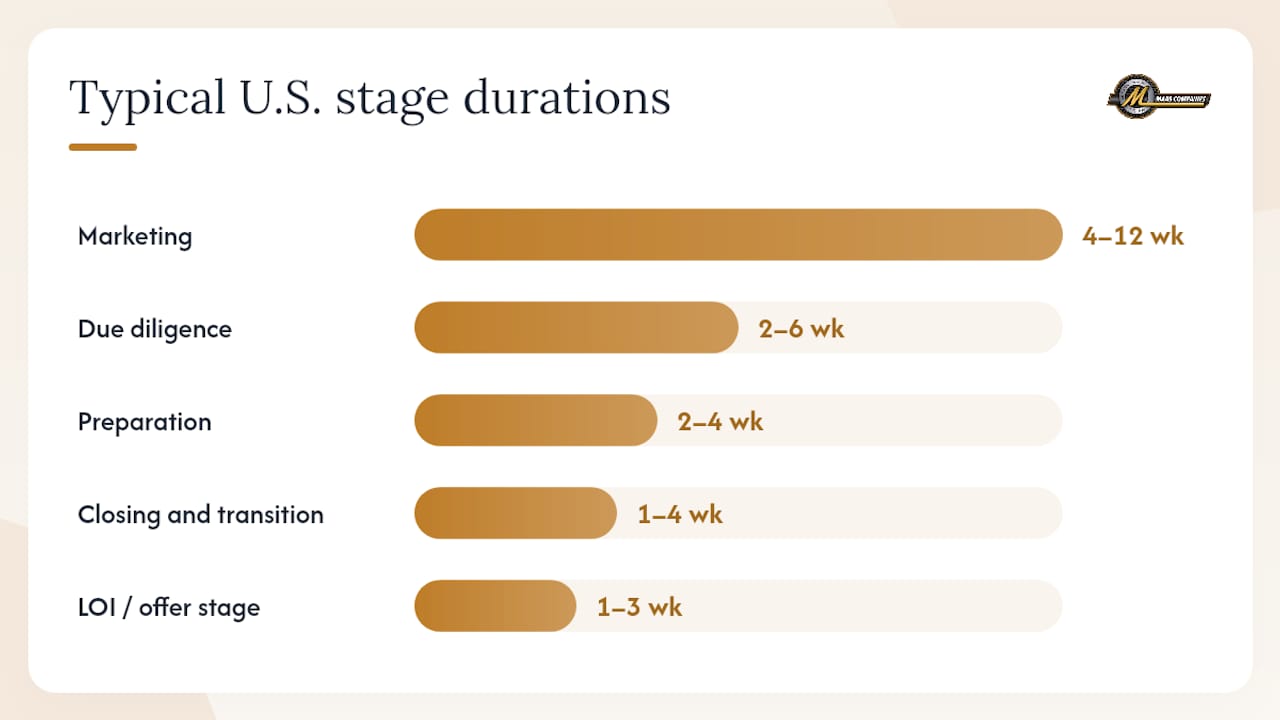
| Stage | Key activities | Typical U.S. duration |
|---|---|---|
| Preparation | Condition reports, title/ownership searches, environmental review, CIM and equipment list preparation | 2–4 weeks |
| Valuation | Market comps, replacement cost analysis, SDE/EBITDA assessment | 1–2 weeks (concurrent with prep) |
| Marketing | Targeted outreach, NDA execution, CIM distribution, auction or listing launch | 4–12 weeks |
| LOI / offer stage | Offer review, negotiation, Letter of Intent execution | 1–3 weeks |
| Due diligence | Buyer inspections, asset audits, title confirmation, financing confirmation | 2–6 weeks |
| Closing and transition | Contract execution, payment, logistics coordination, asset transfer | 1–4 weeks |
For a mid-size industrial equipment package, total time from preparation to closing typically runs 10–20 weeks. A full plant disposition involving real property, equipment, and an operating entity can extend to 6–12 months, particularly when environmental review or court approval is required.
Preparation is the stage sellers most often underinvest in. A complete CIM, organized equipment lists with serial numbers and condition notes, clear title documentation, and professional photography materially reduce buyer due diligence time and support stronger offers. Preparing equipment thoroughly before marketing is one of the highest-return activities a seller can undertake before engaging buyers.
Valuation for equipment relies primarily on market comparables drawn from recent auction results and private sales. For operating businesses, SDE applies to owner-operated entities where the owner’s compensation is a significant component of earnings; EBITDA multiples are the standard for larger businesses where a financial buyer will apply a multiple to normalized earnings.
Marketing channel selection depends on the asset and timeline. Confidential direct outreach to a targeted buyer list is appropriate for assets with a small, identifiable buyer pool or where public exposure would be damaging. Auction formats work well for assets with broad buyer appeal, time-sensitive dispositions, or situations where competitive tension is needed to establish market value. Proven marketing tactics for asset sales include targeted email campaigns to industry contacts, direct outreach to strategic acquirers, and coordinated online and on-site auction formats.
Fee and commission models in the U.S. follow two main structures. Business brokers typically charge a commission on sale price for lower-value deals. M&A advisors working on larger transactions generally charge a retainer plus a success fee of a few percent of transaction value. Auction firms typically charge a buyer’s premium (paid by the buyer) and a seller’s commission, the specific rates for which vary by firm and transaction size. For a mid-size industrial equipment sale, broker fees commonly cover marketing, buyer outreach, negotiation, and closing coordination. For a full plant sale, fees may also cover logistics management, environmental compliance support, and post-sale transition services.
How do brokers support buyers of industrial assets?
Buyers engaging with an industrial broker gain access to off-market opportunities, structured inspection processes, and transaction support that reduces acquisition risk. The broker’s role on the buy side is less prominent than on the sell side, but it is substantive.
- Opportunity sourcing: Brokers with active seller relationships can alert qualified buyers to assets before they reach public listings. For buyers with specific equipment requirements, a broker relationship provides early access to relevant dispositions.
- Inspection and condition verification: Brokers coordinate onsite inspections and, where appropriate, engage third-party inspection specialists to verify equipment condition, operational history, and compliance status. Brokers conduct inspections and risk assessments to reduce the likelihood of post-acquisition disputes.
- Financing support: Brokers familiar with industrial equipment transactions can facilitate introductions to equipment financing providers, help structure seller notes, and coordinate escrow arrangements that protect both parties during the transfer period.
- Transfer logistics: Post-sale coordination covers transport, decommissioning at the seller’s site, reinstallation at the buyer’s facility, spare parts and documentation transfer, and, where applicable, service contract arrangements. For buyers acquiring complex process equipment, this coordination is often as valuable as the transaction itself.
- Cross-border transactions: For buyers acquiring assets from international sellers, or U.S. sellers disposing to international buyers, brokers experienced in cross-border transactions manage customs documentation, export compliance, and logistics coordination that would otherwise require multiple specialist advisors.
For buyers evaluating industrial equipment acquisition as part of a procurement process, a structured sourcing approach provides a framework for integrating broker-sourced opportunities into a broader capital equipment strategy.
How do you choose the right broker for an industrial sale?
The difference between a broker who maximizes recovery and one who simply processes a transaction comes down to five factors: demonstrated transaction experience in your asset category, depth of the buyer network, marketing reach and methodology, project management capability, and fee transparency.
Evaluation criteria
- Transaction history in your sector: Ask for a list of completed transactions in your asset category (not just “industrial” broadly). A broker who has sold food processing equipment, for example, has a buyer network and market knowledge that a generalist does not.
- Buyer network depth: How many qualified buyers does the broker have active relationships with in your asset category? Can they name the types of buyers (strategic, financial, operator) they expect to engage?
- Marketing methodology: Does the broker use confidential direct outreach, public listings, auction formats, or a combination? Can they explain which approach they recommend for your specific situation and why?
- Project management capability: Who will manage the sale day-to-day? Is it the senior broker you met, or a junior associate? What is the communication cadence, and how are milestones tracked?
- References and case studies: Can the broker provide references from sellers in comparable situations? Are case studies available that show preparation, marketing approach, and outcome?
Interview questions to ask
- “What is the most comparable transaction you have closed in the past 24 months, and what was the outcome relative to initial valuation?”
- “Who specifically will manage this engagement, and what is their availability?”
- “What buyer types do you expect to engage, and how will you reach them?”
- “What is your recommended marketing channel for this asset, and what is the expected timeline to close?”
- “How are your fees structured, and what is included versus billed separately?”
Red flags to watch for
- No verifiable transaction references in your asset category
- Vague fee language (“we’ll work something out”) or fees that are not documented in a written engagement letter
- Reliance on public listings as the primary marketing strategy for complex or sensitive assets
- Unwillingness to provide a tailored marketing plan before engagement
- Pressure to sign quickly without time to evaluate competing proposals
Pro Tip: When comparing two or three candidate brokers, ask each one to identify the five most likely buyers for your specific asset and explain how they would reach them. The quality of that answer tells you more about buyer network depth than any credential or years-in-business claim.
How Maascompanies approaches industrial asset sales
Maascompanies brings a structured, process-driven methodology to industrial asset sales that covers the full disposition lifecycle: preparation and packaging, targeted marketing, buyer vetting, negotiation, and post-sale logistics coordination. The approach is designed for sellers who need documented processes, compliance support, and maximum recovery, not simply a listing service.
The preparation phase at Maascompanies begins with a thorough asset inventory, condition documentation, and title review. Marketing materials, including equipment lists, photographs, and buyer-facing summaries, are prepared before any outreach begins. This front-loaded preparation reduces buyer due diligence time and supports stronger, less-contingent offers.
Maascompanies serves clients across manufacturing, energy, hospitality, healthcare, education, agriculture, and contractor inventory sectors. Transaction types include court-ordered and lender-ordered liquidations, planned business exits, surplus asset dispositions, and full plant closures. The firm’s international marketing reach extends buyer outreach beyond domestic markets, which is particularly relevant for specialized process equipment with a limited U.S. buyer pool.
Trust signals that decision-makers should expect from any qualified industrial broker, and that Maascompanies provides, include:
- Documented transaction history across multiple industrial sectors
- Experience with court-ordered, lender-ordered, and government foreclosure asset liquidations
- Auction and negotiated-sale capabilities deployed based on asset type and timeline
- Logistics coordination for decommissioning, transport, and reinstallation
- Compliance management for environmental, safety, and cross-border regulatory requirements
Pro Tip: Before your first broker meeting, compile a complete asset register with serial numbers, purchase dates, original costs, and current condition notes. Sellers who arrive with this documentation in hand compress the preparation phase by weeks and signal to the broker that the engagement will be well-organized, which affects the quality of buyer outreach from day one.
Key Takeaways
Industrial brokers maximize asset recovery by combining buyer network access, confidential marketing, and structured transaction management that sellers cannot replicate independently.
| Point | Details |
|---|---|
| Broker vs. other intermediaries | Business brokers handle smaller deals; M&A advisors manage larger transactions with retainer plus success fees. |
| Trigger events for engagement | Plant closures, lender/court-ordered liquidations, surplus dispositions, and planned exits are the strongest use cases. |
| Typical U.S. timeline | Equipment packages typically close in a few months; full plant dispositions can take several months or longer. |
| Fee models | Business brokers charge 10–12% commission; M&A advisors charge retainer plus 3–6% success fee; auction firms add buyer’s premium. |
| Maascompanies | Provides auction and negotiated-sale services for industrial plants, equipment, and real estate, including court-ordered and lender-ordered liquidations across multiple sectors. |
What sellers consistently get wrong about industrial asset disposition
The conventional wisdom in industrial asset sales is that speed is the enemy of value: take your time, run a long process, and the right buyer will appear. That framing is wrong in most asset recovery situations, and it costs sellers real money.
Carrying costs on idle industrial assets accumulate faster than most sellers account for. Insurance, security, utilities, property taxes, and maintenance on a closed facility add up month by month. A broker who compresses the marketing window through targeted outreach to a pre-qualified buyer list often delivers better net recovery than a longer process that nominally achieves a higher gross price.
The second recurring mistake is conflating confidentiality with secrecy. Sellers who restrict information flow too aggressively, refusing to share condition reports or financial data even under NDA, end up with buyers who discount heavily for uncertainty. Controlled, structured disclosure to vetted buyers produces better outcomes than either full public exposure or excessive information restriction.
The third is choosing a broker based on the highest initial valuation estimate rather than on demonstrated transaction capability. A broker who inflates the opening valuation to win the engagement, then manages expectations downward over a six-month process, is more damaging to recovery than a broker who sets a realistic price and closes efficiently.
The practical takeaway: evaluate brokers on closed transactions, not on pitch materials. Ask for references from sellers in comparable situations, and ask those references specifically about the gap between initial valuation and final sale price.
Maascompanies: a strategic partner for industrial asset recovery
When a plant closes, a lender calls a loan, or a company needs to reposition surplus assets, the difference between adequate recovery and maximum recovery is almost always process and buyer access. Maascompanies provides both.
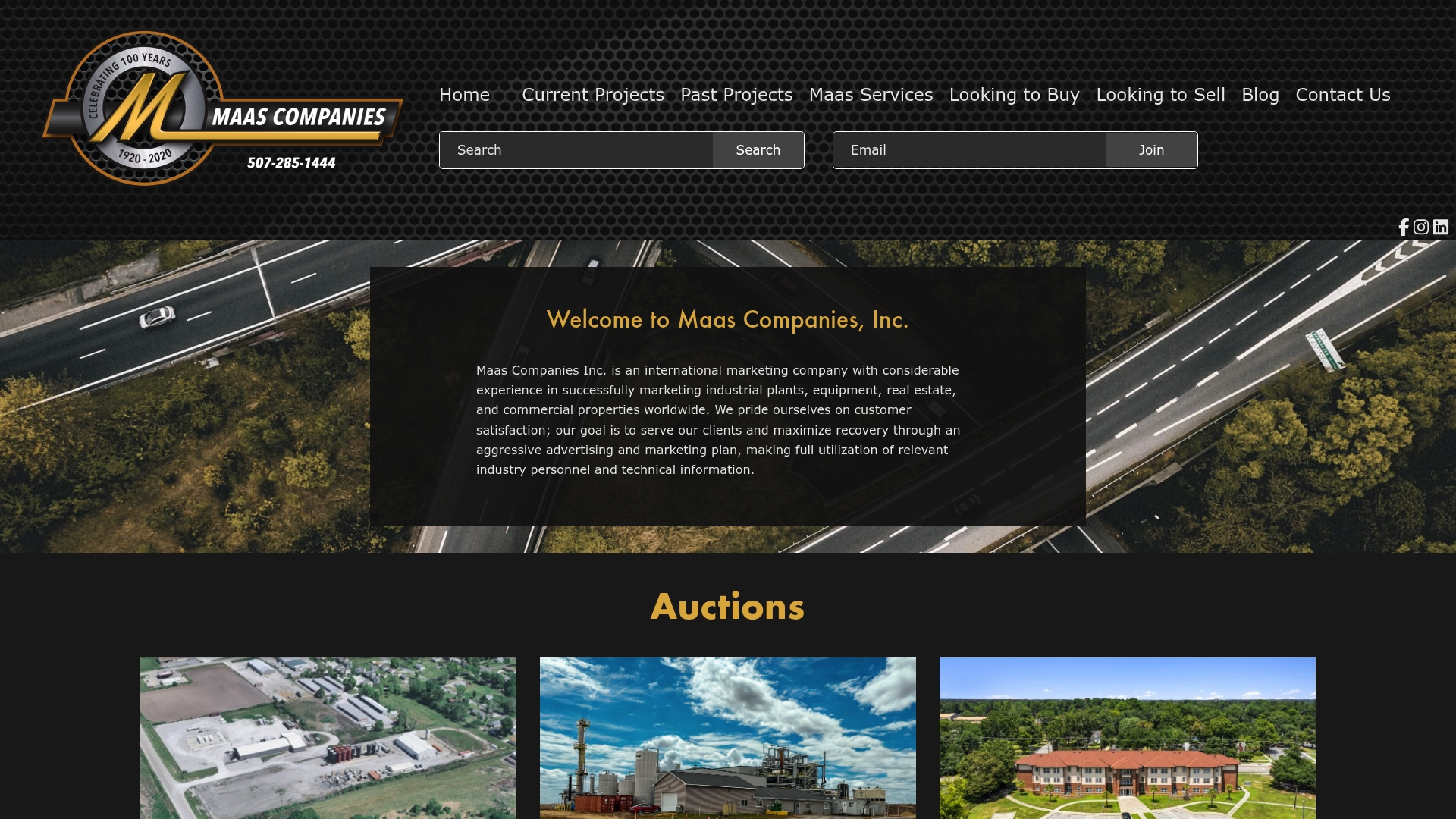
As an international marketing company with deep experience in industrial plant, equipment, and real estate dispositions, Maascompanies manages the full sale process: asset documentation, targeted buyer outreach, auction and negotiated-sale execution, compliance coordination, and post-sale logistics. The firm handles court-ordered and lender-ordered liquidations with the documentation and chain-of-custody discipline those engagements require, and its international marketing reach surfaces buyers that domestic-only processes miss.
Current active projects include a process plant equipment disposition in Galva, IL and an online equipment auction for Remy International, illustrating the range of asset types and transaction formats Maascompanies manages. Sellers evaluating their options can review current and completed projects at maascompanies.com or contact the team directly to discuss a specific disposition situation and receive a preliminary recovery assessment.
Useful sources and further reading
The following sources support the claims and guidance in this article. U.S.-focused industry resources are listed alongside relevant Maascompanies pages for sellers who want to go deeper on specific topics.
Valuation, fee models, and broker vs. M&A advisor distinctions:
Due diligence and compliance:
Manufacturers’ representatives (for comparison with transaction brokers):
Maascompanies internal resources:
- How Brokerage and Auction Work to Sell Industrial Assets — Maascompanies’ combined brokerage and auction methodology
- How to Attract Industrial Buyers: Strategies That Work — preparation and targeted outreach tactics
- Industrial Asset Sale Process: Maximize Recovery — timeline and process guidance for U.S. dispositions
- Industrial Property Disposition Process — Maascompanies’ approach to property-inclusive dispositions
- Auction Lots for Industrial Asset Sales: Maximize Value — lotting strategy and auction structuring guidance
Recommended
- How Brokerage and Auction Work to Sell Industrial Assets | Blog | Insights on Asset Liquidation and Auction Trends
- Role of Brokers in Auctions: A Guide for Investors | Blog | Insights on Asset Liquidation and Auction Trends
- How to Attract Industrial Buyers: Strategies That Work | Blog | Insights on Asset Liquidation and Auction Trends
- How to Sell Industrial Equipment and Maximize Value | Blog | Insights on Asset Liquidation and Auction Trends